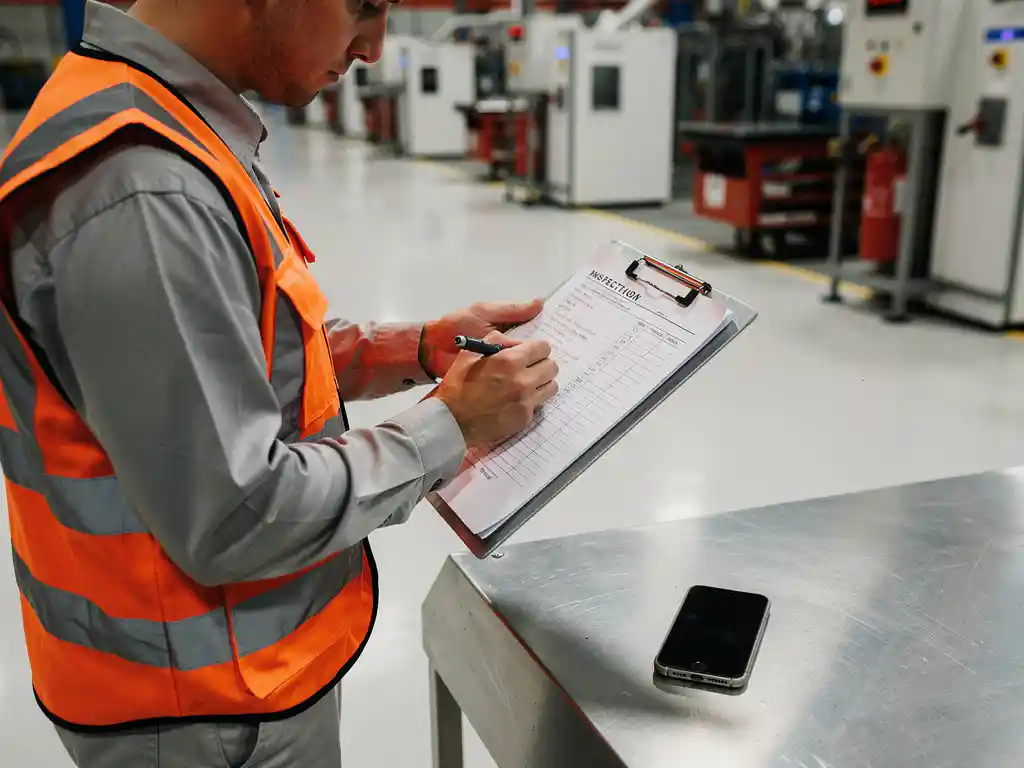



To provide evidence of workplace inspections for a SQAS audit, you need completed inspection checklists, signed-off records, corrective action logs, and a documented inspection schedule — all traceable to named individuals and specific dates. SQAS auditors in the chemical logistics sector expect this documentation to be systematic, consistent, and readily retrievable rather than scattered across folders or filing cabinets. The sections below break down exactly what counts as valid evidence, how often inspections must happen, who owns the process, and where the most common gaps appear.
What types of documentation count as inspection evidence for SQAS?
Valid inspection evidence for a SQAS audit includes completed checklist forms with dates and signatures, corrective action reports linked to specific findings, photographic records where relevant, and a written inspection schedule that shows planned versus actual frequency. Each document must clearly identify the location inspected, the person responsible, and any follow-up actions taken.
SQAS — the Safety and Quality Assessment System used widely in chemical logistics — is designed to evaluate whether a company’s safety and quality management processes are genuinely operational, not just documented on paper. That means auditors look for evidence of a living system rather than a one-time paper exercise. Useful documentation types include:
- Signed inspection checklists covering areas such as loading bays, storage areas, PPE stations, and emergency equipment
- Non-conformance or near-miss reports that reference specific inspection findings
- Corrective action logs showing that identified issues were followed up and closed
- Inspection schedules demonstrating a planned, recurring approach rather than ad hoc checks
- Training records confirming that inspectors are qualified to carry out the assessments
Photographs and short video evidence can strengthen your file significantly, particularly for physical conditions that are hard to describe in a checklist field. Always attach these to the relevant inspection record so the link between the visual evidence and the written finding is clear.
How often must workplace inspections be conducted to satisfy SQAS requirements?
SQAS does not prescribe a universal fixed frequency for all workplace inspections, but it does expect a documented, risk-based schedule that is consistently followed. In practice, most chemical logistics operations conduct formal safety inspections monthly or quarterly, with more frequent spot checks in high-risk areas such as hazardous goods storage or loading operations.
The key principle is that your documented schedule must match your actual practice. If your procedure states monthly inspections but your records show a six-month gap, that inconsistency is itself a finding. A credible inspection programme typically includes:
- Regular scheduled inspections aligned to operational risk levels
- Unannounced or reactive checks following incidents or near-misses
- Seasonal or process-change-triggered reviews when operations shift
When preparing for a 2026 SQAS audit, review your inspection log for the previous 12 months and confirm there are no unexplained gaps. Auditors will cross-reference your stated frequency against the actual dates on your records, so completeness matters as much as content.
Who is responsible for conducting and signing off workplace inspections?
Responsibility for workplace inspections under SQAS must be formally assigned in writing, typically through a role description, procedure document, or quality management system. The person conducting the inspection and the person authorising or reviewing the findings should both be named and their signatures present on the record.
In most chemical logistics operations, line managers or designated safety officers carry out routine inspections, while a senior manager or SHEQ coordinator provides the sign-off. What matters to an auditor is that:
- The roles are defined in a procedure, not just assumed
- Inspectors have documented competence or training for the task
- There is a clear escalation path when serious issues are found
- The sign-off authority is appropriate to the level of risk involved
Avoid a situation where the same person both conducts and solely approves every inspection with no independent review. SQAS assessors look for a degree of oversight and accountability in the sign-off chain, particularly for safety-critical areas.
How should inspection records be stored and made accessible for an audit?
Inspection records for a SQAS audit should be stored in a centralised, retrievable system — whether digital or physical — with a clear retention period defined in your quality management documentation. During the audit, you must be able to produce any requested record quickly, ideally within minutes rather than hours.
Disorganised or incomplete filing is one of the most common reasons organisations struggle during an on-site SQAS assessment. Best practice for record storage includes:
- Organising records by location, date, and inspection type so retrieval is fast
- Defining a minimum retention period (commonly two to three years for safety inspection records)
- Ensuring records are protected from accidental deletion or physical damage
- Giving auditors or internal reviewers read access without requiring them to navigate complex folder structures
If you use paper-based records, maintain a clear index and store originals in a secure, labelled location. Digital systems offer significant advantages here, including search functionality, version control, and the ability to attach photographs directly to a checklist entry.
What are the most common gaps auditors find in inspection evidence?
The most common gaps in workplace inspection evidence found during SQAS audits are missing signatures, incomplete corrective action follow-up, inconsistent inspection frequency, and a lack of documented competence for the people conducting the checks. These gaps signal to auditors that the inspection process may not be genuinely embedded in daily operations.
Understanding where organisations typically fall short helps you address these weaknesses before the audit date. Frequently cited issues include:
- Unsigned or undated records: A checklist without a name, date, or signature has limited evidential value
- Open corrective actions: Findings that were noted but never resolved, or where resolution was not documented
- Gaps in the inspection timeline: Months where no inspection took place and no explanation was recorded
- Generic checklists: Forms that are too broad to demonstrate that specific risk areas were actually assessed
- No evidence of inspector training: Inspections carried out by individuals with no documented qualification or briefing
A practical pre-audit review involves pulling your inspection records for the past 12 months and checking each one against these criteria. Addressing gaps proactively is far more effective than trying to explain them during the assessment itself.
How can digital tools streamline inspection documentation for SQAS?
Digital tools streamline SQAS inspection documentation by automating scheduling reminders, standardising checklists, enabling real-time sign-off, and centralising records in a searchable system. This reduces the administrative burden on safety officers and significantly lowers the risk of missing or incomplete evidence at audit time.
Moving away from paper-based inspection logs brings several practical benefits for SQAS compliance:
- Automated reminders ensure inspections happen on schedule and gaps are flagged immediately
- Standardised digital forms prevent incomplete submissions by requiring all fields before a record can be saved
- Photo attachments can be added directly to an inspection entry from a mobile device
- Corrective actions can be assigned, tracked, and closed within the same system, creating a complete audit trail
- Reporting dashboards give managers a real-time overview of inspection status across all sites
For organisations with multilingual workforces — common in chemical logistics and transport — digital tools that support multiple languages also help ensure that the people conducting inspections fully understand the criteria they are assessing. Consistency across teams and locations is far easier to achieve and demonstrate when the process is standardised in a digital environment.
How E-Lia helps with SQAS inspection documentation
We built E-Lia specifically to make knowledge sharing and process compliance straightforward for operational teams, including those preparing for safety audits like SQAS. Rather than relying on training sessions that people forget or manuals that go unread, we deliver inspection instructions, safety procedures, and compliance checklists directly via WhatsApp. No app download, no login, no friction.
Here is how we support organisations working towards SQAS compliance:
- Microlearning modules on inspection procedures delivered directly to employees’ phones, completed in 3 to 6 minutes
- Standardised instruction content that ensures every inspector follows the same process, reducing variation and audit gaps
- Automatic multilingual support so that non-Dutch-speaking employees receive instructions in their own language
- Progress tracking via a central dashboard that provides evidence of who completed which training and when
- Fast module creation — building a new inspection briefing takes 10 to 15 minutes, so you can update content quickly when procedures change
If you want to see how this works in practice for your organisation, plan a demo or contact us directly and we will walk you through it.
Frequently Asked Questions
Can we use inspection records from a previous SQAS cycle as supporting evidence in a new audit?
Yes, historical records can provide useful context, but SQAS auditors primarily focus on evidence from the current assessment period — typically the 12 months preceding the audit. Older records may support trend analysis or demonstrate long-term consistency, but they cannot substitute for recent, active documentation. Make sure your current cycle has its own complete, uninterrupted record trail.
What should we do if we discover gaps in our inspection records shortly before an audit?
Do not attempt to backfill or recreate records retroactively — auditors are experienced at identifying documents that were produced after the fact, and doing so can seriously damage your credibility. Instead, document the gap honestly, explain the root cause, and show what corrective measures you have put in place to prevent recurrence. A transparent, corrective response is far more credible than a suspiciously complete file that suddenly appears days before the assessment.
Do subcontractors or third-party logistics partners need to provide inspection evidence too?
Yes, if subcontractors or third-party partners are involved in activities covered by the SQAS scope — such as transport, loading, or storage — their compliance is part of your overall assessment. You should have a process for monitoring and collecting relevant evidence from these parties, including their inspection records, certifications, and any corrective actions taken. Auditors will expect you to demonstrate oversight of your supply chain, not just your own internal operations.
How specific do our inspection checklists need to be to satisfy SQAS auditors?
Checklists should be specific enough to demonstrate that real, risk-relevant criteria were actually assessed at a particular location — generic tick-box forms that could apply to any workplace in any industry are a common audit finding. Tailor your checklists to the specific risks of each area, such as hazardous goods storage, loading bay safety, or PPE compliance, and ensure each item is clearly worded so there is no ambiguity about what was checked. The more site- and task-specific your forms are, the stronger the evidence they provide.
Is it enough to have inspection evidence, or do auditors also assess the quality of the findings?
Auditors assess both the existence and the quality of your inspection evidence. A file full of checklists where every item is marked as satisfactory with no findings, no corrective actions, and no variation over 12 months is likely to raise questions about whether inspections are being conducted critically and honestly. Auditors expect to see a realistic spread of minor findings, follow-up actions, and closures — this is what a genuinely operational inspection system looks like in practice.
How do we demonstrate that corrective actions from inspections have actually been resolved?
Each corrective action should have a documented closure entry that includes the action taken, the date it was completed, and the name of the person who verified the resolution — ideally with a follow-up inspection or sign-off confirming the issue no longer exists. Linking the closure record back to the original finding, whether through a reference number, a shared log, or an attached photograph, creates a clear, traceable audit trail. Open corrective actions with no closure date or responsible owner are one of the most frequently cited gaps in SQAS assessments.
How far in advance should we start preparing our inspection documentation for an upcoming SQAS audit?
Ideally, SQAS inspection documentation should be maintained continuously so that audit preparation is simply a review rather than a scramble. That said, a structured pre-audit review of the previous 12 months' records should begin at least six to eight weeks before the assessment date — enough time to identify gaps, implement corrections, and generate any missing evidence legitimately. Use that window to cross-check inspection frequency against your stated schedule, confirm all corrective actions are closed, and verify that all records are signed, dated, and retrievable.