


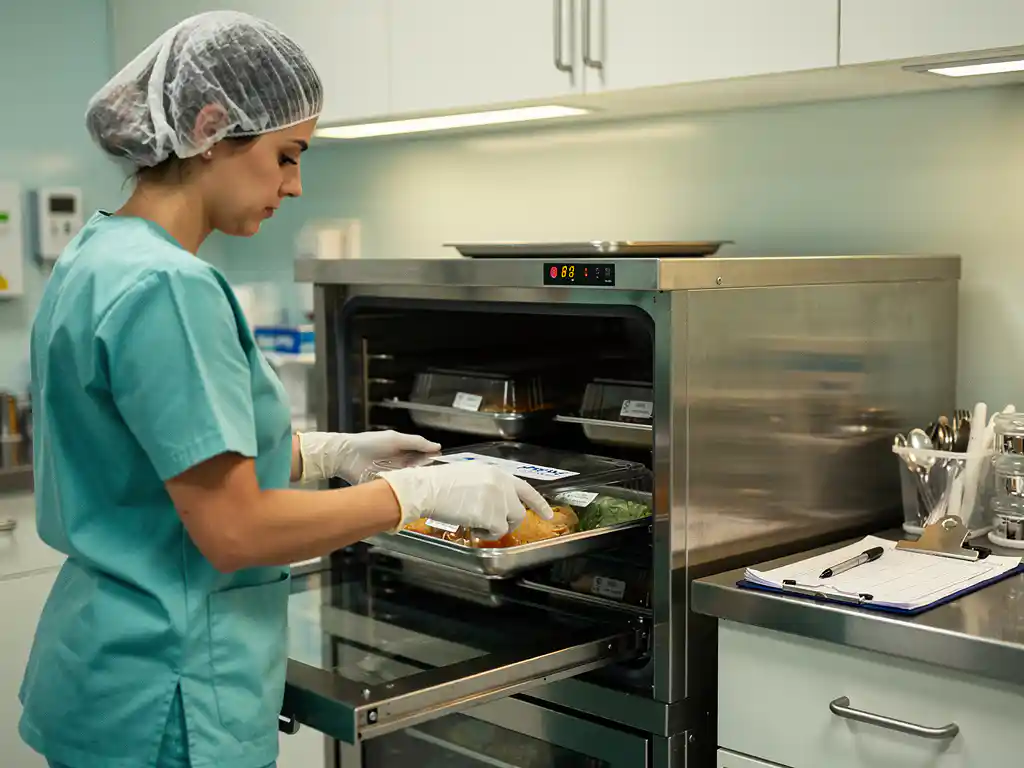
Food safety in healthcare is not a secondary concern. Patients, residents, and clients belong to the most vulnerable groups when it comes to food-related risks; that is why hygiene and food safety deserve the highest priority. HACCP provides healthcare organisations with a structured framework to systematically manage those risks and keep staff aligned.
In this article, we answer the most frequently asked questions about HACCP in healthcare: from the basic principles to the most common mistakes and how to train staff effectively. Whether you are responsible for the kitchen of a hospital, a nursing home, or another care facility, you will find practical guidance here.
What is HACCP and why is it important in healthcare?
HACCP stands for Hazard Analysis and Critical Control Points and is an internationally recognised food safety system. It identifies hazards in the food preparation process and determines at which points control is necessary to prevent, eliminate, or reduce those hazards to an acceptable level. In the healthcare sector, HACCP is a legal requirement for all organisations that prepare or provide food.
The reason HACCP is so important in healthcare comes down to the vulnerability of the target group. Elderly people, individuals with a weakened immune system, and patients recovering from a procedure face a significantly greater risk of serious complications from food poisoning or contamination than healthy adults. A well-functioning HACCP system protects not only the health of clients and patients, but also the reputation and liability of the healthcare organisation itself.
Which HACCP rules apply specifically to healthcare organisations?
Healthcare organisations fall under European Regulation (EC) No. 852/2004 on food hygiene and applicable national food safety legislation. Under this legislation, healthcare organisations are required to draw up, maintain, and demonstrably apply a written HACCP plan. Regulatory authorities such as the national food safety authority can carry out inspections based on this.
In addition to the general HACCP rules, additional considerations apply in healthcare. These include dietary food and adapted textures for specific patient groups, the storage and distribution of food on the ward, and hygiene around tube feeding. Keeping records is also especially critical in healthcare: temperature logs, cleaning schedules, and training records must always be up to date and demonstrably available during an inspection.
How does a HACCP risk analysis work in practice?
A HACCP risk analysis begins by mapping all steps in the food preparation process, from purchasing and storage to preparation, portioning, and serving. For each step, potential hazards are identified: biological (bacteria, viruses), chemical (cleaning agents, allergens), and physical (glass fragments, metal particles). It is then determined which steps are critical control points.
In practice, this works as follows: the team draws up a process flow diagram and works through it step by step. At each step, the question is asked: what could go wrong here and how serious would the consequences be? Steps where a hazard poses a genuine risk to food safety and where control is necessary are designated as Critical Control Points (CCPs). For each CCP, critical limits, monitoring procedures, and corrective actions are then established.
Who carries out the risk analysis?
The risk analysis is ideally carried out by a multidisciplinary team: the head chef or dietitian, a hygiene officer, and a representative from management. It is important that people with practical knowledge of the process are involved, as they are most familiar with the day-to-day risks. External support from a food safety consultant can be helpful for the initial set-up or for a periodic review.
What are the 7 HACCP principles in healthcare?
The 7 principles of HACCP are universal, but their application differs by sector. In healthcare, these principles apply to all locations where food is prepared or provided, from the central kitchen to the ward kitchen.
- Conduct a hazard analysis: Identify all biological, chemical, and physical hazards in the food process.
- Determine Critical Control Points (CCPs): Establish at which points control is essential to manage hazards.
- Establish critical limits: Define measurable standards, such as minimum core temperatures during heating.
- Set up monitoring procedures: Describe how and how often CCPs are monitored and by whom.
- Establish corrective actions: Determine what must happen when a critical limit is exceeded.
- Apply verification procedures: Regularly check whether the system is working correctly and effectively.
- Maintain documentation and records: Record everything in writing so that the system is demonstrable and verifiable.
In healthcare, the seventh principle, documentation, is particularly relevant. In the event of an inspection or incident, a healthcare organisation must be able to demonstrate that the system is being actively followed. Good records are essential for this.
How do you train healthcare staff effectively in HACCP?
Effective HACCP training for healthcare staff starts with relevance: employees need to understand why the rules exist and what the consequences are if they are not followed. Training that connects to the employee’s daily practice, in plain language and preferably in their own language, is retained far better than abstract theory.
Short, repeated learning interventions work better than one-off lengthy training sessions. By breaking HACCP knowledge into small, manageable pieces, known as microlearnings, staff can absorb and retain information more easily. Think of a brief instruction on correct storage temperatures, followed by a check question, and a week later a refresher on maintaining temperature logs.
What should a HACCP training for healthcare staff cover?
A good HACCP training for healthcare should cover at least the following topics:
- The basic principles of food safety and personal hygiene
- Storage and preparation temperatures and the use of a core thermometer
- Handling allergens and dietary requirements
- Cleaning and disinfection procedures
- Correctly maintaining records
- What to do in the event of a deviation or incident
In addition to content, accessibility of the training is also important. Not every healthcare employee works behind a computer. Training available through a familiar channel, without logging in or downloading a new app, significantly lowers the barrier and increases the likelihood that staff will actually complete the training.
What are the most common HACCP mistakes in healthcare?
The most common HACCP mistakes in healthcare organisations are incomplete records, outdated documentation, and staff who know the rules but do not apply them consistently. Errors in compliance tend to creep in particularly during busy periods, such as staff shortages or when onboarding new employees.
Other frequently made mistakes include:
- Not measuring and recording temperatures, or doing so irregularly
- Failing to update the HACCP plan after a process change or renovation
- Not training new employees, or training them insufficiently, before they work independently
- Failing to record corrective actions when a critical limit is exceeded
- Making assumptions about allergens without verifying them with the supplier
Many of these mistakes do not arise from unwillingness, but from time pressure and poor communication. When instructions are unclear or difficult to find, staff fall back on habits. Regular, low-threshold refresher training and clear work instructions on the shop floor help to structurally improve compliance.
How E-Lia helps with HACCP training in healthcare
We understand that HACCP training in healthcare needs to be practical: accessible to staff with different language backgrounds, achievable alongside a busy working day, and demonstrable to regulators. That is exactly why we help healthcare organisations translate their HACCP knowledge into short, effective microlearnings that staff receive via WhatsApp, no app, no login, no hassle.
What we offer for HACCP in healthcare:
- Ready-made and custom HACCP training modules tailored to the daily practice of healthcare staff
- Automatic translations, so every employee learns in their own language
- Modules you can build in 10 to 15 minutes that staff complete in 3 to 6 minutes
- Progress tracking via a clear dashboard, useful during inspections
- Flexible scheduling of training, for example as part of onboarding or as a periodic refresher
Want to find out how our HACCP training helps your healthcare organisation train staff effectively and demonstrably? Book a free demo or explore our solutions for toolbox talks, workplace inspections, and retaining and maintaining knowledge to discover how straightforward learning about food safety can be.
Frequently Asked Questions
How often does a HACCP plan need to be reviewed in a healthcare organisation?
A HACCP plan must be reviewed at least annually, but also immediately after any significant change in the process, such as a renovation, a new supplier, a revised menu, or an expansion of the target group. It is also advisable to evaluate the plan following an incident or an inspection in which shortcomings were identified. By linking the review to a fixed date in the annual planning, you prevent the plan from quietly becoming outdated.
What should I do if a staff member exceeds a critical limit, for example an insufficient core temperature?
When a critical limit is exceeded, the established corrective action must be carried out immediately: the product is not served, is reheated to the correct core temperature, or is discarded if necessary. It is essential that both the deviation and the corrective action are always recorded in the log, even if the issue is resolved quickly. This allows you to demonstrate during an inspection that the system is actively working and that deviations are taken seriously.
Are agency workers and interns also required to complete HACCP training?
Yes, temporary staff such as agency workers, on-call workers, and interns who are involved in the preparation or provision of food must also be demonstrably trained in HACCP and food safety. Responsibility for this lies with the healthcare organisation itself, not with the staffing agency or educational institution. Short, easy-to-schedule onboarding modules are ideal for this purpose, ensuring that no one starts working independently without the basic knowledge.
How do I handle HACCP for food service on the ward, outside the central kitchen?
Food service on the ward also falls under the HACCP system and requires the same attention to temperature control, hygiene, and record-keeping as in the central kitchen. This includes monitoring correct serving and storage temperatures, handling leftovers hygienically, and cleaning ward refrigerators and heated trolleys. Staff on the ward who serve or prepare food must therefore also possess the relevant HACCP basic knowledge, even if they have not completed a culinary qualification.
What are the risks if a healthcare organisation does not comply with HACCP obligations?
During an inspection by the relevant food safety authority, a healthcare organisation without a demonstrable and up-to-date HACCP system can receive an official warning, a fine, or even a temporary closure of the kitchen. Beyond the legal and financial consequences, inadequate food safety also poses direct health risks for a vulnerable target group, which can lead to reputational damage and liability claims. Investing in a sound HACCP system is therefore not only a legal obligation, but also direct protection for residents, patients, and the organisation itself.
How do I motivate staff to consistently comply with HACCP rules, even during busy periods?
Consistent compliance starts with understanding: staff who know why a rule exists are more likely to follow it even under time pressure. Provide clear, visible work instructions on the shop floor, such as a checklist by the refrigerator or a temperature chart next to the stove, so that the correct action requires no extra thought. Regular, short refresher training keeps knowledge fresh and gives managers the opportunity to discuss compliance without needing to organise a large formal event.
How do I prove during an inspection that my staff are sufficiently trained in HACCP?
During an inspection, you must be able to demonstrate who completed which training and when. This means maintaining an up-to-date training register with names, dates, and the content of the modules completed. Digital learning platforms with a progress dashboard make this straightforward: you can see at a glance which staff members have completed their training and export this data directly for the inspector. Make sure the register also includes new employees and temporary staff, as this is a point that inspections regularly check.