


Toolbox talks via WhatsApp
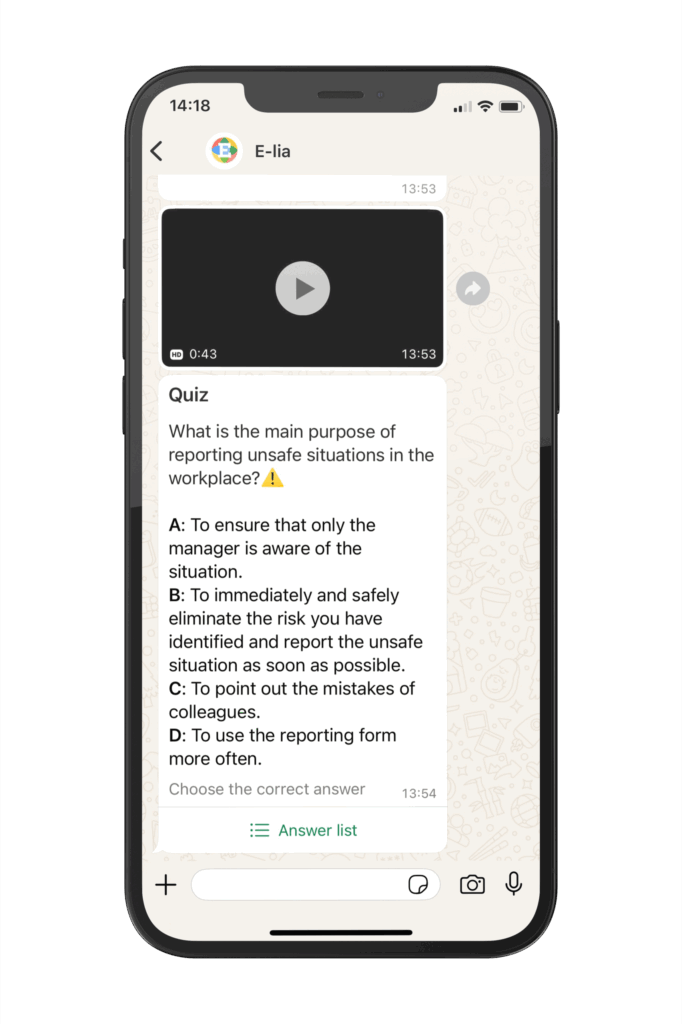
Deliver toolbox talks straight through WhatsApp — the platform your team already uses every day. Register in-person sessions and log attendance automatically. No apps, no logins, no hassle. Just direct access to your people on the work floor.
Don’t just take our word for it — these organisations already trust E-lia.




Run toolbox talks without the hassle
Stay compliant without the admin. Replace paper lists with a fully digital system — no more chasing signatures or spreadsheets.
Send interactive toolbox talks via WhatsApp, with built-in knowledge checks and a live dashboard. Compliance evidence for CHAS, SMAS Worksafe, SafeContractor and ISO 45001 — instantly.
Why it works
- Multilingual: automatic translation
- No work disruption: complete on the job
- Less admin: no paper or Excel tracking
- Compliance-ready: instant digital proof
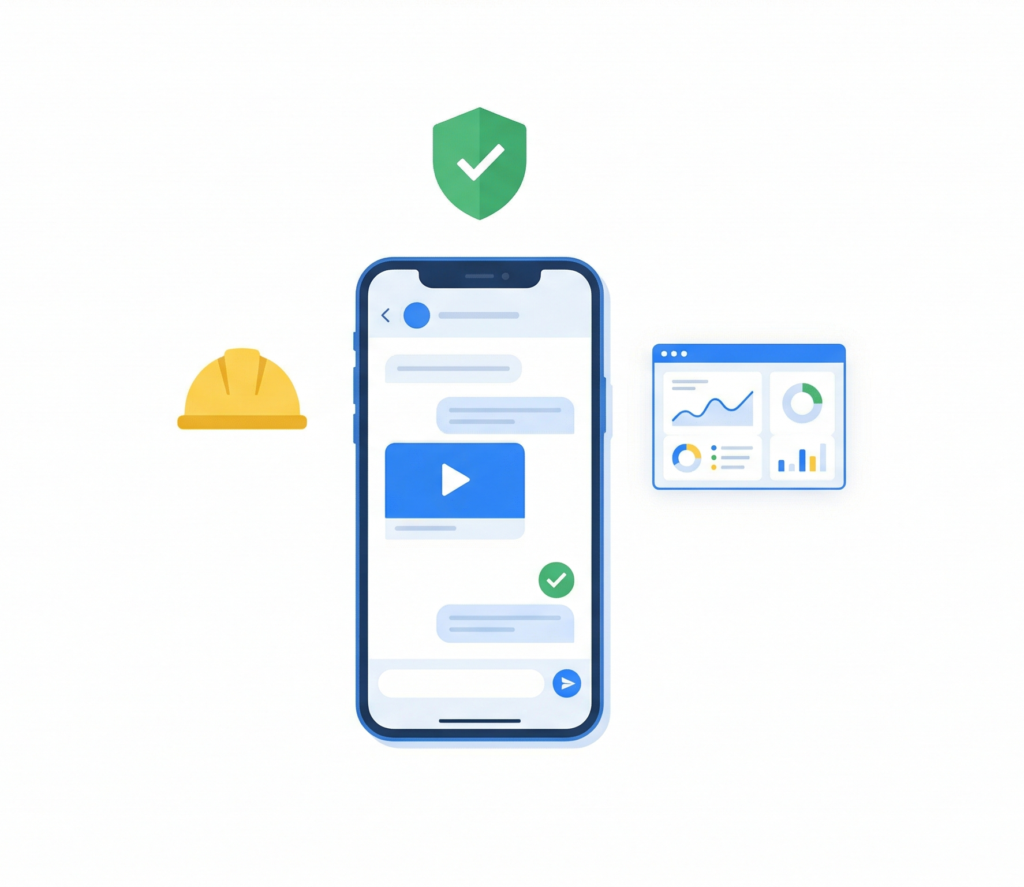
Instant access to 60+ practical toolbox talks
In addition to your own content, you get access to our extensive library of over 60 practical topics — updated monthly by a NEBOSH-qualified safety professional.
Each interactive toolbox includes:
- Clear explanations and visual examples
- Supporting videos and images
- Knowledge checks and quiz questions to reinforce learning
See how it works in practice
Request a free demo and experience how toolbox talks via WhatsApp works for your employees.
- Receive a live example directly on your phone
- Follow the employee journey step by step
- Quickly see if it fits your organisation
Start your WhatsApp demo
Why professionals trust E-lia
Toolbox talks via WhatsApp
No login required — delivered via a platform employees already use every day.
Workplace inspections
Carry out digital inspections and record them instantly. Safety has never been this clear and measurable.
Live dashboard
Get clear, compliance-ready overviews at a glance — by team, project or location.
Hybrid content
Use our 60+ templates or create your own content. We develop new topics on request, free of charge.
On-site registration
Register in-person toolbox talks with ease. A simple QR code scan provides reliable, compliance-ready proof.
Fully multilingual
With smart AI translations, everyone understands safety instructions in their own language.
Less admin
Save time. No more chasing signatures or manually updating Excel sheets.
Highly cost-effective
Increase safety awareness at a competitive rate — from just €10 / £8.50 per employee per year.
Ready to run toolbox talks without the hassle?
See why safety-focused organisations are switching to E-lia — less admin, better proof, higher team engagement.
- No new app or login required
- Save up to 70% on administrative costs
- 100% compliance-ready reporting
Get in touch
FAQ for Toolbox Talks
What is a toolbox talk?
A toolbox talk is a short, focused safety briefing delivered to workers on site. It’s designed to raise safety awareness and to open up discussion around a specific workplace risk (such as working at height or handling hazardous substances). In practice, a toolbox talk typically lasts 10 to 15 minutes and is delivered on the worksite, in the welfare cabin, or — increasingly — digitally on the worker’s phone.
How many toolbox talks am I required to deliver?
There is no fixed legal minimum in the UK. However, under the Health and Safety at Work etc. Act 1974 and the Management of Health and Safety at Work Regulations 1999, every employer must provide adequate information, instruction and training to their workers. In practice, most UK contractors aim for one toolbox talk per month (around 10–12 per year) — particularly those holding CHAS, SafeContractor, SMAS Worksafe, Constructionline or ISO 45001 accreditation, where evidence of ongoing safety communication is part of the assessment. In Ireland, the equivalent obligation comes from the Safety, Health and Welfare at Work Act 2005 and is monitored by the Health and Safety Authority (HSA).
What makes a good toolbox talk?
A valid and effective toolbox talk needs three things:
- Relevance — the topic must reflect current site activities and the risks identified in your risk assessment.
- Interaction — it must not be one-way; workers should be able to ask questions and share their own observations.
- Evidence — during a compliance check (or an HSE inspection) you must be able to demonstrate who attended and that they understood the content.
As a result, with E-lia this evidence is recorded automatically in your dashboard — including timestamps and quiz scores.
Who can deliver a toolbox talk?
Anyone with sufficient knowledge of the topic can deliver a toolbox talk. In practice this is usually the site manager, site supervisor, project manager or SHEQ / HSE coordinator. Because preparing and delivering toolbox talks can be time-consuming, more and more companies are switching to ready-made digital toolbox talks that workers complete independently on their phones.
Is it mandatory to record attendance at a toolbox talk?
Yes — if you are CHAS, SMAS Worksafe, SafeContractor or ISO 45001 accredited, or if you need to demonstrate that you’ve met your duty of care under HSWA 1974, recording attendance is essential. Specifically, you must be able to prove which workers attended which session, on which date, and that they understood the content. Traditionally this was done with paper sign-in sheets; today it can be captured fully digitally and compliance-ready through platforms such as E-lia.
How long should a toolbox talk last?
An effective toolbox talk is short and to the point — typically 10 to 15 minutes. In short, the aim is to focus on one specific safety topic without becoming a lecture. Because gathering everyone physically in the welfare cabin takes time (and time is money), many companies now run digital toolbox talks: workers receive the content (including a short video and a quiz) on their phone, which minimises disruption to the working day.
Which toolbox-talk topics are mandatory?
There is no statutory list of mandatory topics in the UK. However, HSWA 1974 and the regulations under it require that the topics directly reflect the specific risks of your work activities, as identified in your risk assessment. If your team regularly works on scaffolding, working at height (Work at Height Regulations 2005) is essential. Similarly, if you work on or near the highway, streetworks safety is essential. If you handle chemicals, COSHH (Control of Substances Hazardous to Health Regulations 2002) is essential.
The E-lia library includes more than 60 ready-made topics, written and reviewed by qualified safety professionals.
Do toolbox talks also apply to self-employed contractors and subcontractors?
Yes. As the principal contractor or client under CDM 2015 (Construction (Design and Management) Regulations 2015), you are responsible for the health and safety of everyone on site — including sole traders, agency workers and self-employed contractors. The challenge in practice is that these workers are often not part of your company’s systems. That’s where E-lia helps: simply send external workers a WhatsApp message or have them scan a QR code on arrival. No app, no login, no admin.
How do you deliver toolbox talks to workers whose first language isn't English?
UK and Irish health and safety law is clear: safety information must be understood by the people it’s given to. For instance, delivering an English-only toolbox talk to a workforce that includes Polish, Romanian, Portuguese, Ukrainian or other non-English speakers means you may not be meeting your duty of care under HSWA 1974 (or the Safety, Health and Welfare at Work Act 2005 in Ireland). With a physical session this is almost impossible to solve; E-lia automatically translates toolbox talks and quiz questions into each worker’s preferred language.
How do I prove to my CHAS / SMAS / SafeContractor / ISO assessor that I've delivered toolbox talks?
During a compliance check you’ll need to demonstrate two things: which topics were covered, and that the workforce was demonstrably present and understood the content. Historically this meant passing round a paper sign-in sheet for signatures. In contrast, with the E-lia dashboard you have a compliance-ready overview in one click — topic, date, attendance, quiz score, and the worker’s understanding — all timestamped and exportable.