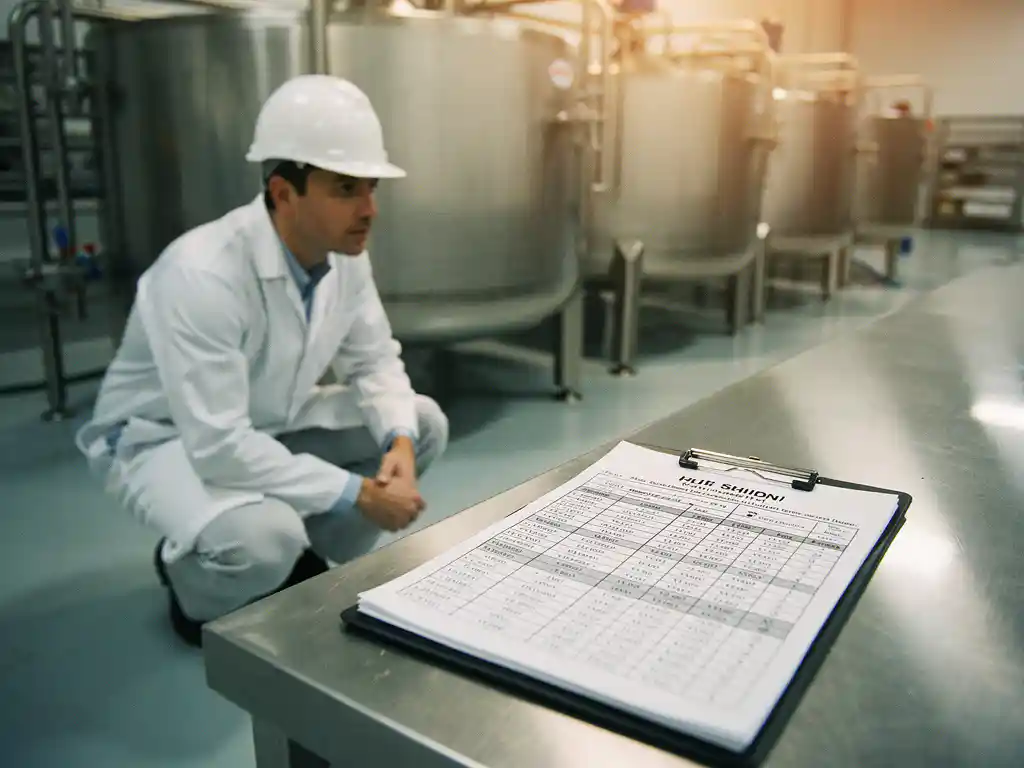
Food safety is not a secondary concern in manufacturing companies. Whether you produce dairy products, processed meats, ready-made meals, or snacks: if something goes wrong in the production process, the consequences can be significant for consumers and your organisation alike. HACCP is the system that helps companies manage those risks step by step, in a structured way.
In this article, we explain what HACCP entails, why it is mandatory, what risks it prevents, and how to effectively train your employees on it. Whether you are new to the topic or want to refresh your knowledge: here you will find clear answers to the most frequently asked questions about HACCP training and food safety in production.
What is HACCP and why does it exist?
HACCP stands for Hazard Analysis and Critical Control Points. It is a systematic approach to identifying, assessing, and controlling food safety risks in the production process. The system focuses on prevention: hazards are addressed before they become a problem, rather than being corrected after the fact.
The system was developed in the 1960s for the American space industry, to ensure that astronauts could eat safe food. It was later adopted worldwide by the food industry, because it provides a reliable and structured method for controlling hazards such as bacteria, chemical substances, and physical contaminants.
HACCP exists because traditional end-product checks are insufficient. Once a product has been manufactured, any contamination has already occurred. By monitoring critical points in the process, you intervene before something goes wrong.
Why is HACCP mandatory in manufacturing companies?
HACCP is legally required in the United Kingdom and across the European Union for all businesses that produce, process, or distribute food. European Regulation EC 852/2004 stipulates that every link in the food chain must operate a HACCP-based system. In the UK, the Food Standards Agency (FSA) oversees compliance and can impose sanctions for violations.
The obligation does not exist solely for legal reasons. HACCP protects consumers from unsafe products, protects businesses from product recalls and reputational damage, and ensures a standardised way of working within the organisation. For manufacturing companies that export or work with major retailers, a demonstrable HACCP system is also frequently a strict requirement from the supply chain.
What are the 7 principles of HACCP?
The 7 principles of HACCP form the backbone of every food safety system. They provide a structured method for identifying and controlling hazards, from analysis through to documentation.
- Conduct a hazard analysis: Identify all biological, chemical, and physical hazards in the production process.
- Identify Critical Control Points (CCPs): Determine at which steps in the process hazards can be controlled or eliminated.
- Establish critical limits: Define measurable standards, such as temperature or time, that each CCP must meet.
- Set up a monitoring system: Ensure systematic monitoring of CCPs, for example through temperature measurements or visual inspections.
- Define corrective actions: Describe what must happen if a CCP falls outside the critical limits.
- Establish verification procedures: Regularly check whether the HACCP system is working effectively.
- Maintain documentation and records: Record all procedures, checks, and deviations in writing as evidence and for audits.
These seven steps only work well if employees understand and apply them. Knowledge of the principles on paper is not enough; the translation into daily behaviour on the shop floor is where the difference is made.
What risks does HACCP prevent in production?
HACCP prevents three categories of hazards in the production process: biological hazards such as bacteria, viruses, and moulds; chemical hazards such as cleaning agents, pesticides, and allergens; and physical hazards such as glass, metal particles, or plastic fragments in the product.
In practice, biological hazards occur most frequently and are potentially the most dangerous. Think of salmonella in poultry products, listeria in dairy, or E. coli in raw vegetables. By monitoring critical control points, such as the core temperature during heating, these hazards are systematically eliminated.
Chemical hazards are less visible, but equally serious. Residues of cleaning agents or cross-contamination with allergens can cause severe health damage. HACCP requires companies to map and control these risks as well, through protocols and separation procedures.
How do you effectively train employees on HACCP?
Effective HACCP training focuses on practical applicability, not just theoretical knowledge. Employees need to understand why certain actions are important, what goes wrong if they do not follow them, and how to recognise and report deviations.
What makes an HACCP course effective?
A good HACCP course connects with the daily work practices of employees. Abstract theory is less effective than concrete scenarios from their own work environment. Employees in production learn better when training is short, repeatable, and easily accessible, without needing to find a computer or attend a lengthy session.
Microlearning is an approach that is increasingly used for this type of training. By breaking learning content into small, digestible units of three to six minutes, information is retained more effectively and it becomes easier to deliver knowledge at the right moment, for example just before a new task or when a process change is introduced. You can explore how E-lia supports this through digital work instructions and knowledge retention tools.
When should HACCP training be repeated?
HACCP training is not a one-time activity. Employees need to be regularly updated, especially when processes change, new products are introduced, seasonal peaks occur, or when audits reveal that knowledge has faded. New employees need immediate foundational knowledge during onboarding about hygiene codes and critical control points relevant to their specific role.
How do you know if your HACCP system is working properly?
An HACCP system is working well when critical control points are consistently monitored, deviations are identified and corrected in a timely manner, and employees can demonstrably show that they know what to do. Verification, internal audits, and documentation are the three pillars against which you measure this.
Internal audits provide insight into whether procedures are actually being followed. Do not look only at the paperwork, but also observe behaviour on the shop floor. Are temperatures really being measured and recorded? Do employees know what to do when a deviation occurs? These are the questions that determine the effectiveness of your system. Structured workplace inspections and toolbox talks can support this process significantly.
In addition, continuous training is a reliable indicator. When employees are trained regularly and their knowledge is tested, procedures are less likely to erode. Organisations that integrate learning into daily work routines generally see better compliance with HACCP protocols than companies that only offer training once a year.
How E-lia helps with HACCP training
We understand that HACCP training in manufacturing companies needs to be practical and accessible. Employees work in shifts, sometimes speak multiple languages, and do not have time for long classroom sessions. That is why we offer HACCP training via WhatsApp: short microlearning modules that employees receive directly on their phone, without downloading an app or logging in.
What we offer for your HACCP training:
- Ready-made HACCP modules you can deploy immediately, or custom content you can build yourself in 10 to 15 minutes
- Automatic translation, so multilingual teams are trained in their own language
- Modules that can be scheduled, for example during onboarding or ahead of seasonal peaks
- A clear dashboard that lets you track progress and results per employee
- Simple integration with existing HR systems and LMS platforms via an API
Want to see how we can train your team quickly and effectively on HACCP? Check out our HACCP course via WhatsApp and discover how straightforward learning can be. Or book a free demo to see E-lia in action.
Frequently Asked Questions
What is the difference between an HACCP plan and an HACCP system?
An HACCP plan is the written document in which all hazards, critical control points, limits, and corrective actions are recorded. The HACCP system is broader: it encompasses the plan and the daily execution of it, including training, monitoring, documentation, and verification. A well-written HACCP plan on paper is therefore not yet a working system — that also requires employees to know the plan and apply it consistently on the shop floor.
How do I start setting up an HACCP system if we have nothing in place yet?
Start with a thorough inventory of your production process: map out every step, from raw material storage to finished product. Then conduct a hazard analysis to identify biological, chemical, and physical risks, and determine at which steps you need critical control points (CCPs). It is strongly recommended to involve a certified HACCP coordinator or external consultant, especially for the initial setup. Afterwards, ensure that employees are immediately trained on the parts of the system relevant to their role.
Which employees need HACCP training, and at what level of depth?
All employees who are directly or indirectly involved in the production, storage, or distribution of food products need a basic understanding of HACCP, including temporary workers and seasonal staff. The depth of training varies by role: production employees primarily need practical knowledge of hygiene rules, CCPs, and reporting deviations, while team leaders and quality managers also need to understand the underlying principles and verification procedures. When designing your training, make a clear distinction between basic training for the shop floor and in-depth training for supervisors and managers.
What are the most common mistakes in implementing HACCP in manufacturing companies?
A common mistake is that the HACCP system exists on paper but is not lived on the shop floor — employees do not know the procedures or do not follow them consistently. Other frequent pitfalls include: critical limits that have not been set realistically, incomplete or inconsistent recording of measurements, and failure to update the HACCP plan after process changes or new products. The solution lies in regular training, internal audits, and a culture in which employees feel safe to report deviations without fear of consequences.
How do I keep multilingual production teams effectively trained on HACCP procedures?
Language barriers are one of the biggest practical challenges in HACCP training in manufacturing companies with diverse teams. Ensure that training materials are available in the languages your employees speak, and use visual instructions where possible, such as pictograms, videos, or step-by-step illustrations that rely less on language proficiency. Digital training solutions with automatic translation functionality, such as microlearning via WhatsApp, make it easy to train every employee in their own language without creating additional administrative burden.
How often is an HACCP system inspected by the food safety authority, and what do they look for?
The Food Standards Agency (FSA) conducts unannounced inspections, with the frequency depending on the risk profile of your business and previous findings. Inspectors look not only at whether an HACCP plan is in place, but also at actual execution: are records up to date, are CCPs actively monitored, and can employees explain what they do and why? Companies with demonstrable, well-documented training and current records generally fare better during an inspection than companies that can only present a paper-based system.
Can a small manufacturing company also meet HACCP requirements without a large quality department?
Yes, the size of your business does not determine whether you must comply with HACCP, but it does affect how you practically set up the system. Small businesses can work with a simplified HACCP plan that is proportionate to the complexity of their processes. What matters is that responsibility is clearly assigned — even if that falls to one person — and that employees are well trained. Lightweight, digital training solutions are particularly attractive for smaller businesses, as they require little management effort while still ensuring demonstrable and repeatable training.