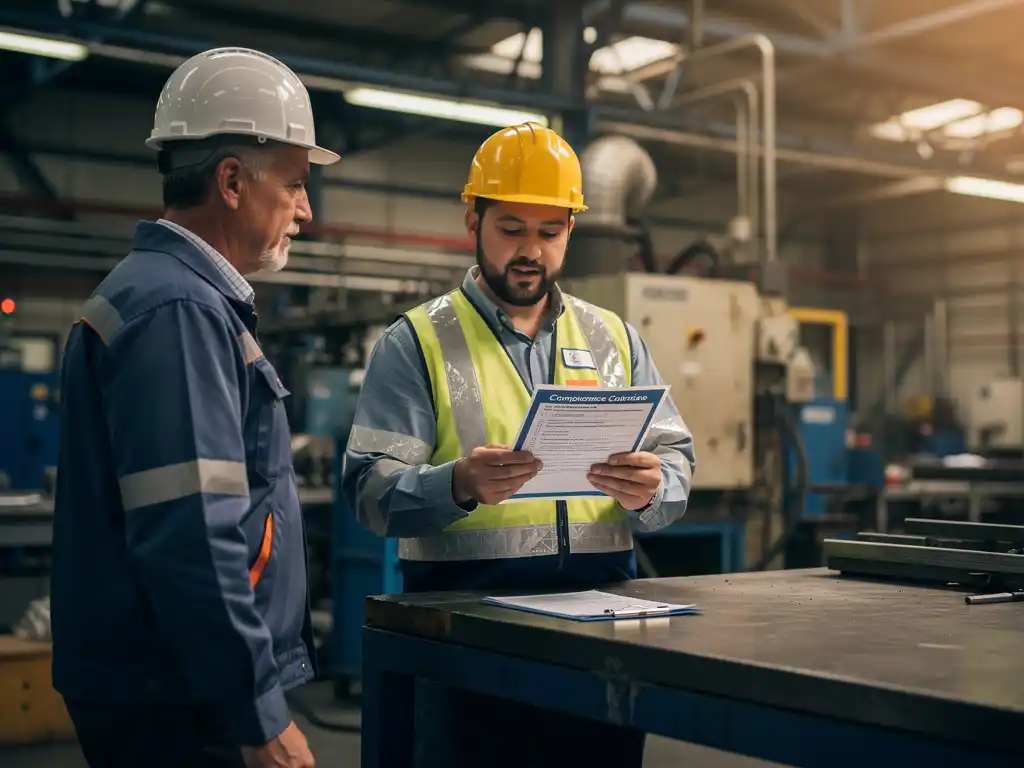
The most common mistakes when onboarding production employees are information overload on day one, relying on paper-based instructions that workers cannot access on the floor, skipping language-appropriate training, and failing to deliver consistent onboarding across shifts and teams. These errors share a root cause: onboarding processes designed for office workers are being applied to production environments where conditions, pace, and workforce profiles are fundamentally different. The sections below unpack each mistake in detail so you can identify and fix the gaps in your own process. If you want to discuss your current setup, book a free demo and we can help you take a closer look.
Why do production employees quit within the first 90 days?
Production employees most often quit within the first 90 days because they feel unprepared, unsupported, or unclear about what is expected of them. When onboarding fails to give workers the practical knowledge and confidence they need to perform safely and correctly from day one, frustration builds quickly and early turnover follows.
The production floor is a high-pressure environment. Machines run on tight schedules, safety procedures must be followed precisely, and team leads rarely have time to walk every new hire through every process step by step. When onboarding does not fill that gap, new employees are left to figure things out on their own or rely on colleagues who may pass on inconsistent habits.
Early quitting is rarely about pay alone. Industry experience consistently shows that workers who leave within the first three months cite feeling lost, undertrained, or disconnected from their team. A structured onboarding process that delivers the right information at the right time reduces that feeling of being thrown in at the deep end and directly improves retention.
What onboarding information do production workers most often miss?
Production workers most often miss safety procedures, machine-specific operating instructions, quality standards, and escalation protocols during onboarding. These are the practical details that determine whether a worker can do the job safely and correctly, yet they are frequently buried in lengthy documents or delivered in a single orientation session that is easy to forget.
The gap between what new employees are told and what they actually retain is significant. A one-time classroom session or a thick onboarding folder does not translate into on-the-job knowledge. Workers need information at the moment they need it, not hours before their first shift begins.
The most commonly missed categories include:
- Safety protocols specific to their workstation or machine
- Step-by-step operating procedures for the equipment they will use
- Quality control checkpoints and what to do when something does not meet standards
- Who to contact when something goes wrong or when they need support
- Team-specific norms around breaks, handovers, and shift communication
Addressing these gaps requires delivering information in short, focused formats that workers can revisit when they are actually standing at their workstation, not just during an induction session. Digital work instructions are one of the most effective ways to make this possible.
How does information overload affect new production employees?
Information overload during onboarding causes new production employees to retain less, make more errors, and feel more anxious in their role. When workers are given too much information at once, particularly in the first days, the practical knowledge they need most gets lost in the volume of everything else they are trying to absorb.
This is a particularly acute problem in manufacturing and production environments, where the consequences of forgetting a procedure can mean a safety incident, a quality failure, or damaged equipment. Overloading new hires with policies, compliance documents, HR paperwork, and operational procedures all in the same session is a recipe for poor retention.
Spacing learning over time, a principle known as distributed practice, consistently outperforms single-session information delivery. Breaking onboarding content into small, focused pieces delivered across the first days and weeks allows workers to absorb and apply information gradually. Short learning moments of three to six minutes, focused on one topic at a time, are far more effective than a two-hour induction session covering everything at once.
Why is paper-based onboarding a problem on the production floor?
Paper-based onboarding is a problem on the production floor because workers cannot easily access documents while operating machinery, paper gets lost or damaged in industrial environments, and printed materials become outdated the moment processes change. The production floor is not an office, and onboarding tools designed for desk workers do not transfer well to physical, fast-moving work environments.
When a new employee needs to double-check a procedure mid-shift, a printed manual stored in a locker room or a binder on a shelf is not a practical resource. Workers either skip the check, ask a colleague, or guess. All three options introduce risk.
Paper also creates version control problems. If a process changes and new instructions are printed, there is no guarantee that old versions have been replaced. Workers may follow outdated procedures simply because the paper in front of them has not been updated. Digital delivery of onboarding content solves both the accessibility and the version control problem simultaneously, ensuring every worker always sees the most current information. Structured workplace inspections can further help identify where outdated practices are still being followed on the floor.
How can production teams onboard employees more consistently?
Production teams can onboard employees more consistently by standardising content delivery, removing dependency on individual trainers, and using tools that deliver the same information to every new hire regardless of which shift they join or which team lead is on duty. Inconsistency in onboarding is one of the most common and most damaging mistakes in manufacturing environments.
When onboarding relies on experienced workers passing knowledge verbally to new hires, quality varies enormously. One team lead may cover safety thoroughly and rush through quality standards. Another may do the opposite. Over time, this creates uneven competence across the workforce and increases the risk of errors and incidents.
Practical steps for improving consistency include:
- Document all core procedures in a standardised format before building any training content
- Create structured onboarding modules that every new employee completes, regardless of their start date or shift
- Automate delivery so that content is sent at the right moment without relying on a trainer to remember
- Track completion so team leads and HR can see who has received what information and follow up on gaps
- Review and update content regularly to reflect process changes as they happen
Consistency does not mean rigidity. Teams can still adapt onboarding to specific roles or departments whilst maintaining a shared baseline that every production employee receives. Tools such as toolbox talks are a practical way to reinforce key topics and keep teams aligned on a regular basis.
What role does language play in production onboarding mistakes?
Language is one of the most overlooked sources of onboarding mistakes in production environments. When onboarding materials are only available in the dominant language of the organisation and workers are not fully fluent in that language, critical information is misunderstood, skipped, or simply not retained. In sectors like manufacturing, logistics, and food production, multilingual workforces are the norm rather than the exception.
A worker who does not fully understand a safety instruction is not a careless worker. They are a worker whose onboarding failed them. Providing training in the language a person actually thinks and works in is not a luxury; it is a basic requirement for effective knowledge transfer.
Organisations that invest in language-appropriate onboarding see fewer procedural errors, higher completion rates for training content, and stronger early retention. Automatic translation tools built into modern training platforms make it possible to deliver the same content in multiple languages without creating and maintaining separate versions manually. For industries with strict compliance requirements, this also supports effective HACCP training across diverse teams.
How E-Lia helps with onboarding production employees
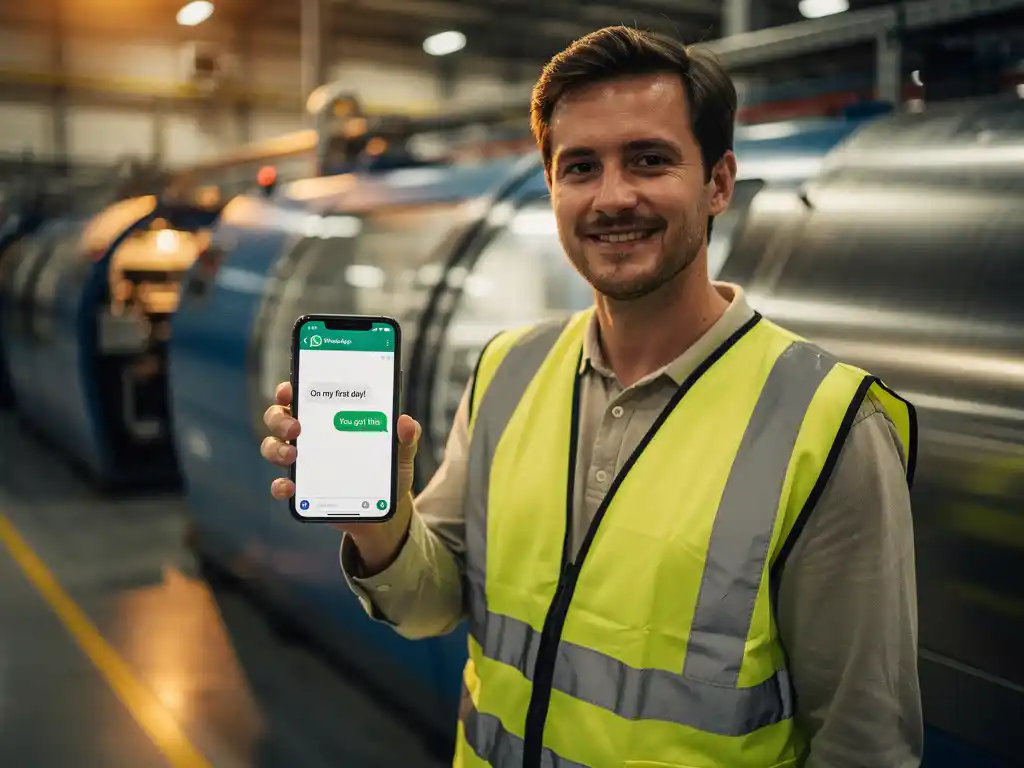
We built E-Lia specifically to address the onboarding challenges that production environments face every day. Our platform delivers microlearning modules directly via WhatsApp, which means no app to download, no login required, and no computer needed. Workers receive the right information at the right moment, on the device they already use.
Here is what E-Lia makes possible for production teams:
- Short, focused modules of three to six minutes that prevent information overload and improve retention
- Automatic scheduling so onboarding content is delivered consistently to every new hire, regardless of shift or team lead
- Automatic translations so workers receive training in their own language without manual effort
- A progress dashboard so HR and team leads can track who has completed what and where gaps exist
- Fast content creation with modules built in an average of ten to fifteen minutes, keeping your procedures current
- No paper, no outdated documents and no version control problems
E-Lia also supports teams in building a culture of retaining and maintaining knowledge long after the initial onboarding period is complete. Organisations like Erasmus MC and ETZ already use E-Lia to onboard and train their teams more effectively. If you want to see how it works in practice, plan a free demo and we will walk you through the platform with your specific situation in mind.
Frequently Asked Questions
How long should onboarding take for a new production employee?
Effective onboarding for production employees typically spans the first 30 to 90 days, not just the first day or week. Rather than compressing everything into an initial orientation session, onboarding should be structured as a gradual process where foundational knowledge comes first, followed by role-specific procedures, quality standards, and team integration over subsequent weeks. The goal is to match the pace of information delivery to the pace at which a new hire can realistically absorb and apply it on the floor.
What is the best way to get started with improving our current onboarding process?
The most practical starting point is to audit what your current onboarding actually covers versus what new employees say they wish they had known sooner. Interview recent hires who have passed the 90-day mark and ask them directly where they felt underprepared. From there, prioritise filling the highest-risk gaps first — typically safety procedures and machine-specific operating instructions — before expanding to broader process and culture content.
How do we onboard production employees who work rotating or night shifts when no trainer is available?
This is one of the most common structural challenges in manufacturing environments, and it is exactly why onboarding should never depend on a specific trainer being present. Automated digital delivery — where onboarding modules are sent directly to the worker’s phone at scheduled intervals — ensures that employees on any shift receive the same quality of onboarding without requiring a team lead or HR representative to be physically available. This removes the shift dependency entirely and guarantees consistency across your entire workforce.
What if our processes change frequently — how do we keep onboarding content up to date without it becoming a full-time job?
The key is choosing a content format and platform that makes updates fast and low-effort. If updating a training module takes hours of design work, it will not happen consistently and your onboarding will fall out of date. Modern microlearning tools allow procedure updates to be made in minutes, with changes instantly reflected for all future learners. Building a habit of updating training content at the same time a process change is approved — rather than treating it as a separate task — keeps everything current without creating a significant ongoing workload.
How do we measure whether our production onboarding is actually working?
The most reliable indicators are 90-day retention rates, early-stage error and incident rates, and training completion data. If a significant portion of new hires are leaving within the first three months, or if quality and safety incidents cluster around newer employees, those are clear signals that onboarding is not delivering the knowledge workers need. Tracking module completion per employee also allows team leads to identify who has gaps before those gaps result in a problem on the floor.
Is it realistic to provide onboarding in multiple languages for a small or mid-sized production company?
Yes, and the barrier is much lower than most companies assume. Historically, multilingual onboarding required creating and maintaining entirely separate content sets for each language, which was time-consuming and expensive. Automatic translation features built into modern training platforms now allow a single piece of content to be delivered in each worker’s preferred language without any additional manual effort. For companies with even a small percentage of non-native speakers, this investment directly reduces procedural errors and early turnover.
What is the difference between onboarding and ongoing training for production employees, and do we need both?
Onboarding covers the foundational knowledge a new employee needs to perform their role safely and correctly from the start — procedures, safety rules, quality standards, and team norms. Ongoing training builds on that foundation over time, addressing process updates, skill development, compliance refreshers, and preparation for new responsibilities. Both are necessary: onboarding sets the baseline, whilst ongoing training ensures that knowledge stays current and employees continue to grow in their roles. The good news is that the same tools and formats that work for onboarding — short, focused, mobile-friendly modules — work equally well for continuous learning.