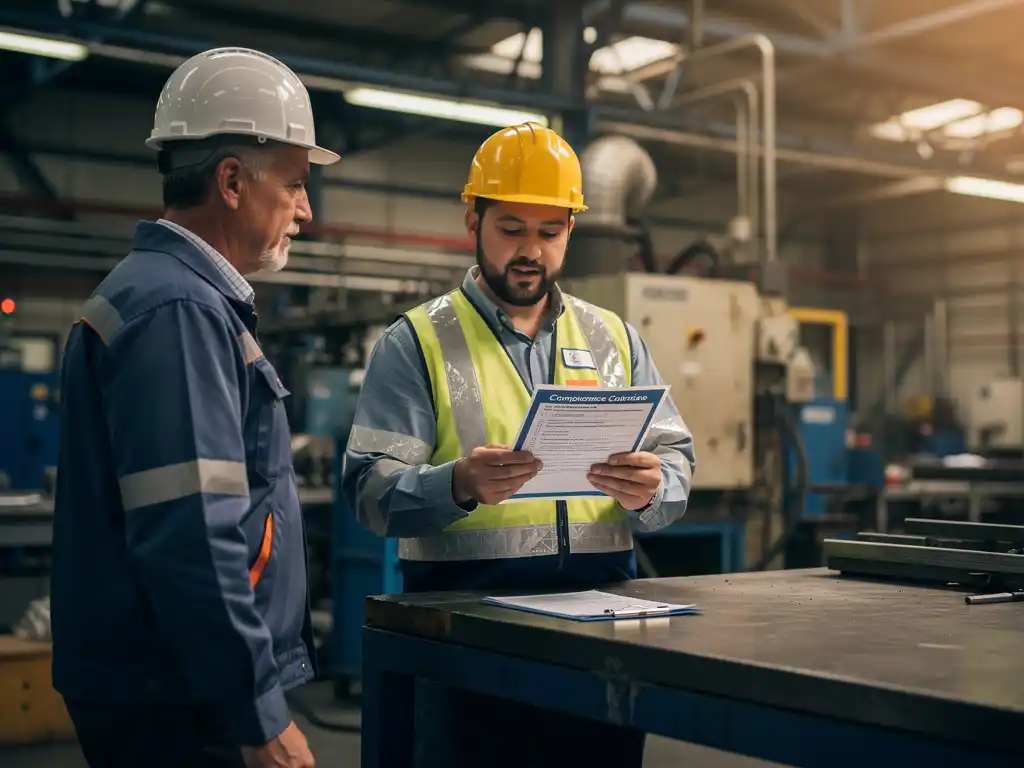
New production employees most commonly ask questions about safety procedures, their specific tasks and workflows, shift schedules, and where to find equipment or materials during their first week. These questions cluster around three core concerns: staying safe, doing the job correctly, and understanding the practical logistics of the role. The sections below break down each category in detail so organisations can anticipate and address them before day one.
What do new production employees struggle with most in week one?
The biggest struggle for new production employees in week one is information overload combined with limited access to support. Workers receive large amounts of procedural, safety, and logistical information in a short time, often during a single induction session, and are then expected to perform independently on the production floor with minimal follow-up guidance.
This challenge is compounded by the environment itself. Production floors are busy, loud, and fast-paced. Supervisors and experienced colleagues are focused on output targets, which means a new worker asking a question at the wrong moment may get a rushed answer or no answer at all. The result is that many first-week employees make mistakes not because they lack ability, but because they lack timely, clear information.
The questions that cause the most friction tend to fall into four areas: safety and compliance, task execution and processes, HR and administration, and general orientation such as where things are and who to speak to. Each of these deserves a structured answer before the first shift begins, not after.
What safety and compliance questions come up on the production floor?
Safety and compliance questions are among the most urgent that new production employees ask, and they typically centre on personal protective equipment, emergency procedures, hazardous materials handling, and which areas or machines require specific authorisation before use.
Common safety questions from new manufacturing workers include:
- Which PPE is required in which zones, and where is it stored?
- What is the procedure if a machine malfunctions or stops unexpectedly?
- Who do I report a near-miss or accident to, and how?
- Are there restricted areas I should not enter without supervision?
- What are the lockout/tagout procedures for this equipment?
What makes these questions particularly high-stakes is that a new employee who does not know the answer may not ask at all, either out of embarrassment or because no obvious moment to ask presents itself. Safety compliance in manufacturing is not just about regulation; it directly affects the wellbeing of the individual and everyone around them. Organisations that treat safety onboarding as a one-time briefing rather than an ongoing reference resource are leaving a significant gap in their onboarding process.
What process and task questions do new workers ask their supervisors?
New production workers most frequently ask supervisors about the specific steps of their assigned tasks, the acceptable quality standards for their output, how to handle exceptions or defects, and what to do when a process does not go as expected. These are questions about doing the job correctly, not just safely.
Process and task questions on the production floor typically include:
- What is the correct sequence of steps for this task?
- How do I know if the output meets the required standard?
- What do I do if a component is defective or missing?
- How fast am I expected to work, and how is my output measured?
- Who checks my work, and at what stage?
These questions are often repeated multiple times across the first week because verbal instructions given during induction are difficult to retain under the pressure of real-time work. Workers who have access to a written or digital reference for their tasks ask supervisors fewer questions and make fewer errors. This is why clear, accessible work instructions are one of the highest-return investments an organisation can make in onboarding manufacturing workers.
What HR and administrative questions do new production hires ask in week one?
HR and administrative questions from new production employees in week one typically cover shift schedules, break times, payroll processes, absence reporting, and where to find or submit required documents. These questions feel practical and low-stakes, but when unanswered, they create anxiety and distraction.
Typical HR questions new hires ask include:
- When and how do I receive my first payslip?
- How do I report absence or lateness?
- What are my contracted hours and how are overtime hours handled?
- Where do I submit my bank details or tax documents?
- Who is my direct contact for HR-related questions?
These questions are predictable and consistent across almost every new hire in production. Yet many organisations leave employees to find the answers themselves, which means asking multiple colleagues, searching for documents, or waiting until a manager is free. A structured first-week information flow that proactively delivers this information removes unnecessary friction from the employee experience and reduces the administrative burden on HR teams and supervisors.
How can organisations answer these questions before the first shift starts?
Organisations can answer first-week questions before the first shift starts by delivering structured pre-onboarding content that covers safety, tasks, HR logistics, and orientation in the days before a new employee arrives. This shifts the information exchange from reactive to proactive, so new production workers arrive prepared rather than overwhelmed.
Effective pre-onboarding for manufacturing workers typically includes:
- A clear overview of safety rules, PPE requirements, and emergency procedures
- Step-by-step work instructions for the most common tasks in their role
- Practical logistics such as shift times, break schedules, and who to contact for what
- HR information covering payroll timelines, absence procedures, and document submission
- A brief introduction to the team, the facility layout, and key contacts
The format matters as much as the content. Long documents or e-learning modules with login requirements create barriers for production workers, many of whom do not regularly use computers as part of their role. Short, mobile-friendly content delivered through a channel workers already use, such as WhatsApp, removes those barriers entirely. When new employees can review their work instructions and safety briefings on their phone before they arrive, they start their first shift with confidence rather than confusion. Learn more about how structured onboarding can support your production team.
What happens when first-week questions go unanswered on the production floor?
When first-week questions go unanswered on the production floor, the consequences range from minor inefficiencies to serious safety incidents. New production employees who cannot get clear answers to their questions either make assumptions, interrupt experienced colleagues repeatedly, or disengage from the role entirely.
The practical impact of unanswered questions in manufacturing onboarding includes:
- Higher error rates: Workers who are unsure of the correct process make more mistakes, which increases waste and rework.
- Safety risks: Uncertainty about safety procedures creates conditions where near-misses and incidents are more likely.
- Slower productivity ramp-up: New employees take longer to reach full output when they spend time searching for information rather than applying it.
- Lower retention: A disorganised first week is one of the most commonly cited reasons employees leave a role within the first 90 days.
- Supervisor burden: When new hires lack structured support, the question load falls on supervisors, pulling them away from their own responsibilities.
The cost of a poor first week is rarely tracked directly, but it shows up in turnover figures, quality metrics, and supervisor time. Organisations that invest in answering first-week questions systematically see measurable improvements in all three areas. The first week on the production floor sets the tone for everything that follows, and the questions a new hire asks in that period are a reliable signal of where the onboarding process has gaps. Explore how retaining and maintaining knowledge can help close those gaps over time, and how toolbox talks can reinforce critical information throughout the first weeks.
How E-Lia helps with onboarding new production employees
We built E-Lia specifically to solve the information gap that new production employees experience in their first week. Our platform delivers microlearning, work instructions, and safety briefings directly via WhatsApp, the channel your workers already use, with no app to download and no login required.
Here is what organisations use E-Lia for when onboarding manufacturing workers:
- Pre-onboarding sequences that deliver safety rules, task instructions, and HR information before the first shift starts
- Step-by-step work instructions that workers can reference on the production floor in real time
- Multilingual content with automatic translations so every employee receives information in their own language
- Scheduled or instant delivery of modules so the right information reaches workers at the right moment
- Progress tracking via a simple dashboard so managers can see who has completed which modules
- Fast module creation averaging 10 to 15 minutes to build, with employees completing each module in 3 to 6 minutes
E-Lia also supports workplace inspections, HACCP training, and toolbox talks, making it a complete solution for keeping your production workforce informed, safe, and compliant from day one onwards.
If your organisation is ready to give new production employees the answers they need before they even walk through the door, we would be glad to show you how it works. Plan a demo and see E-Lia in action.
Frequently Asked Questions
How long should a structured pre-onboarding programme for production workers actually take to complete?
A well-designed pre-onboarding programme for production workers should take no more than 20 to 40 minutes in total, broken into short modules of 3 to 6 minutes each. The goal is not to cover everything before day one, but to cover the most critical information — safety essentials, key task steps, and practical logistics — so workers arrive with enough context to feel confident. Depth can be added progressively throughout the first week rather than front-loaded into a single session.
What is the best way to onboard production workers who are not comfortable with technology or do not regularly use computers?
The most effective approach is to deliver onboarding content through a channel workers already use in their personal lives, such as WhatsApp, rather than requiring them to log in to a new platform or complete e-learning on a desktop. Short, mobile-friendly modules with clear visuals and minimal text reduce the technical barrier significantly. Avoiding app downloads and login requirements removes the two most common points of drop-off for workers who are not digitally confident.
How do you onboard production workers who speak different languages on the same production floor?
The most scalable solution is to build onboarding content once and use automatic translation to deliver it in each worker’s preferred language, rather than creating separate versions manually. This ensures every employee receives the same quality of information regardless of their language, which is particularly important for safety-critical content. Organisations with multilingual workforces that rely on verbal translation during induction risk inconsistency, especially when key details are lost or simplified in translation.
What are the most common mistakes organisations make when onboarding new production employees?
The three most common mistakes are delivering all onboarding information in a single session and expecting workers to retain it, relying entirely on verbal instruction with no written or digital reference to fall back on, and treating onboarding as complete after day one rather than supporting workers progressively through the first week. A fourth frequent mistake is focusing exclusively on compliance and safety paperwork while underestimating how much anxiety workers feel about practical logistics like payroll, break times, and who to contact. All of these are solvable with a structured, staged information flow.
At what point in the hiring process should pre-onboarding content be sent to new production employees?
Pre-onboarding content should ideally be sent two to five days before the first shift, giving workers enough time to review it at their own pace without it feeling too distant from their start date. Sending it too early risks the information being forgotten; sending it on the morning of day one defeats the purpose. A simple sequence works well: practical logistics and HR information on day one of pre-onboarding, safety essentials on day two, and task-specific instructions on day three or the day before the first shift.
How can supervisors tell whether a new production employee actually understood their onboarding content?
The most reliable signal is whether the employee asks fewer repetitive questions and makes fewer procedural errors in the first week compared to previous new hires who did not have structured onboarding. More directly, short knowledge checks embedded within onboarding modules — even just two or three questions per module — allow managers to see which topics workers understood and which may need reinforcement. Progress tracking dashboards that show module completion rates also help supervisors identify workers who may not have engaged with the material before their first shift.
Can the same onboarding approach work for temporary or agency production workers, or is it only suited to permanent hires?
A structured onboarding approach is arguably more important for temporary and agency workers than for permanent hires, because short-term workers receive even less investment in their integration yet face the same safety risks and performance expectations from day one. Mobile-based, no-login onboarding content is particularly well-suited to temporary workers since it can be sent and completed before they even set foot on site, regardless of how short their contract is. Organisations that onboard temporary workers as thoroughly as permanent staff consistently see lower incident rates and faster productivity ramp-up across that workforce segment.