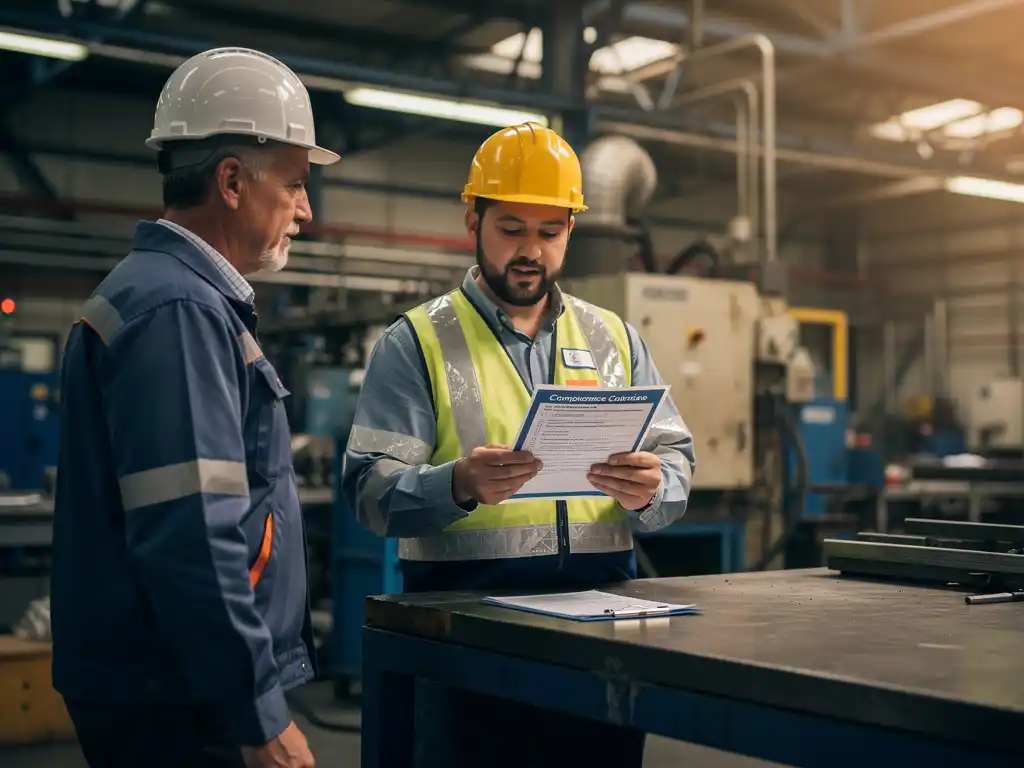



Onboarding in manufacturing is fundamentally different from other sectors because it centres on physical safety, hands-on equipment training, and compliance with strict regulatory standards from day one. Unlike office-based roles where new hires can gradually learn systems and processes, factory workers must be operationally ready and safe before they can contribute. The questions below unpack the key factors that shape a strong factory onboarding process and what it takes to get it right.
Why is safety training so central to manufacturing onboarding?
Safety training is central to manufacturing onboarding because the physical risks on a factory floor are immediate and serious. Before a new employee can operate machinery, handle materials, or move through a production area, they need to understand the hazards around them. Unlike most other sectors, a gap in knowledge here can cause direct physical harm within the first hours on the job.
Manufacturing environments involve heavy equipment, moving parts, chemical exposure, noise hazards, and strict protocols around personal protective equipment. Regulatory frameworks in most countries require documented safety inductions before new workers are permitted on the floor. This means safety training is not just a best practice but a legal obligation for most manufacturers.
What makes this particularly challenging is that safety knowledge needs to be retained, not just received. A new employee who watches a video on day one and never revisits the content is at greater risk than one who receives reinforcement over the first few weeks. Spacing out safety content and using short, focused modules improves retention and helps workers apply what they know in real situations.
How does the factory floor environment affect onboarding design?
The factory floor environment directly shapes how onboarding content must be designed and delivered. Workers are rarely seated at desks, often do not have access to computers during shifts, and may be moving between stations throughout the day. This makes traditional e-learning platforms impractical for in-the-moment learning and instruction.
Effective manufacturing onboarding design accounts for this physical reality. Content needs to be short, visual, and accessible on a mobile device without requiring a login or a quiet environment to focus. Step-by-step work instructions, process checklists, and short video demonstrations work far better than lengthy written documents when someone is standing next to a machine.
Noise levels and shift patterns also affect onboarding design. Workers on rotating shifts may miss scheduled training sessions, and content delivered only in group settings creates gaps for those who start mid-cycle. A well-designed factory onboarding process allows workers to access content at their own pace, on their own device, without depending on a trainer being physically present.
What role do multilingual workforces play in manufacturing onboarding?
Multilingual workforces are a defining feature of many manufacturing environments, and they significantly increase the complexity of onboarding. When workers receive safety instructions or process guidance in a language they do not fully understand, the risk of errors, accidents, and non-compliance rises sharply. Language is not just a communication barrier but a safety issue.
Manufacturing companies operating in 2026 increasingly recruit from diverse linguistic backgrounds, particularly in logistics-heavy and production-intensive regions. Translating onboarding materials into multiple languages is no longer a nice-to-have but a practical necessity. However, manually translating every document is time-consuming and expensive, which is why automated translation tools have become a core feature of modern onboarding platforms.
Beyond translation, the format of content matters for multilingual teams. Visual instructions, icons, and short video demonstrations reduce reliance on text and help bridge language gaps. When workers can receive onboarding content in their own language, comprehension improves, confidence builds faster, and the time to full productivity shortens noticeably.
How long does onboarding typically take in manufacturing compared to other sectors?
Onboarding in manufacturing typically takes longer than in office-based roles because of the combination of safety certification, equipment training, and hands-on practice required before a worker can operate independently. While a knowledge-worker role might see someone fully functional within two to four weeks, a factory role often requires four to eight weeks or more depending on the complexity of the machinery and processes involved.
That said, the structured portion of onboarding, meaning the knowledge transfer, safety briefings, and process introductions, can be significantly compressed with the right approach. The physical practice and supervised floor time cannot be rushed, but the informational side of onboarding does not need to take days of classroom time. Short, focused modules delivered over the first few weeks allow workers to absorb information gradually rather than in overwhelming blocks. Tools that support retaining and maintaining knowledge are particularly effective here.
Companies that front-load all their onboarding content into day one or day two often find that retention is poor and workers return with the same questions weeks later. Spreading content delivery across the onboarding period, aligned with what workers are actually doing on the floor, produces better outcomes and reduces the burden on supervisors and trainers.
What types of content work best for manufacturing onboarding?
The content types that work best for manufacturing onboarding are short, visual, and task-specific. Workers on a production line need to know how to do their job correctly and safely, not absorb lengthy policy documents. The most effective formats are step-by-step work instructions, short demonstration videos, visual checklists, and knowledge checks that reinforce key points after a module is completed.
Microlearning modules, typically two to five minutes in length, are particularly well-suited to the manufacturing context. They can be consumed between tasks, during breaks, or while waiting for a process to complete. They are easy to update when a process changes, and they can be sent directly to workers without requiring them to log into a separate platform.
Pre-onboarding content also plays an underestimated role. Sending new hires basic information about the site, safety expectations, and first-day logistics before they arrive reduces anxiety and shortens the time needed for introductory briefings. Workers who arrive informed are more ready to engage with hands-on training from the start. Regular toolbox talks and workplace inspections further reinforce the knowledge workers build during onboarding.
How can manufacturers track whether onboarding is actually working?
Manufacturers can track onboarding effectiveness by monitoring completion rates, knowledge check scores, time-to-competency, and incident rates among recently onboarded workers. Tracking these indicators over time reveals whether workers are absorbing the information they receive and whether the onboarding process is actually preparing them to perform safely and correctly.
Completion data alone is not sufficient. A worker who opens a module but does not engage with it meaningfully will show as complete in a basic tracking system. Adding short knowledge checks at the end of each module provides a more reliable signal of whether the content has been understood. Comparing scores across teams, shifts, or departments can also highlight where additional support is needed.
Qualitative feedback from supervisors and new hires themselves is equally valuable. If workers consistently ask the same questions after completing onboarding, that signals a gap in the content. If supervisors report that new starters are making the same errors repeatedly, the relevant module may need to be redesigned or reinforced. Onboarding should be treated as a living process, reviewed and improved based on real performance data rather than assumed to be working because it exists.
How E-Lia helps with onboarding in manufacturing
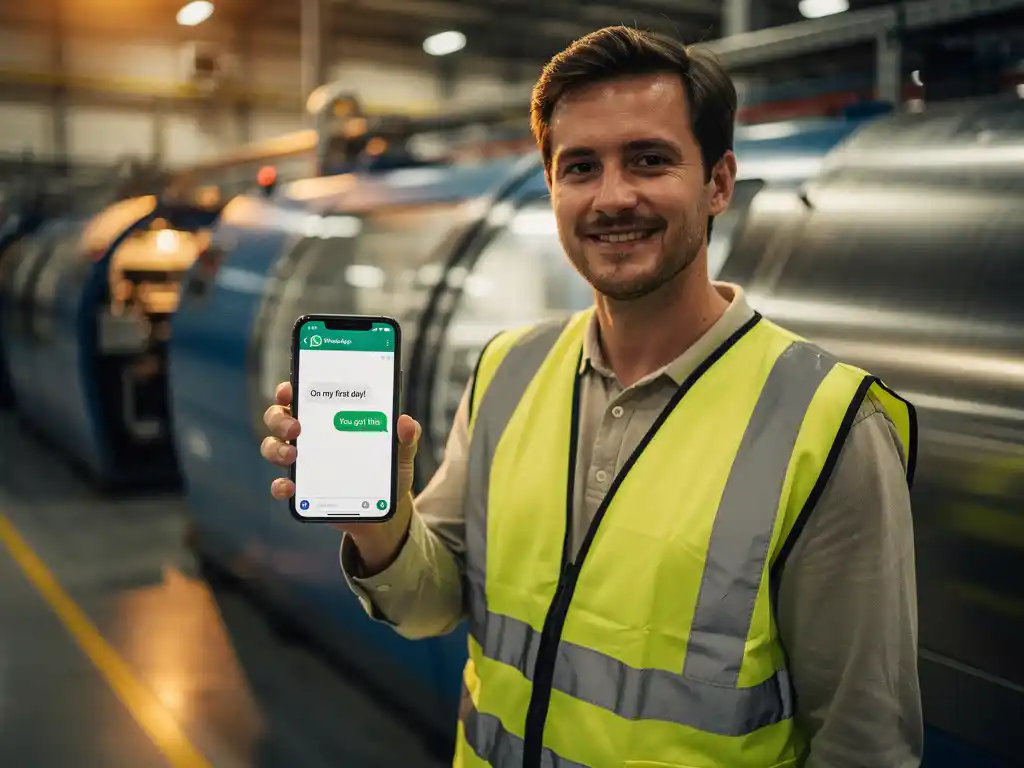
We built E-Lia specifically to solve the challenges that make manufacturing onboarding difficult: the physical environment, the multilingual workforce, the need for fast content creation, and the absence of desks or login screens on the factory floor. Our platform delivers microlearning modules, work instructions, and onboarding content directly via WhatsApp, so workers receive the right information on the device they already use, without downloading an app or remembering a password.
- No login required: Workers access training directly through WhatsApp, removing the biggest barrier to engagement on the factory floor
- Multilingual support: Automatic translations mean every worker receives content in their own language without extra effort from your team
- Fast content creation: Building a module takes an average of 10 to 15 minutes, and workers complete it in 3 to 6 minutes
- Progress tracking: A clear dashboard shows who has completed what, with knowledge check results to confirm understanding
- Scheduled delivery: Modules can be sent immediately or planned in advance, spreading onboarding content across the first few weeks rather than front-loading everything
- Pre-onboarding ready: Send new hires site information, safety expectations, and first-day instructions before they arrive
If you are rethinking your factory onboarding process, we are happy to show you how it works in practice. Book a demo and see how E-Lia fits into your manufacturing environment.
Frequently Asked Questions
What should manufacturers prioritize in the first week of onboarding versus the first month?
The first week should focus exclusively on safety-critical content: hazard awareness, PPE requirements, emergency procedures, and any regulatory certifications required before a worker can be on the floor unsupervised. The first month can then build on that foundation with equipment-specific training, process instructions, and quality standards delivered gradually as workers encounter them in practice. Trying to cover everything in week one overwhelms new hires and leads to poor retention, so sequencing content to match what workers are actually doing on the floor each day produces far better results.
How do we handle onboarding for workers who start on night shifts or rotating schedules?
This is one of the most common onboarding gaps in manufacturing, and the solution is to move away from trainer-dependent, session-based delivery entirely. When onboarding content is available on-demand via a worker’s own device, shift timing becomes irrelevant — a night shift starter can complete the same modules as a day shift hire without needing a trainer physically present. Pairing self-paced digital content with a designated buddy or supervisor on each shift ensures workers still have a go-to person for questions, regardless of when they are working.
What are the most common mistakes manufacturers make when designing their onboarding process?
The most common mistake is front-loading all content into the first one or two days, which overwhelms new hires and results in poor retention by the end of the first week. A close second is relying on paper-based or PDF documents that are difficult to update, easy to lose, and inaccessible on the factory floor. Many manufacturers also underestimate the impact of language barriers, delivering all content in a single language and assuming workers will manage — a gap that directly increases safety risk and slows time to productivity.
How do we keep onboarding content up to date when processes or regulations change?
This is where the format of your content matters enormously. PDFs and printed manuals require a full reprint cycle every time something changes, while modular digital content can be updated in minutes and redelivered to the relevant workers immediately. Best practice is to assign ownership of each module to a specific team lead or process owner who is responsible for flagging when an update is needed. Whenever a process changes on the floor, the corresponding onboarding module should be updated and re-sent to any workers whose role involves that process — not just new starters.
Can onboarding content also be used for retraining or upskilling existing workers?
Absolutely, and many manufacturers find this is where the investment in good onboarding content pays off beyond the hiring cycle. Well-structured microlearning modules built for onboarding can be repurposed directly for refresher training after an incident, process change rollouts, or skills development for workers moving into new roles. The key is building content in a modular format from the start, so individual topics can be extracted and reused without having to rebuild from scratch.
How do we get supervisors and team leads on board with a new onboarding approach?
Supervisor buy-in is critical because they are the ones who determine whether new hires actually complete their training or whether it gets deprioritised in favour of production targets. The most effective approach is to show supervisors how a structured digital onboarding process reduces the number of questions they field from new starters and decreases the error rate in the first few weeks — both of which directly reduce their workload. Giving supervisors visibility into who has completed what, and flagging gaps automatically, also removes the administrative burden of chasing completion manually.
What is a realistic benchmark for measuring onboarding success in a manufacturing setting?
A practical set of benchmarks includes: module completion rates above 90% within the scheduled timeframe, knowledge check scores averaging above 80%, a measurable reduction in near-miss incidents among newly onboarded workers compared to previous cohorts, and a decrease in the number of repeat questions supervisors receive from new starters in their first month. Time-to-competency — meaning how quickly a new worker can operate independently without supervision — is arguably the most meaningful single metric, as it directly reflects whether the onboarding process is translating into real-world capability.