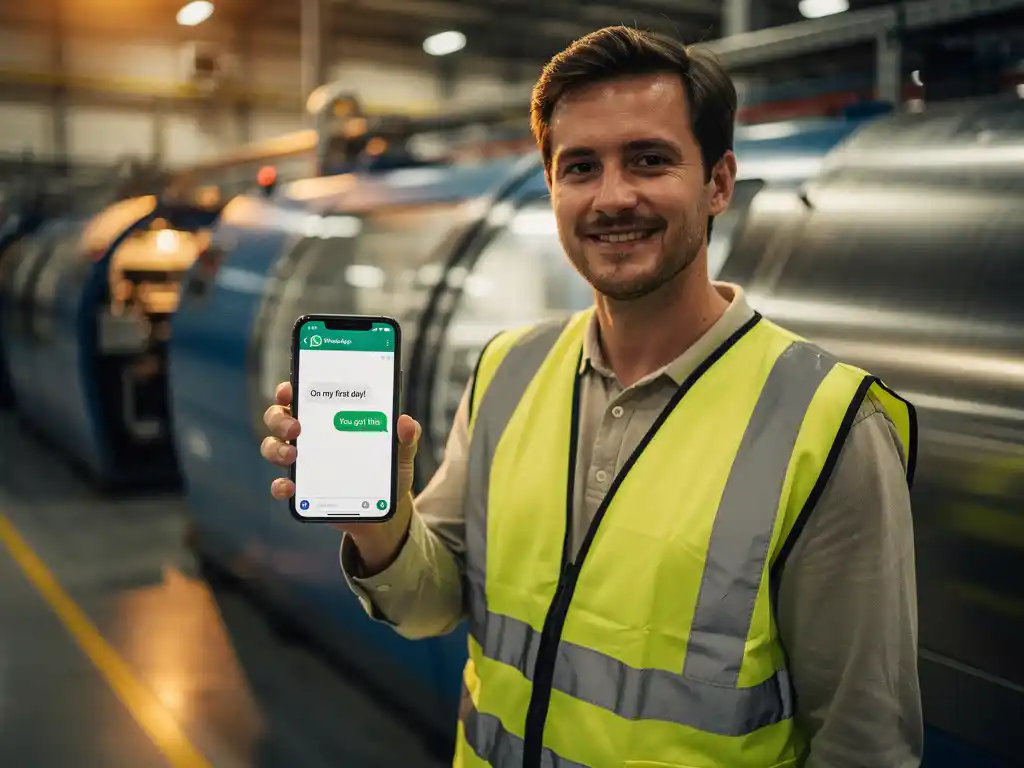


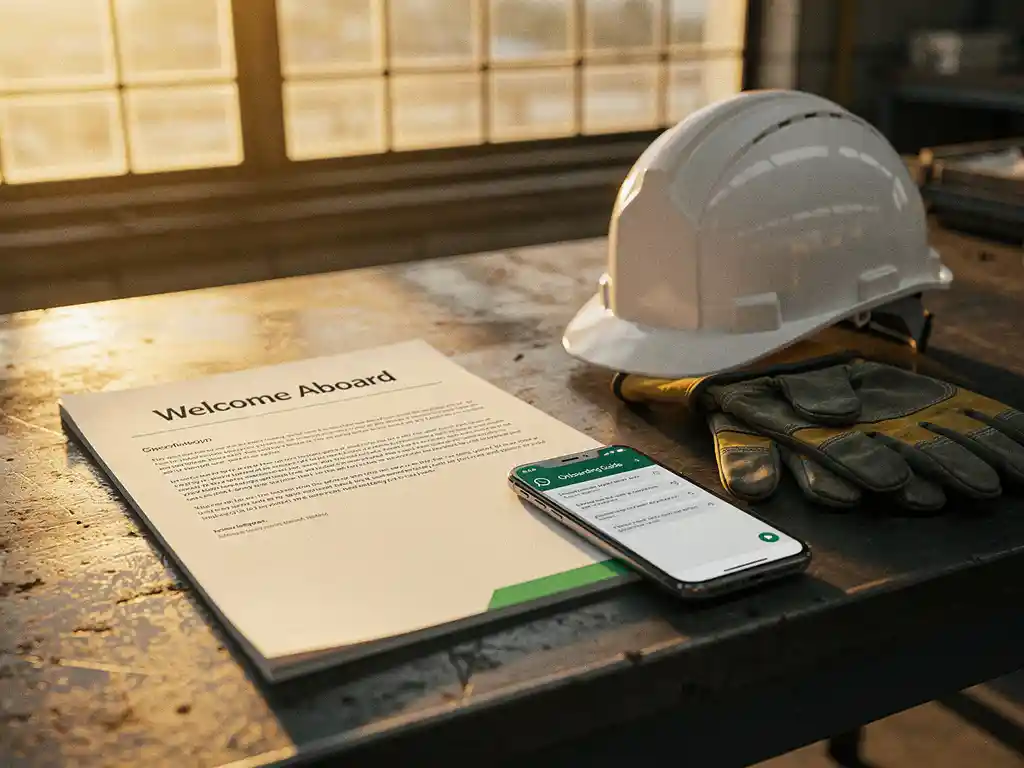
A preboarding email for a new production employee should include a warm welcome, practical first-day logistics, safety expectations, and a brief overview of what the first week looks like. Keep it short, clear, and action-oriented. Production workers rarely sit behind a desk, so the message needs to reach them where they are and give them exactly what they need, nothing more. Below, we break down the most common questions around employee preboarding in manufacturing environments, from timing and tone to channel choice and costly mistakes to avoid. If you want to see how modern tools handle this, get in touch with us for a quick conversation.
What should a preboarding message include for production workers?
A preboarding message for production workers should include a welcome note, first-day reporting instructions, safety requirements, dress code or PPE expectations, and a point of contact for questions. Keep it practical and avoid corporate jargon. Production employees want to know where to go, what to wear, and who to ask if something goes wrong.
Beyond the basics, consider including:
- The exact location, entrance, and parking instructions
- Start time and who to ask for upon arrival
- Any documents or certificates to bring (such as ID or safety training proof)
- A brief description of what the first day will look like
- Contact details for HR or a team lead
Avoid overwhelming new hires with long policy documents at this stage. The goal of a preboarding email is to reduce anxiety and build confidence, not to front-load every rule in the employee handbook. Save the detailed compliance content for onboarding itself.
How is preboarding different from onboarding in manufacturing?
Preboarding happens before the first day and focuses on preparation and connection. Onboarding begins on day one and covers role-specific training, compliance, and integration into the team. In manufacturing, the distinction matters because production workers often have shorter lead times between signing a contract and starting work, which makes early communication even more critical.
Think of preboarding as the bridge between “I accepted the job” and “I know what I am walking into.” It reduces no-shows, lowers first-week anxiety, and sets the tone for how the organisation communicates. Onboarding, by contrast, is where the real skill transfer and process learning happens, including machine operation, quality standards, and team routines.
In a manufacturing context, skipping preboarding entirely and jumping straight into onboarding often leads to confusion on day one. New hires show up without the right clothing, miss safety briefings they were supposed to complete in advance, or simply do not turn up at all because they felt disconnected during the waiting period.
When should a preboarding email be sent to a new hire?
A preboarding email should be sent within 24 to 48 hours of a new hire accepting their offer, with at least one follow-up message three to five days before their start date. For production workers, this timing is especially important because the gap between offer and start date can be short, sometimes just a few days.
A simple two-message structure works well in most manufacturing environments:
- First message (within 48 hours of offer acceptance): Welcome, confirmation of start date and location, and a short overview of what to expect
- Second message (two to three days before start): Practical reminders, first-day checklist, and a contact person for any last-minute questions
If the lead time is longer, such as two weeks or more, consider sending a third touchpoint in the middle. This keeps the new hire engaged and reduces the risk of them accepting another offer in the meantime. Silence between signing and starting is one of the most common drivers of pre-start drop-off in production environments.
What tone and language work best for production employees?
The best tone for a preboarding message aimed at production workers is friendly, direct, and respectful. Avoid formal corporate language or lengthy paragraphs. Short sentences, plain words, and a human voice work far better than polished HR copy. If your workforce includes non-native speakers, clarity becomes even more important.
A few principles to keep in mind:
- Write at a reading level that is easy to scan on a phone
- Use “you” and “we” to make it feel personal, not institutional
- Avoid acronyms or internal jargon the new hire does not know yet
- If your team is multilingual, consider sending the message in the employee’s preferred language
Production workers often receive little communication from employers between hiring and starting. A message that feels warm and human stands out and immediately signals that this is an organisation that respects its people. That first impression carries weight well beyond the preboarding phase.
Can WhatsApp replace email for preboarding production staff?
Yes, WhatsApp is often a more effective channel than email for production worker onboarding and preboarding. Most production employees check WhatsApp far more frequently than a personal or work email account. Messages arrive instantly, read rates are significantly higher, and the format naturally fits shorter, more conversational content.
For organisations with a deskless or shift-based workforce, email can feel like a mismatch. A new hire who works rotating shifts is unlikely to check a corporate inbox before their first day. WhatsApp, on the other hand, lives on the phone they already use throughout the day.
WhatsApp onboarding also opens the door to richer preboarding experiences. Instead of a plain text email, you can send short video clips of the workplace, quick safety reminders formatted as toolbox talks, or a simple checklist the new hire can tick off before arrival. This kind of bite-sized, mobile-first communication aligns naturally with how production workers consume information outside of work.
That said, WhatsApp should complement rather than replace formal documentation where legal or compliance requirements demand a paper trail. For the relational, practical, and welcoming side of preboarding, it is often the better tool.
What are common preboarding mistakes that increase early turnover?
The most common preboarding mistakes that drive early turnover are sending no communication at all, overwhelming new hires with paperwork, using language that feels cold or bureaucratic, and failing to provide clear first-day logistics. In manufacturing, these mistakes are especially costly because the labour market is competitive and new hires have options.
Watch out for these specific pitfalls:
- Radio silence after the offer: If a new hire hears nothing between signing and starting, they may assume the offer is uncertain or that the culture is indifferent
- Sending a policy document dump: Attaching a 40-page employee handbook to a preboarding email signals poor communication design and rarely gets read
- Generic, impersonal messages: A copy-paste welcome email with no personalisation makes new hires feel like a number, not a person
- Missing practical details: Forgetting to mention where to park, what to wear, or who to ask for creates unnecessary stress on day one
- No follow-up before the start date: A single email sent weeks in advance is not enough, especially if the start date is still far away
Each of these mistakes sends an unintended signal to the new hire: that the organisation is disorganised, indifferent, or difficult to work with. Fixing them does not require a large investment, just a thoughtful, structured approach to pre-start communication.
How E-Lia helps with preboarding production employees
We built E-Lia specifically for organisations where traditional training tools do not fit. For production teams, that means microlearning onboarding delivered via WhatsApp, with no app to download, no login required, and no need for a desktop computer. A new production employee can receive a structured preboarding sequence on their own phone, in their own language, before they ever set foot on the floor.
Here is what that looks like in practice:
- Build a preboarding module in 10 to 15 minutes using our intuitive editor
- Schedule messages to send automatically at the right moment before the start date
- Include safety reminders, first-day logistics, and a welcome video in one clean WhatsApp flow
- Support multilingual teams with automatic translation into the employee’s preferred language
- Track who has completed the preboarding sequence via a simple dashboard
The result is a consistent, professional, and genuinely welcoming preboarding experience that reduces no-shows, improves day-one readiness, and sets the right tone from the start. Want to see it in action? Plan a demo and we will show you exactly how it works for production environments like yours.
Frequently Asked Questions
How do I get started with preboarding if we currently have no process in place?
Start simple: draft a two-message sequence, one sent within 48 hours of offer acceptance and one sent two to three days before the start date. Focus the first message on a warm welcome and start date confirmation, and the second on practical first-day logistics. You do not need a dedicated platform to begin — even a well-written WhatsApp message or email template is a significant improvement over silence. Once you have a basic flow working, you can gradually add elements like safety reminders, welcome videos, or multilingual support.
What if a new production hire does not have a work email address yet?
This is extremely common in manufacturing environments, and it is one of the strongest reasons to use WhatsApp or SMS as your primary preboarding channel. Most production workers already have a personal phone number you collected during the hiring process, which means you can reach them immediately without waiting for IT to set up a company account. If you do use email, make sure you are sending to their personal address, not a work inbox they cannot yet access.
How do we handle preboarding for workers who speak different languages?
The most practical approach is to send preboarding messages in the employee’s preferred language from the very first touchpoint. If you are managing this manually, maintain template versions in your most common languages and select the appropriate one at the time of hire. Platforms like E-Lia handle this automatically by detecting language preference and delivering content accordingly. Even a simple translated welcome message signals respect and dramatically improves comprehension and engagement before day one.
Is there a risk of sharing too much information during preboarding?
Yes, and it is one of the most common mistakes organisations make. Preboarding should focus exclusively on what the new hire needs to feel prepared and confident before their first day — not on policies, procedures, or compliance content that belongs in formal onboarding. If you find yourself attaching handbooks, contract addendums, or lengthy process documents to a preboarding message, that is a sign the content belongs elsewhere. A good rule of thumb: if it does not help the employee show up on day one feeling ready and welcomed, save it for later.
How do we measure whether our preboarding process is actually working?
The most direct indicators are pre-start drop-off rate (how many new hires fail to show up on day one), day-one no-show rates, and early turnover figures within the first 30 to 90 days. If you are using a digital tool, you can also track message open rates and preboarding completion rates to see how engaged new hires are before they start. Qualitative feedback from new hires during their first week — simply asking what they knew and what surprised them — is also a fast and low-cost way to identify gaps in your current process.
Can preboarding really reduce no-shows in production environments?
Yes, and the impact is often more significant than organisations expect. No-shows in production are frequently driven not by a change of heart about the job, but by anxiety, unclear logistics, or a competing offer accepted during a period of silence. A structured preboarding sequence that keeps new hires informed, engaged, and connected to the organisation directly addresses all three of those drivers. Even a single well-timed, warm, and practical message in the days before the start date can meaningfully reduce pre-start drop-off.
What is the difference between preboarding and a standard offer confirmation email?
An offer confirmation email is a transactional document — it confirms the terms of employment and is primarily a legal or administrative record. Preboarding is a deliberate communication strategy designed to make the new hire feel welcomed, informed, and prepared before they start. The two can overlap, but they serve different purposes. A strong preboarding approach goes beyond confirming the offer and actively builds the new hire’s connection to the team, reduces uncertainty about day one, and sets the tone for how the organisation communicates with its people.