Turning inspection results into concrete improvement actions requires converting every finding directly into a specific action with an owner, a deadline, and a measurable outcome. Without that structure, findings remain stuck in reports that nobody reads. In this article, we answer the most frequently asked questions about how to effectively organise the process from inspection to improvement.
Why are inspection results rarely converted into action?
Inspection results often go unaddressed because the step from finding to action has not been made concrete enough. A finding without an owner, without a deadline, and without a clear expected outcome is not an action — it is a wish. That is the core of the problem: the inspection itself is completed, but the improvement process that follows is never organised.
A number of practical obstacles also play a role:
- Paper or separate digital records that are never consulted after the inspection
- Unclear responsibilities meaning nobody feels ownership of a finding
- No prioritisation, making everything seem equally urgent so that nothing gets addressed in the end
- Lack of follow-up because there is no system for tracking progress
- Employees who are not involved in the outcomes of an inspection at their own workplace
The result is that the same findings resurface at the next inspection. This undermines confidence in the inspection process and makes it harder to build a safety culture in which improvement is genuinely central.
How do you convert an inspection result into a concrete improvement action?
You convert an inspection result into a concrete improvement action by translating every finding into an action that meets four criteria: what exactly needs to happen, who is responsible for it, when it must be completed, and how you will know the action has succeeded. Without all four elements, the action is not workable.
In practice, work this out as follows:
- Describe the finding concretely. Not “workplace untidy” but “walkway at machine A blocked by pallets, resulting in insufficient emergency exit width.”
- Formulate the action specifically. Not “tidy up” but “move pallets to storage zone B and keep walkway clear.”
- Assign an owner. One person, not a department or a team.
- Set a realistic deadline. Based on the severity of the finding and the resources required.
- Define the desired outcome. What will someone checking the action see as evidence that it is complete?
This sounds straightforward, but in practice many organisations skip steps 1 and 5. A vaguely formulated finding always leads to a vague action. And without a clear outcome criterion, nobody knows when the action can be considered complete.
How do you prioritise which findings are addressed first?
You prioritise inspection findings based on two factors: the severity of the risk and the feasibility of the solution. Findings that pose a direct safety risk to employees always take priority, regardless of how complex or costly the solution may be.
A widely used approach is to work with three categories:
- Address immediately: findings that pose an acute risk to the safety or health of employees. Think of blocked emergency exits, defective protective equipment, or hazardous situations that could directly lead to injury.
- Short term: findings that pose an elevated risk but are not immediately dangerous. A clear deadline within an agreed period applies here.
- Longer term: improvement points that are structural in nature and require a change to work processes, infrastructure, or policy.
In addition to severity, the origin of the finding also plays a role. A finding that has been identified previously but not resolved deserves a higher priority than a new finding of comparable severity. Recurrence is a signal that the cause has not been addressed — only the symptom.
Who is responsible for following up on inspection results?
Responsibility for following up on inspection results lies with the line manager of the relevant work area, not with the inspector or the safety coordinator. The inspector identifies and records. The line manager ensures that something is done with the findings.
This does not mean the line manager carries out everything personally. Execution can be delegated to an employee or a team. But ultimate responsibility for completing improvement actions on time lies with the person who manages the work area.
In practice, it is useful to clearly separate roles:
- The inspector records findings and formulates recommendations
- The line manager assesses, prioritises, and assigns owners
- The action owner carries out the improvement measure and reports back
- The safety coordinator or manager monitors the overall picture and identifies patterns
A common mistake is for the safety coordinator to take on follow-up for the entire organisation. This does not scale and causes line managers to feel that safety is “something for the safety department” rather than a shared responsibility on the shop floor.
How do you track the progress of improvement actions?
You track the progress of improvement actions by maintaining a central overview in which the status, owner, and deadline for each action are visible. That overview must be accessible to everyone involved in the follow-up and must be discussed regularly in team meetings or safety reviews.
Effective follow-up requires a few concrete habits:
- Set fixed moments at which outstanding actions are reviewed, for example weekly or fortnightly
- Make the status visible to the employees involved, not just to managers
- Send a timely reminder to action owners before a deadline passes
- Record when an action has been completed and by whom this has been confirmed
- Close the cycle by checking after completion whether the measure has had the desired effect
Paper lists and separate spreadsheets make this difficult, particularly in organisations with multiple locations or shift patterns. Digital workplace inspections for better follow-up make it easier to maintain an up-to-date overview and to intervene in good time when actions are at risk of being left unaddressed.
How do you prevent the same findings from recurring?
The same findings recur when you address the symptoms but not the cause. To prevent recurrence, after every improvement action you must ask: why did this situation arise, and what will prevent it from arising again?
This requires a brief root cause analysis for recurring or serious findings. Not every finding requires an extensive investigation, but the question “how did this come about?” must always be asked. Possible causes include:
- Missing or unclear work instructions
- Employees who do not know what is expected of them
- Work processes that structurally make the desired situation difficult to achieve
- Insufficient resources or materials to carry out the work safely
- Lack of feedback to employees about inspection results
A second way to prevent recurrence is to share findings and improvement actions with the shift or team working at the relevant workplace. Employees who understand why a measure has been taken are more likely to comply with it. Communication about inspection results is therefore not merely an administrative step, but part of the learning process on the shop floor.
How E-lia helps with following up on workplace inspections
We see in many organisations that it is not the inspection itself that fails, but the follow-up afterwards. Paper forms go missing, Excel lists are not kept up to date, and employees on the shop floor never hear what has been done with their report. Our workplace inspections via WhatsApp address that problem directly:
- Digital registration directly at the workplace, without an app or login procedure
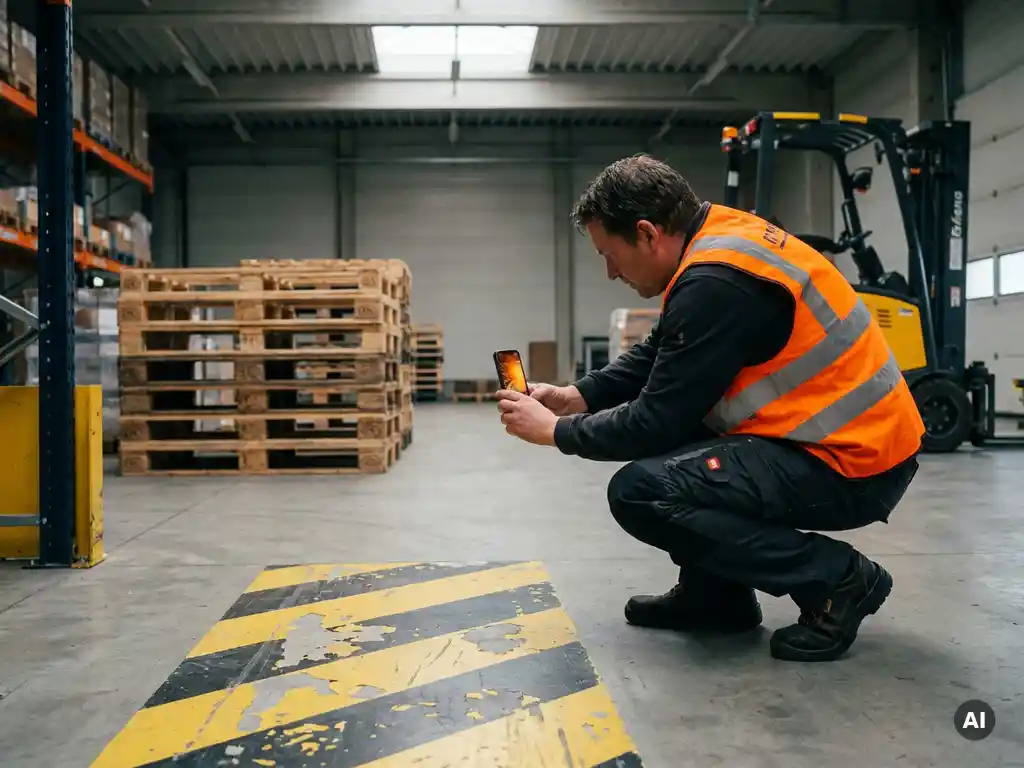
- Findings are recorded immediately with a timestamp and photographs
- Improvement actions are immediately visible in a central dashboard for line managers
- Employees receive feedback via WhatsApp, the channel they already use every day
- AI translations in more than 50 languages so that employees who speak other languages can also understand instructions
- Existing checklists are digitalised on a one-to-one basis, so you can continue using familiar processes
Would you like to see how this works for your organisation? Get in touch with us and discover how to structurally convert inspection results into concrete improvements on the shop floor.