

Paper workplace inspections are no longer sufficient because they create delays, introduce human error, and make it nearly impossible to track follow-up actions reliably. In fast-moving work environments, a checklist completed on paper today may not reach the right person until tomorrow, by which time a safety risk may already have caused harm. The questions below unpack exactly where paper-based systems break down and what a modern alternative looks like in practice. If you want to explore how digital tools can transform your inspection process, feel free to plan a demo with us.
What are the biggest limitations of paper-based workplace inspections?
The biggest limitations of paper-based workplace inspections are data loss, slow information flow, and the inability to act on findings in real time. Paper forms can be misplaced, damaged, or left incomplete. Because they require manual processing, critical safety information often sits in a filing cabinet rather than reaching the people who need it.
Beyond the physical risks of losing a document, paper inspections create a fragmented picture of workplace safety. Each completed form is an isolated record. Without a centralised system, it is difficult to identify recurring problems, spot trends across multiple sites, or demonstrate consistent compliance over time. Managers who rely on paper often spend more time chasing completed forms than acting on what those forms reveal.
There is also the issue of legibility and standardisation. When inspectors fill in handwritten forms, answers vary in detail and interpretation. One inspector may flag a hazard as minor whilst another would classify the same issue as urgent. Without a structured, standardised format enforced by software, the quality of inspection data is inconsistent and hard to compare.
How do paper inspections create compliance and liability risks?
Paper inspections create compliance and liability risks because they offer no reliable audit trail, no timestamp verification, and no guarantee that corrective actions were completed. In the event of a workplace incident, organisations need to demonstrate that inspections were carried out correctly and that identified risks were addressed. Paper records make this extremely difficult to prove.
Regulatory frameworks in sectors such as healthcare, logistics, and manufacturing require organisations to maintain documented evidence of safety compliance. When inspections are recorded on paper, version control becomes a problem. Outdated checklists may still be in circulation, meaning inspectors are checking against criteria that no longer reflect current regulations or internal standards.
Liability exposure increases significantly when records are incomplete or when there is no clear chain of accountability. If a paper form shows a hazard was identified but there is no corresponding record of remediation, an organisation cannot demonstrate due diligence. Digital inspection systems address this directly by automatically logging who completed an inspection, when it was completed, and what actions were taken afterwards. Learn more about how digital workplace inspections can strengthen your compliance process.
Why do paper inspections fail in multilingual or distributed workplaces?
Paper inspections fail in multilingual or distributed workplaces because a single fixed-language form excludes employees who are not fluent in that language, and physical documents cannot be updated or redistributed across multiple locations simultaneously. Both problems introduce errors, inconsistency, and safety gaps that are entirely avoidable.
In workplaces where employees speak different languages, a paper checklist written in only one language creates an immediate barrier. Inspectors may misinterpret questions, skip items they do not understand, or complete forms incorrectly. This is not a minor inconvenience. In safety-critical environments, a misunderstood inspection criterion can lead to a missed hazard and a serious incident.
For organisations operating across multiple sites, the logistics of paper inspections are simply unworkable at scale. Distributing updated forms, collecting completed ones, and consolidating findings across locations requires significant administrative effort. There is no efficient way to compare results between sites or ensure that all locations are using the same version of a checklist at the same time.
What does a digital workplace inspection system actually look like?
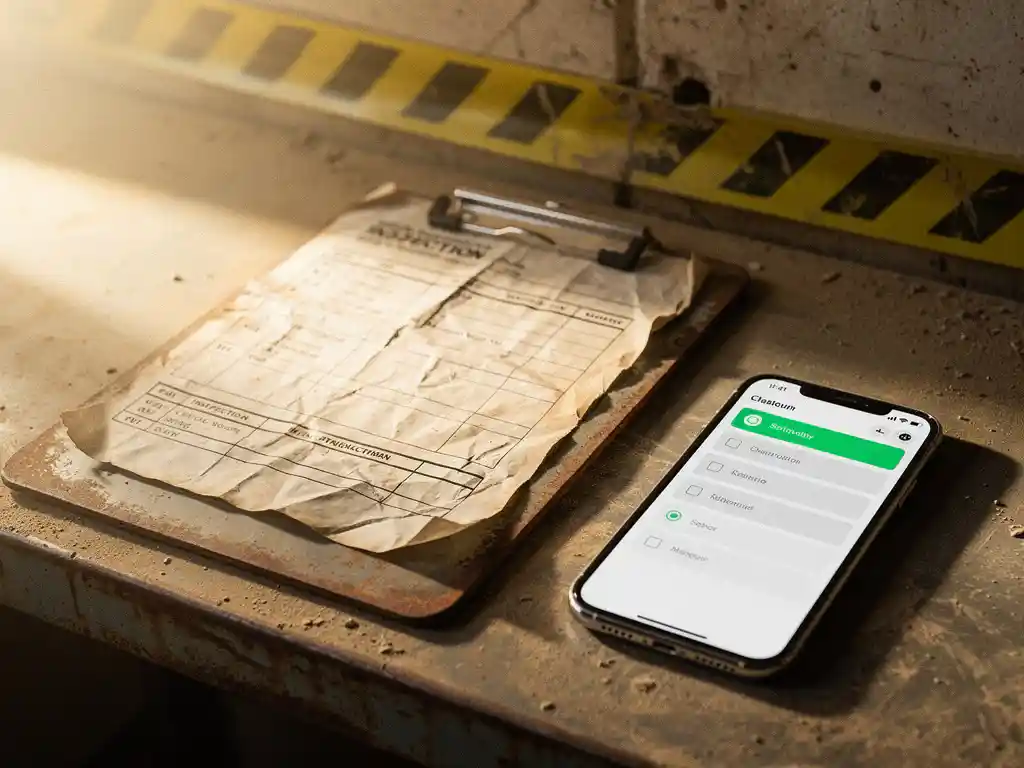
A digital workplace inspection system is a software-based platform that replaces paper checklists with structured digital forms, accessible on a smartphone or tablet, that automatically record, timestamp, and route inspection data to the right people in real time. The best systems require no specialist hardware and integrate with existing workflows.
In practice, an inspector opens the relevant checklist on their device, works through standardised questions, and submits the completed form digitally. The system immediately logs the response, flags any items that require follow-up, and notifies the appropriate manager or safety officer. No paper changes hands, no data entry is required after the fact, and nothing gets lost in transit.
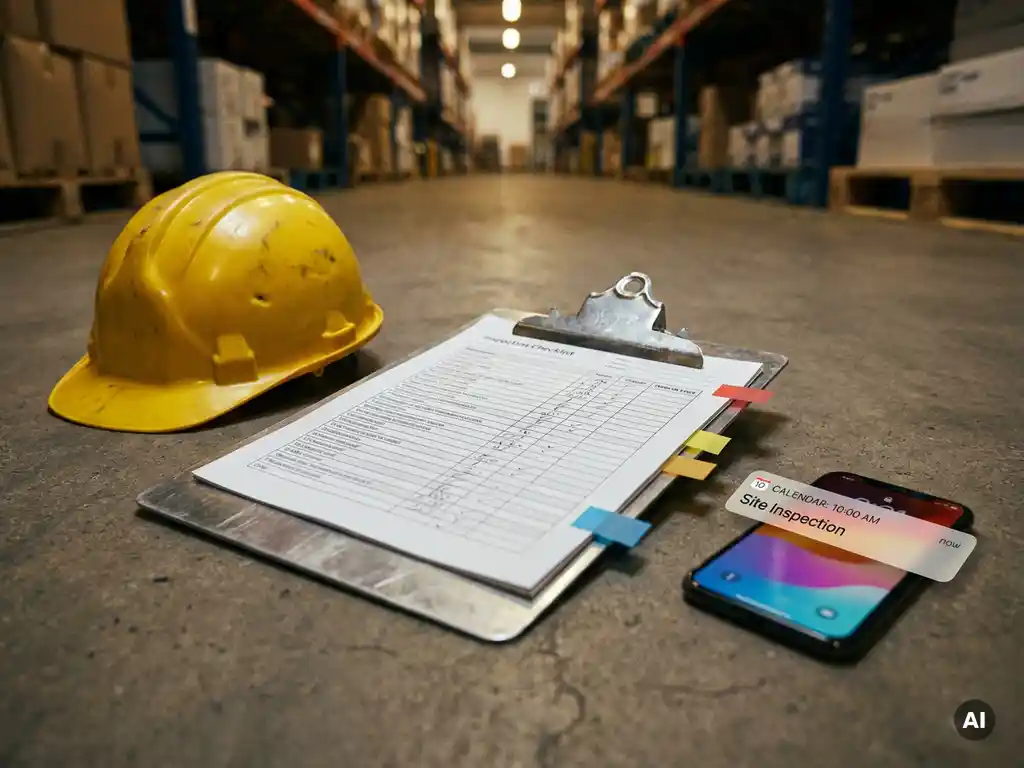
More advanced digital inspection platforms offer features such as photo attachments to document hazards visually, automatic language switching so inspectors can complete forms in their preferred language, and dashboard reporting that aggregates results across teams, shifts, or locations. Some platforms also support scheduled inspections, sending reminders to ensure inspections happen on time rather than relying on manual coordination. Explore how E-Lia’s workplace inspection tools bring these features together in a single accessible platform.
How do digital inspections improve follow-up and corrective actions?
Digital inspections improve follow-up and corrective actions by automatically creating tasks, assigning responsibility, and tracking resolution from the moment a hazard is identified. Unlike paper, where a flagged issue depends on someone manually reading the form and deciding what to do next, a digital system can trigger the entire corrective action workflow without any manual handover.
When an inspector flags a problem in a digital system, the platform can immediately assign a corrective action to a named individual, set a deadline, and send a notification. The person responsible receives a clear task with context, including any photos or notes attached during the inspection. Progress is tracked automatically, and managers can see at a glance which issues are resolved and which are overdue.
This closed-loop approach is what makes digital inspection management genuinely more effective than paper, not just more convenient. Organisations can demonstrate that every identified risk was acted upon, with a full record of who did what and when. Over time, this data also reveals patterns, such as recurring hazards in a specific area or consistent gaps in a particular team’s inspection results, that would be invisible in a stack of paper forms. Combining inspections with structured toolbox talks is an effective way to address those recurring patterns directly with your teams.
When should an organisation switch from paper to digital inspections?
An organisation should switch from paper to digital workplace inspections when the cost and risk of maintaining paper records outweigh the effort of transitioning to a digital system. For most organisations, that point arrives well before they expect it. Common triggers include a failed audit, a near-miss incident linked to a missed inspection, or rapid growth that makes manual record-keeping unmanageable.
Some practical signals that the time to switch has arrived include:
- Inspections are being completed inconsistently or not at all because the process is too cumbersome
- Managers cannot quickly retrieve inspection records when needed for audits or incident reviews
- Follow-up actions from inspections are frequently missed or untracked
- The workforce is multilingual and paper forms are not accessible to all employees
- The organisation operates across multiple sites and cannot maintain consistent standards using paper
- Regulatory requirements are becoming more stringent and paper records no longer provide sufficient evidence of compliance
The good news is that switching does not need to be disruptive. Modern digital inspection tools are designed for fast adoption, with intuitive interfaces that require minimal training. The transition can often begin with a single team or site and expand gradually, reducing the risk of a large-scale rollout. Pairing the rollout with a structured onboarding programme ensures every employee is confident using the new system from day one.
How E-Lia helps with digital workplace inspections
We built E-Lia specifically to make knowledge sharing, training, and structured communication accessible to every employee, including those on the shop floor, in a care facility, or working a warehouse shift without access to a computer. Our platform delivers content via WhatsApp, which means no app to download, no login to remember, and no barrier to adoption.
When it comes to workplace inspections and safety processes, E-Lia supports organisations in several concrete ways:
- Digital checklists and microlearning modules delivered directly via WhatsApp, so inspectors and employees receive the right information at the right moment
- Automatic language switching so every employee can engage with inspection protocols and safety instructions in their own language
- Fast module creation averaging 10 to 15 minutes per module, so updated inspection criteria can be deployed immediately when standards change
- Progress tracking via dashboard so managers can see who has completed which modules or checklists, and where follow-up is needed
- Scheduled and instant distribution so inspection reminders and updated protocols reach the right people at the right time, without manual coordination
Our platform also supports knowledge retention over time, ensuring that safety standards and inspection criteria stay embedded in your team’s day-to-day work rather than being forgotten after a single training session. For organisations in food production or hospitality, E-Lia also offers dedicated HACCP training and digital work instructions to complement your inspection processes. Organisations such as Erasmus MC and ETZ already use our platform to standardise processes and improve knowledge retention across their teams. If you are ready to move beyond paper and build a more reliable inspection process, plan a demo and we will show you exactly how E-Lia works in practice.
Frequently Asked Questions
How long does it typically take to fully transition from paper to digital inspections?
For most organisations, a phased transition can begin within days of adopting a digital inspection platform. Starting with a single team or site, inspectors can often be up and running within a week, with a full rollout completed over a few months depending on the size of the organisation. Modern platforms like E-Lia are designed for fast adoption, with intuitive interfaces that require minimal training, so the disruption is far less significant than most organisations anticipate.
What happens to our historical paper inspection records when we switch to a digital system?
Your existing paper records do not need to be discarded or digitised all at once. Most organisations maintain their historical paper records in physical storage for the required legal retention period while beginning to generate new records digitally from the transition date onwards. Over time, your digital system will build a comprehensive, searchable history that makes your paper archive largely redundant for day-to-day compliance purposes.
Can digital inspection tools work in environments with limited or no internet connectivity?
Many modern digital inspection platforms are designed to handle low-connectivity environments, either through offline modes that sync data once a connection is restored or by using widely available channels like WhatsApp, which functions reliably on basic mobile data. It is worth confirming connectivity requirements with your platform provider before rollout, particularly if inspections take place in basements, cold storage areas, or remote outdoor locations where signal can be unreliable.
How do we ensure inspectors actually complete digital inspections on time rather than skipping them?
Digital inspection systems address this directly through automated scheduling and reminders, which are sent directly to the inspector’s device at the designated time, removing the reliance on manual coordination or memory. Managers can monitor completion rates in real time via a dashboard, making it immediately visible when an inspection has been missed rather than discovering the gap days later during a manual review. This accountability layer is one of the most significant practical advantages digital tools have over paper-based processes.
What should we look for when evaluating different digital inspection platforms?
The most important factors to evaluate are ease of adoption for frontline workers, language support if your workforce is multilingual, the quality of corrective action tracking, and how quickly new or updated checklists can be created and deployed. Integration with existing tools and the accessibility of the platform on devices your team already uses are also critical, since a solution that requires a dedicated app or new hardware will face much higher resistance from staff. Asking for a live demo with your own use case scenarios is the most reliable way to assess whether a platform genuinely fits your operational reality.
Is a digital inspection system suitable for small organisations, or is it only cost-effective at scale?
Digital inspection tools are increasingly accessible and cost-effective for organisations of all sizes, including small teams with a handful of inspectors. The return on investment is not purely about volume; even a small organisation benefits from reduced administrative burden, a reliable audit trail, and faster corrective action response times. Many platforms offer flexible pricing that scales with the number of users, making it straightforward to start small and grow as your needs evolve.
How do digital inspections support regulatory compliance in highly regulated industries like healthcare or manufacturing?
Digital inspection platforms create an automatic, tamper-evident audit trail that records exactly who completed each inspection, at what time, and what actions were taken in response to any findings, which is precisely what regulators in sectors like healthcare and manufacturing require as evidence of due diligence. Because checklists are centrally managed, you can ensure that all inspectors are always working from the most current, regulation-aligned version of a form, eliminating the risk of outdated paper templates remaining in circulation. This makes preparing for audits significantly faster and reduces the likelihood of compliance gaps that could result in fines or liability exposure.