


Temporary workers must receive safety information before they start work. This applies to agency workers, seasonal workers and self-employed contractors who are active at your organisation for a short period. The challenge lies in speed and documentation: how do you ensure that someone starting tomorrow has already received and understood the right instructions today? This article answers the most frequently asked questions about safety onboarding for temporary staff.
What safety information are temporary workers required to receive?
Temporary workers are entitled to the same safety information as permanent employees. Employers are obliged to inform workers about the risks associated with their work and the measures taken to address those risks. This applies regardless of the type of contract or the duration of the employment.
In practice, the following topics are typically covered for temporary staff:
- The risks associated with the specific workplace and work activities
- The correct use of personal protective equipment (PPE)
- Emergency procedures, evacuation routes and first aid information
- Hazardous substances present in the workplace
- Specific work instructions applicable to the role
- Reporting procedures for incidents or near-misses
Do you work in a sector where VCA is relevant, such as construction or industry? If so, additional requirements may apply under the certification scheme. VCA is not a law in itself, but clients often require the certificate contractually. The safety instruction you provide to temporary staff then forms part of your organisation’s broader VCA approach.
Important: the content of the safety information must correspond to the actual risks of the workplace. A generic instruction that does not address the specific situation does not fulfil the purpose of the duty to inform.
Why is safety onboarding for temporary staff so challenging?
Safety onboarding for temporary staff is challenging because the available time is short, the workforce is constantly changing and the administrative pressure is high. Whereas permanent employees go through an extensive induction process, temporary staff often need to be operational within a day or even a few hours.
A number of practical obstacles add to this:
- No business email address or laptop: Many temporary workers in construction, logistics or manufacturing do not have access to company systems. Traditional e-learning or intranet solutions simply do not reach them.
- Language barriers: Temporary staff are often international. Safety instructions provided only in Dutch do not reach all workers effectively.
- High turnover: New faces every week means the onboarding process has to be restarted repeatedly, which places significant demands on managers.
- Paper-based processes: Signature sheets get lost, are difficult to retrieve and provide no insight into whether someone has actually understood the information.
- Responsibility ambiguity: With agency workers, it is not always immediately clear who is responsible for the safety instruction: the agency or the hiring organisation.
The result is that safety onboarding for temporary staff often takes place too late, too superficially or without adequate documentation. This is a risk for the worker and for the organisation.
How quickly must a temporary worker receive safety instructions?
A temporary worker must receive safety instructions before starting work. Employers are required to inform workers about the risks associated with their work. This means that the instruction cannot wait until the end of the first working day.
In practice, it is advisable to send safety information in the period between hiring the worker and the first working day. This is also known as pre-onboarding. This way, someone does not arrive at the workplace without any prior knowledge, but has already been introduced to the basic rules, the layout of the workplace and the emergency procedures.
For higher-risk activities, such as working at height, with hazardous substances or with heavy machinery, it is even more important that the instruction takes place before the worker carries out those activities. Do not wait for a quiet moment — ensure that safety information is a standard part of the hiring process.
The faster and more straightforward you make this process, the greater the likelihood that it will actually happen consistently, even for short assignments or peak periods.
Which methods work best for safety training of temporary staff?
The methods that work best for safety training of temporary staff are short, accessible and digital. Temporary staff have little time for extensive training and often do not have access to company systems. The training must reach them through channels they already use.
Microlearning via smartphone
Short modules of a few minutes, delivered via smartphone, fit well with the reality of the workplace. Workers can complete the instruction at a time that suits them, even before the first working day. Knowledge checks at the end of a module provide insight into whether the information has been understood, not just whether the module has been opened.
Toolbox talks as a recurring form of instruction
Toolbox talks are short, structured safety discussions focused on a specific topic, such as the use of PPE, working with hazardous substances or reporting incidents. For temporary staff, toolbox talks are useful for targeted safety instructions because they can be organised quickly and connect directly to current work activities. Digital toolbox talks offer an additional advantage: workers receive the content directly on their phone, without needing to be present at a fixed location or time.
Instructions in the worker’s own language
Safety information only works if workers understand it. For international or non-native-speaking workers, providing instructions in their own language is not a luxury but a necessity. Automatic translation makes it possible to offer the same module in dozens of languages, without having to create separate content for each language.
How do you demonstrate that temporary workers have received safety information?
You can demonstrate that temporary workers have received safety information by using digital registration. This records who received which instruction, when it was received and whether the worker completed the associated knowledge check.
Paper signature sheets are the traditional method, but have clear drawbacks: they get lost, are difficult to search and provide no insight into whether someone has actually read or understood the information. A signature proves attendance, not comprehension.
Digital registration offers more possibilities:
- Automatic recording of who received and opened the instruction
- Knowledge check results per worker
- An overview by date, location or group of workers
- Easy to retrieve during internal audits or inspections
Good digital record-keeping can support the process of demonstrating safety activities. It does not replace the substantive responsibility of the employer, but it does make it easier to show that instructions were provided and that workers actively engaged with them.
What are common mistakes when informing temporary staff about safety?
The most common mistakes when informing temporary staff about safety are starting too late, using generic instructions and failing to record who received what. These mistakes are understandable given the time pressure, but they increase the likelihood of incidents and make it difficult to demonstrate responsibility.
Here are the mistakes that occur most frequently:
- Waiting until the first working day: Safety instructions given only once someone has arrived at the workplace come too late. Particularly for short assignments, there is then barely enough time for a proper instruction.
- The same instruction for everyone: A general safety presentation that does not address the specific risks of the role or workplace has little effect. Tailor the content to the work activities.
- No check on comprehension: Providing information is not the same as ensuring someone understands it. Without a knowledge check or follow-up, you do not know whether the instruction has been taken on board.
- No records kept: Explaining something verbally without documentation makes it impossible to demonstrate afterwards that the instruction took place.
- Language as a blind spot: Instructions provided only in Dutch do not reach non-native-speaking workers effectively. This is a common issue with international temporary staff.
- Lack of clarity about responsibility: With agency workers, it is not always clear who provides the safety instruction. Establish this in advance in the agreements with the agency.
How we support safety onboarding for temporary staff
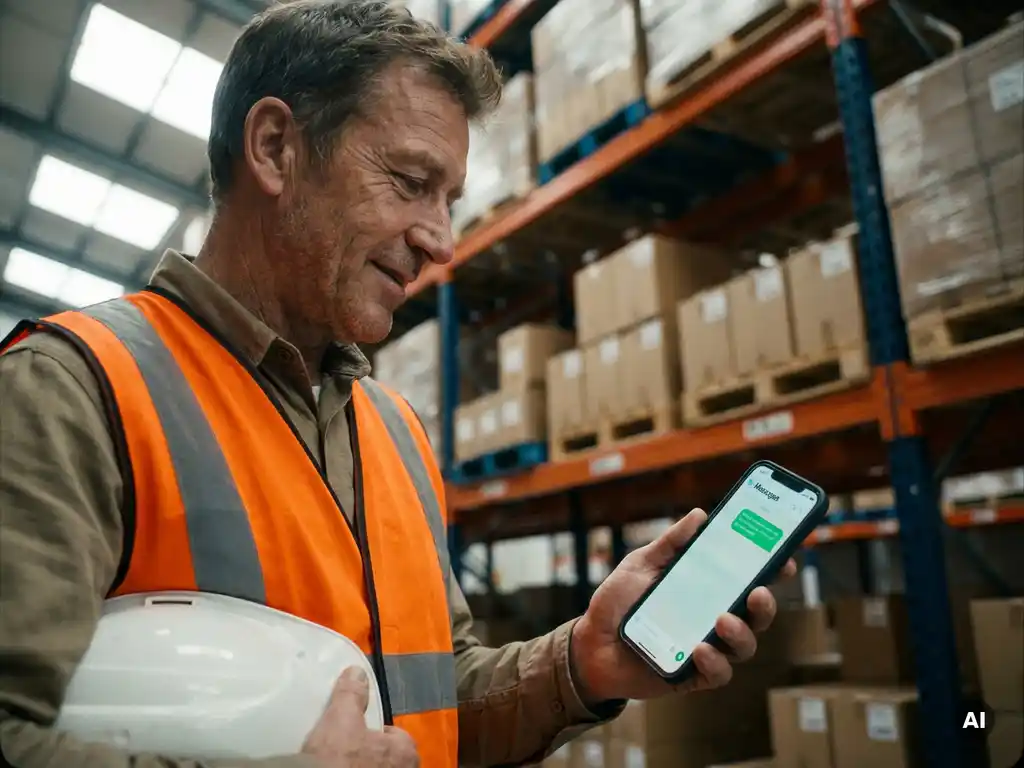
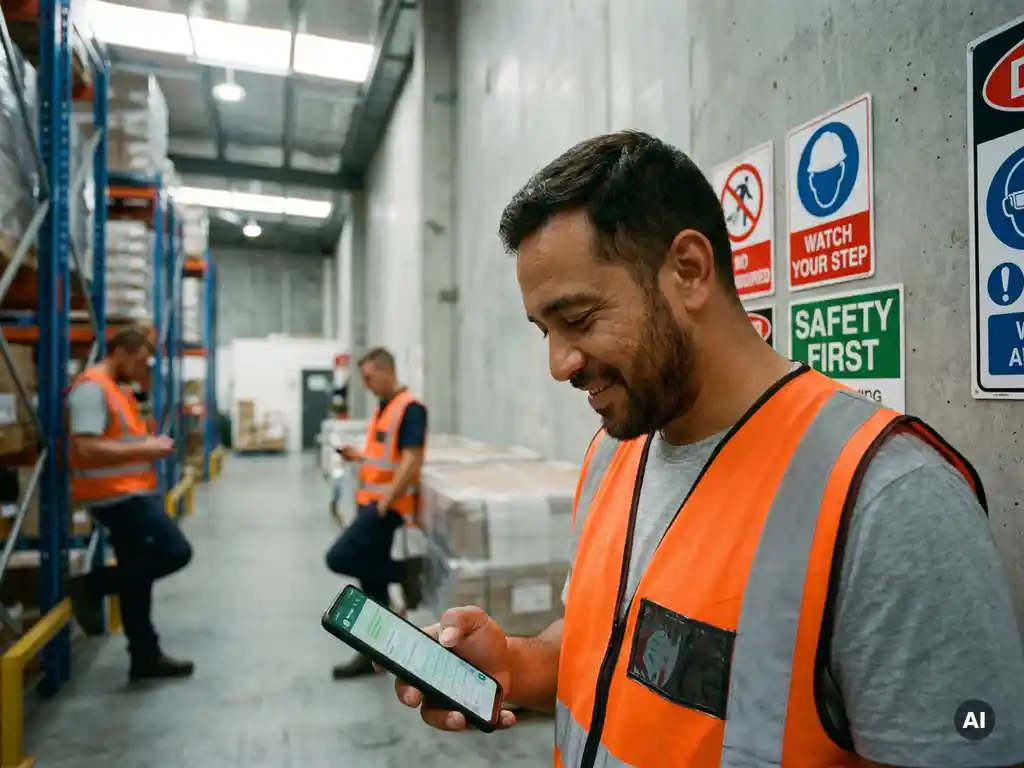
We developed E-lia specifically for organisations that want to inform workers on the shop floor quickly and demonstrably — even when those workers do not have a business email address or laptop. Via WhatsApp, temporary workers receive safety instructions, work instructions and toolbox talks directly on their phone, without needing to download an additional app or create an account.
Here is what you can do with E-lia for temporary staff:
- Send safety instructions during the pre-onboarding phase, before the first working day
- Offer digital toolbox talks as short, practice-oriented modules with knowledge checks
- Automatically translate instructions into more than 50 languages, so that non-native-speaking workers also receive the information in their own language
- Record participation and results per worker via a live dashboard
- Choose from a library of more than 60 practice-oriented safety topics, updated monthly
This makes safety onboarding for temporary staff manageable, even with high turnover or changing locations. Would you like to see how this works in practice? Contact us for a no-obligation demo.