

New safety rules reach the entire workforce when you use a channel that employees already use daily, keep the information concise and easy to understand, and immediately record who has received and understood the update. For organisations with dispersed, multilingual, or operational employees, this means in practice: less reliance on physical meetings and greater use of digital communication that reaches employees on their own phones. In this article, we answer the most frequently asked questions about effectively communicating safety instructions across the workforce.
Why don’t safety rules always reach all employees?
Safety rules don’t reach all employees because most communication channels depend on physical presence, a work email address, or a login procedure that excludes a large part of the workforce. Employees in construction, logistics, or manufacturing rarely have a laptop or company account, meaning updates simply don’t reach them through the usual channels.
Language and timing also play a significant role. In sectors with many international employees, information gets lost when it is only available in one language. And when a safety update is passed on verbally by a manager, there is no guarantee that the message reaches everyone who needs it fully and consistently.
Another common issue is the way toolbox meetings are traditionally organised. A physical toolbox meeting at a single location requires planning, attendance at one location, and paper-based registration. Employees who are not present that day miss the information entirely. Without a system that tracks who was present and who was not, it remains unclear where the gaps are.
How quickly should new safety rules be communicated?
New safety rules should be communicated as quickly as the situation requires. In the case of an acute risk — such as a changed work procedure following an incident or an immediate hazard on the workfloor — you want to inform employees the same day. For planned changes, such as an update to legislation or a new policy, a careful and structured approach is more important than speed alone.
What matters is that you don’t delay communication until a physical meeting can be scheduled. When employees work at varying locations or in shift patterns, a planned toolbox meeting may take weeks to arrange. In the meantime, people are working with outdated information, which carries risks.
The best approach combines speed with structure: send the key message immediately via a channel that reaches everyone, and follow this up with a structured instruction or toolbox that deepens and records the information. This ensures that urgency and completeness complement rather than exclude each other.
Which channels work best for safety instructions on the workfloor?
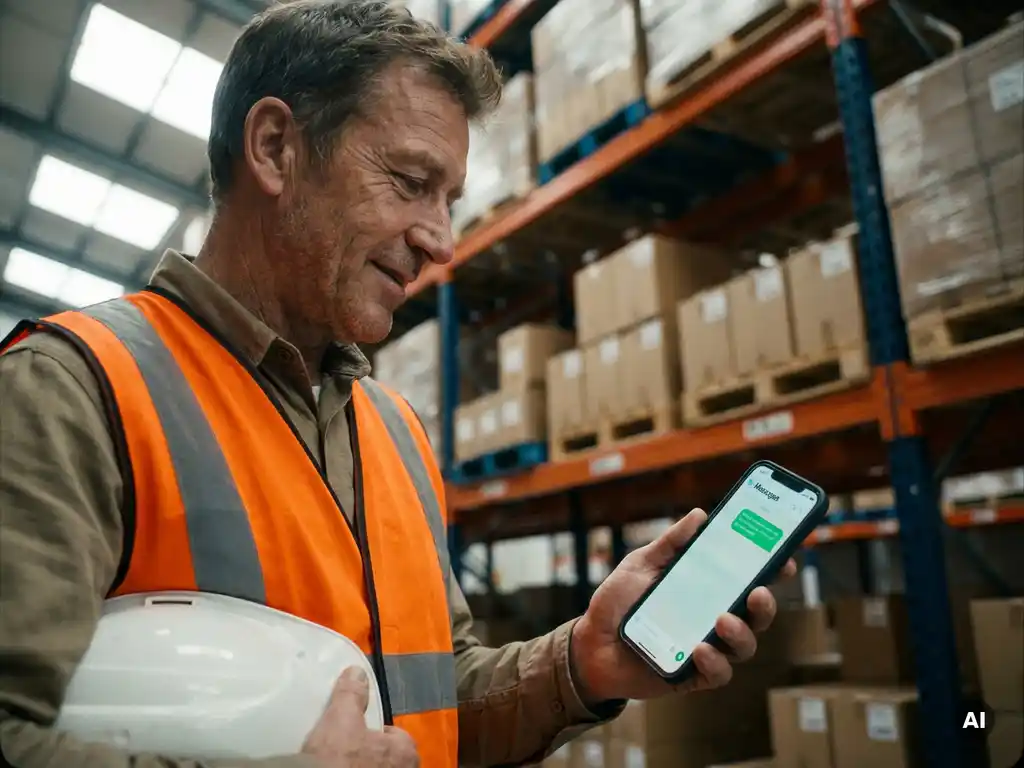
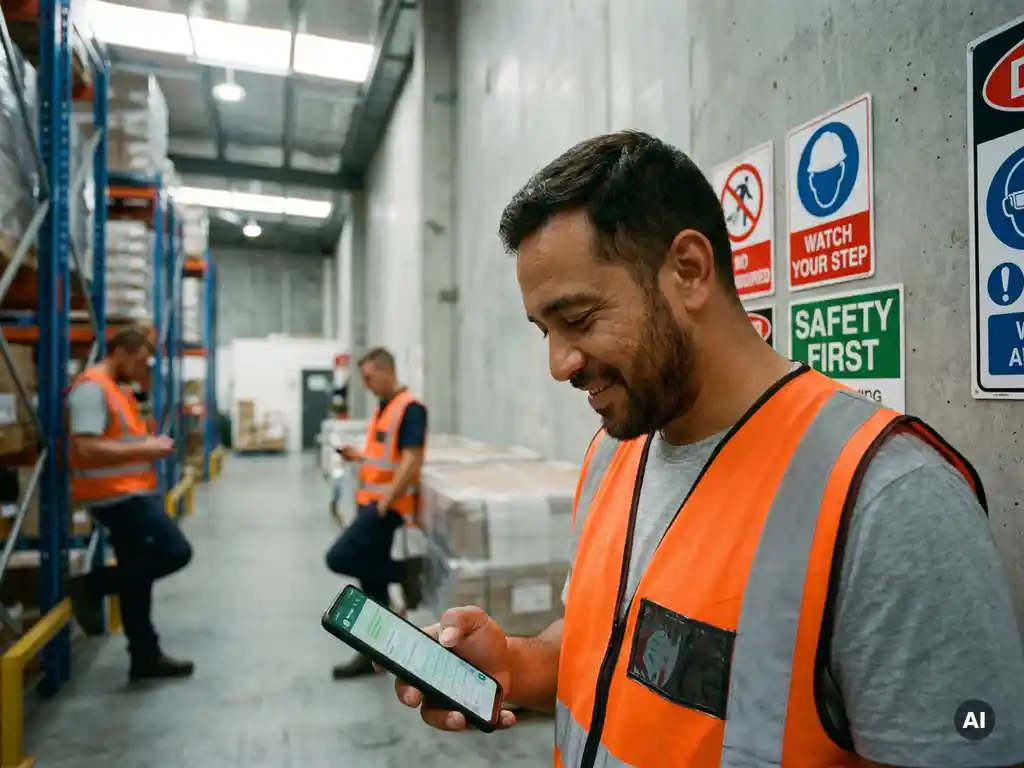
The channels that work best for safety instructions on the workfloor are those that employees already use daily, without any additional barrier. For most operational employees, this means their own smartphone. A channel that requires no separate app, account, or password significantly lowers the threshold and increases the likelihood that the information is actually read.
Why traditional channels fall short
Email works well for office-based employees, but not for those without a work email address. Intranets require a login procedure that many operational employees have never set up. Printed instructions are difficult to update and provide no record of who has received the information. Physical toolbox meetings are valuable, but depend on attendance and planning.
What does work: familiar digital communication
For many employees on the workfloor, a messaging service on their phone is the most familiar way of communicating. When safety instructions are delivered through such a familiar channel — in the employee’s own language and in a concise, easy-to-understand format — engagement increases noticeably. Short modules with a knowledge check, offered at the moment they are relevant, fit better into daily working practice than a lengthy instruction document or a meeting that requires scheduled attendance.
How do you demonstrate that employees have received and understood the safety rules?
You demonstrate that employees have received and understood safety rules by digitally recording participation and knowledge uptake at the moment they occur. This means: a system that automatically registers who has received an instruction, when it was opened, and whether the associated knowledge check was completed correctly.
Paper signature sheets and spreadsheet records offer limited capabilities. They are time-consuming, prone to error, and difficult to consult when a manager or external party wants to know who has completed which instruction. Digital registration makes this information immediately available via a dashboard, without any manual administration.
Knowledge checks add an extra layer: they show not only that someone has received the instruction, but also whether the content has been understood. This is particularly relevant for toolbox meetings covering specific risks, work procedures, or the use of personal protective equipment. Good record-keeping can support the ability to demonstrate safety activities when needed — for example, during an internal audit or an inspection.
What do you do when part of the workforce has missed the update?
When part of the workforce has missed a safety update, the first step is to know who they are. Without registration, this is guesswork. With a digital system, you can see immediately who has not yet received or completed the instruction, and follow up in a targeted way without approaching the entire group again.
You then send a reminder or supplementary instruction to the employees who missed the update. This can be done via the same channel as the original communication, keeping the barrier low. Employees who were off sick, working at a different location, or on a different shift do not need to wait for the next scheduled toolbox meeting.
It is also important to consider why employees missed the update. Was it a planning issue? A language barrier? Or does the channel used structurally fail to reach a particular group? That analysis helps you prevent recurrence and improve your communication approach for future safety updates.
How we help safety instructions reach the entire workforce
With our platform, you send safety instructions, toolbox meetings, and work instructions directly via WhatsApp to employees’ phones, without them needing to download an extra app or create an account. This way, you also reach employees without a work email address or laptop, at any location and at any time.
- Immediate distribution: send a safety instruction or toolbox meeting directly or on a scheduled basis to individual employees or groups, in their own language thanks to automatic translations into more than 50 languages.
- Knowledge checks: add a short quiz to see whether employees have understood the content, not just received it.
- Automatic registration: a live dashboard shows who has received, opened, and completed the instruction, without any manual administration.
- Targeted follow-up: see immediately who has missed an update and send a targeted reminder, without approaching the entire group again.
- Library of practice-oriented topics: use ready-made modules on safety topics, updated monthly, or build your own content in an average of 10 to 15 minutes.
Would you like to see how this works for your organisation? Request a no-obligation demo and discover how you can distribute safety instructions more quickly, more easily, and with a clear record.