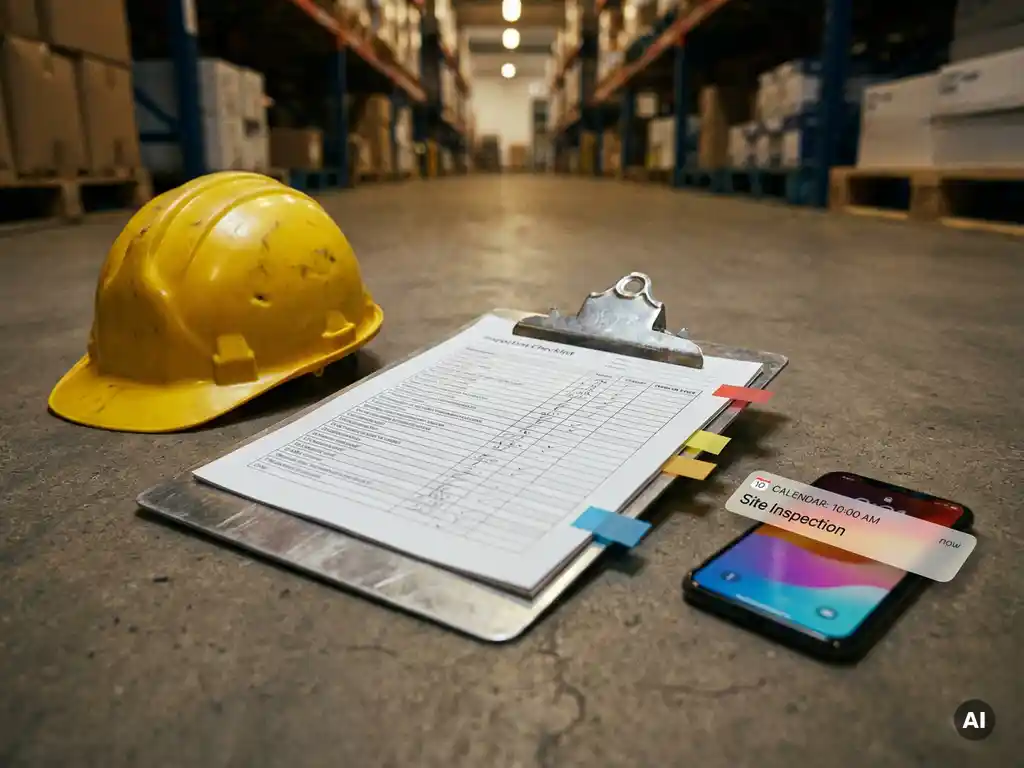
You record deviations during a workplace inspection immediately by describing them at the moment of discovery, photographing them, and linking them to a location, date, and responsible person. The faster and more completely you register a deviation, the better you can follow up on it. In this article, you will find answers to the most frequently asked questions about recording and following up on deviations during workplace inspections.
What types of deviations do you encounter during a workplace inspection?
During a workplace inspection, you encounter deviations in the areas of physical safety, behaviour, documentation, and environmental conditions. The most common category is the physical deviation: a missing safety fence, defective equipment, an unsafe passageway, or an incorrectly stored hazardous substance. However, behavioural and administrative deviations are also part of a thorough inspection.
Physical and technical deviations
These are visible defects at the workplace itself. Think of damaged floors, missing or damaged personal protective equipment, unsafe storage of materials, defective machinery, or insufficient lighting. These deviations are relatively straightforward to identify and photograph.
Behavioural and procedural deviations
Behavioural deviations are less tangible, but equally relevant. Employees not wearing a helmet, procedures not being followed, or safety instructions not being adhered to also fall under deviations. Procedural deviations relate to the absence of work permits, instructions that have not been updated, or missing signatures on required documents.
How do you record a deviation directly and completely on the shop floor?
You record a deviation completely by registering at least four elements: a clear description of the deviation, the exact location, a photograph as evidence, and the name of the person who identified the deviation. Do this directly on the worksite, not afterwards in the office, so that details are not lost.
A good registration contains the following components:
- Description: what exactly is deviating, described concretely and factually
- Location: which workplace, room, floor, or project number
- Date and time: recorded automatically or manually
- Photograph: visual evidence of the situation at the moment of identification
- Severity or priority: whether it is a direct safety risk or a less urgent finding
- Responsible person: who is the point of contact for follow-up
Avoid vague descriptions such as “mess found”. Instead, write: “Unsecured stack of pallets at loading dock 3, approximately 2 metres high, no barrier present.” The more specific the registration, the easier the follow-up.
What are the advantages of digital recording compared to paper forms?
Recording deviations digitally is faster, less prone to errors, and immediately produces usable reports. With a paper form, you run the risk of notes being illegible, forms going missing, or data being retyped later with errors as a result. Digital registration eliminates these steps.
The main advantages of digital recording during a digital workplace inspection via WhatsApp are:
- Immediate availability: the report is available to managers as soon as the inspection is complete
- Photographs linked to the registration: no loose attachments or lost images
- Timestamp and location data: recorded automatically, no manual entry required
- Clear reports: trends and recurring deviations are quickly visible
- Easier follow-up: deviations can be assigned directly to a responsible person
- Accessible for multilingual employees: digital forms can be offered in the employee’s own language
Paper checklists have the additional disadvantage of being difficult to search. If you need to demonstrate during an audit which deviations were identified over a given period and how they were followed up, this takes considerably more time with paper than with a digital system.
How do you ensure that employees consistently report deviations?
Employees report deviations consistently when reporting is straightforward, when they know what happens with their report, and when there is no barrier to reporting something. The biggest obstacle to consistent reporting is not unwillingness, but a barrier: a complicated system, an unfamiliar procedure, or the feeling that reports do not lead to any change.
Practical steps to improve reporting behaviour:
- Make reporting as simple as possible. Use a channel that employees already know, so they do not have to learn a new system.
- Provide feedback. Let employees know what has been done with their report. This increases engagement and trust in the process.
- Create an open reporting culture. Make it clear that reporting is valued and that the aim is improvement, not punishment.
- Train employees in identifying deviations. Not everyone knows what constitutes a deviation. Short, practical instructions help employees assess situations correctly.
- Provide multilingual support. In teams with employees who speak different languages, it is helpful to offer instructions and forms in the employee’s own language.
Managers play an important role in this. When they actively report and discuss deviations themselves, it sends a clear signal that reporting is normal and encouraged.
What do you do with recorded deviations after the inspection?
After the inspection, you follow up on recorded deviations by prioritising them, assigning a responsible person, and setting a deadline for resolution. Without follow-up, an inspection loses its value. The registration is the starting point, not the end point.
A good follow-up procedure looks as follows:
- Prioritise deviations. Direct safety risks require immediate action. Less urgent findings can be scheduled.
- Assign a responsible person. Each deviation is given an owner who is responsible for the resolution.
- Set a realistic deadline. Make the deadline concrete and achievable, so that follow-up actually takes place.
- Verify the resolution. After the agreed deadline, check whether the deviation has been resolved. Record the resolution as well.
- Analyse recurring deviations. If the same deviation keeps occurring, this points to a structural problem that requires a different approach.
Reports on deviations are also useful for broader safety discussions within the organisation. Trends identified in inspections can provide input for toolbox meetings, work instructions, or adjustments to working procedures.
How we help with recording deviations during workplace inspections
With our workplace inspections via WhatsApp, we make recording deviations straightforward for everyone on the shop floor, including employees without a business email address or laptop. Via a familiar channel, inspectors can immediately add photographs, specify locations, and register findings, without downloading a separate app or logging in.
- Existing paper checklists or Excel forms are converted one-to-one into a digital inspection form
- Completed inspections are immediately available as a digital report with timestamp and photographs
- Everything is stored centrally and can be easily exported for internal follow-up or external audits
- Thanks to AI-powered translations in more than 50 languages, you can also reach multilingual employees without additional barriers
- Both proactively sent inspections and inspections initiated by employees themselves are possible
Would you like to see how this works for your organisation? Get in touch for a demonstration.