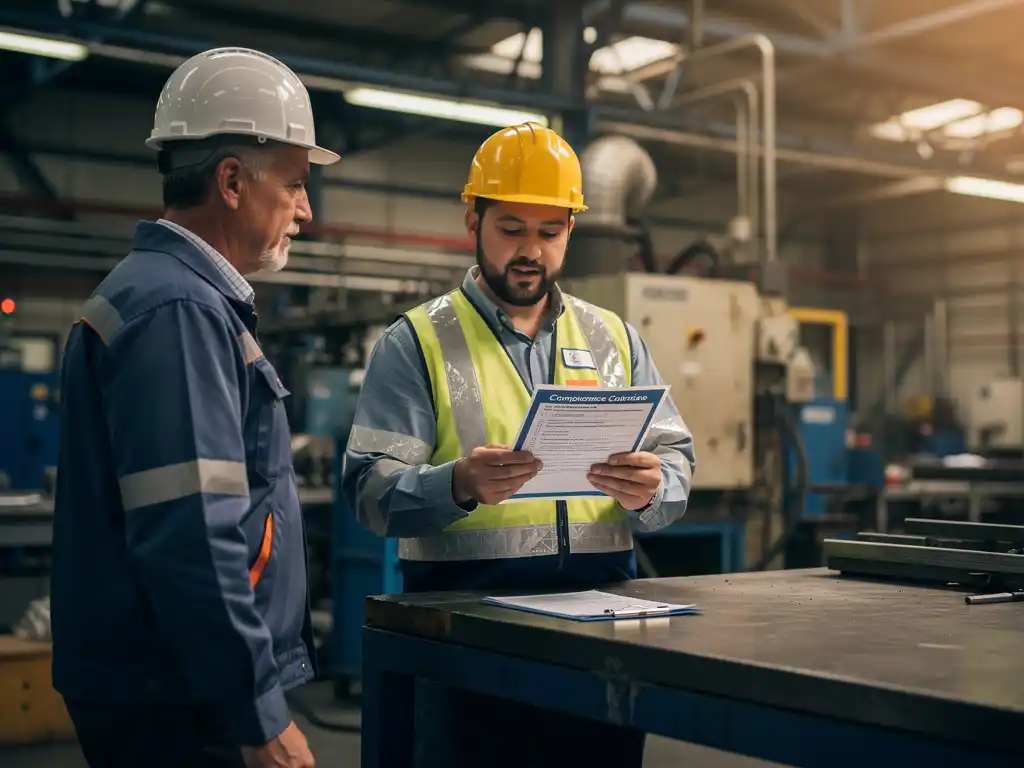



You can download a free onboarding checklist for production employees from HR resource platforms such as SHRM, HubSpot’s resource library, Workable, and various manufacturing industry associations. Many of these sites offer editable Word or PDF templates at no cost. That said, a generic checklist is only a starting point — production environments have specific safety, compliance, and operational requirements that demand customisation. Below, we cover exactly what to include, where to find templates, and how to move beyond paper checklists toward something that actually works on the factory floor. If you want to explore a more practical approach, you can always book a demo to learn what works for teams like yours.
What should an onboarding checklist for production employees include?
A strong onboarding checklist for production employees should cover safety protocols, equipment training, role-specific tasks, compliance requirements, and team introductions — structured across the first day, first week, and first month. Unlike office-based checklists, production onboarding must prioritise physical safety and hands-on competency from day one.
Here is what a solid production employee onboarding checklist typically includes:
- Pre-arrival: Employment paperwork, safety induction scheduling, PPE preparation, and access badge setup
- Day one: Site tour, emergency procedures, hygiene and safety rules, introduction to the direct supervisor and team
- First week: Equipment operation training, quality standards overview, shift procedures, and buddy system pairing
- First month: Performance check-ins, compliance sign-offs, cross-training opportunities, and feedback sessions
- Ongoing: Refresher training on updated procedures, safety drills, and skills assessments
The checklist should also account for language accessibility if your workforce includes non-native speakers — a common reality in manufacturing and logistics environments. Every item should have a clear owner (HR, supervisor, or team lead) and a completion date to prevent items from falling through the cracks. For a structured approach to employee onboarding, it helps to have a platform that supports delivery, tracking, and multilingual content from the start.
Where can you download a free onboarding checklist for production workers?
Several reputable platforms offer free, downloadable onboarding checklists for production and manufacturing workers. The most reliable sources include SHRM (Society for Human Resource Management), Workable’s HR templates library, HubSpot’s free resource centre, and Factorial HR. These are available in Word, PDF, or Google Docs format and can be edited to fit your context.
When choosing a template, look for ones that include a timeline structure (day one, week one, month one) rather than a flat list. Templates that separate HR tasks from operational tasks are especially useful in factory settings, where the floor supervisor and the HR team have distinct responsibilities during onboarding.
If you work in a regulated industry such as food production or pharmaceuticals, also check whether your sector’s trade association offers industry-specific templates. These are often more relevant than generic HR resources and may already include compliance checkpoints required by local labour or safety regulations. Organisations in food manufacturing, for example, often need to incorporate HACCP training as a mandatory part of the onboarding process.
How do you adapt a generic checklist to a production environment?
To adapt a generic employee onboarding checklist for a production environment, replace office-centric items with manufacturing-specific tasks, add safety and compliance milestones, and structure the checklist around shift patterns rather than standard working hours. The goal is to make the checklist reflect what actually happens on your production floor.
Practical steps for adapting a generic template:
- Audit your current process: Walk through what a new hire actually experiences on their first day. Note every handover, instruction, and sign-off that happens informally.
- Add safety-critical items: Include specific machine certifications, lockout/tagout procedures, hazard identification, and PPE sign-off. Structured toolbox talks are an effective way to cover these topics consistently across shifts.
- Assign clear ownership: In production, onboarding is split between HR, floor supervisors, and team leads. Make sure the checklist reflects who is responsible for each step.
- Account for shift patterns: A new employee on a night shift may not have access to the same resources as a day-shift worker. Build flexibility into the timeline.
- Include language options: If your team is multilingual, note which materials are available in which languages and flag where translation is needed.
- Test with a recent hire: Ask someone who joined in the last three months to review the checklist. They will quickly identify what was missing from their own experience.
What’s the difference between a paper checklist and a digital onboarding tool?
A paper checklist is a static document that records completed steps, while a digital onboarding tool actively delivers content, tracks progress in real time, and adapts to individual learners. The core difference is that paper checklists confirm that onboarding happened, whereas digital tools help ensure it actually works.
Paper checklists have real advantages: they are simple, require no technology, and work well in environments where devices are restricted. They are also easy to customise and cost nothing to produce. However, they rely entirely on the person holding the checklist to follow through, and there is no visibility for managers unless forms are manually collected and reviewed.
Digital onboarding tools address these gaps by automating delivery, sending reminders, tracking completion rates, and storing records automatically. They also make it easier to update content when procedures change — something that happens frequently in production environments. Rather than reprinting and redistributing paper forms, a digital update reaches everyone immediately. Tools that support digital work instructions make this especially straightforward, as updated procedures can be pushed to employees without any additional distribution effort.
The practical trade-off comes down to your team’s size, the complexity of your onboarding process, and how often your procedures change. For small teams with stable processes, a well-designed paper checklist may be entirely sufficient. For larger operations with high turnover, multilingual teams, or frequent process updates, a digital tool will save significant time and reduce errors.
How can production teams deliver onboarding content without a new app or login?
Production teams can deliver onboarding content without a new app or login by using messaging platforms employees already have on their phones — most notably WhatsApp. This approach removes the most common barrier to digital onboarding in manufacturing: the fact that floor workers rarely sit at a desk, rarely have a company email address, and rarely engage with platforms that require registration.
WhatsApp-based onboarding works by sending short, structured learning modules directly to a worker’s phone number. The employee receives a message, reads or watches the content, answers a quick question, and moves on. No account creation, no password, no app to download. For production environments where employees are on their feet and time is limited, this format fits naturally into the working day.
This approach also supports multilingual teams. Automated translation means the same module can be sent in Dutch, English, Arabic, or any other language your workforce uses — without creating separate versions manually. Managers can track who has completed which modules through a dashboard, giving them the oversight that paper checklists cannot provide. Regular workplace inspections become more meaningful when paired with digital records showing which employees have completed relevant training.
The key is keeping the content short and task-focused. Modules that take three to six minutes to complete are far more likely to be finished than lengthy e-learning courses. Think of each module as a digital version of a supervisor briefing a new hire before a shift — specific, practical, and immediately relevant.
How E-Lia helps with onboarding production employees
We built E-Lia specifically for teams where traditional onboarding tools do not fit the reality of the work. Our platform delivers microlearning modules and work instructions directly via WhatsApp, meaning your new production employees receive the right information at the right moment — on the device they already use, without any login or app download required.
Here is what we offer for production onboarding:
- Fast module creation: Build a complete onboarding module in 10 to 15 minutes using our editor
- Short, effective content: Employees complete each module in 3 to 6 minutes, fitting naturally into shift schedules
- Automatic translation: Send the same module in multiple languages without extra effort
- Scheduled delivery: Plan when each module is sent, so new hires receive content in the right order at the right time
- Progress tracking: Monitor completion rates and results through a simple dashboard
- No new systems for employees: Everything runs through WhatsApp, which your team already knows how to use
- Knowledge retention: Our approach to retaining and maintaining knowledge ensures new hires stay competent well beyond their first month
E-Lia is already used by organisations in healthcare, logistics, and manufacturing to standardise onboarding and reduce the time it takes for new employees to become fully productive. If you want to see how it works in practice, plan a demo and we will walk you through a live example built for a production environment.
Frequently Asked Questions
How long should onboarding take for a new production employee?
A structured onboarding process for production employees typically spans 30 to 90 days, depending on role complexity and the number of machines or procedures involved. Day one and week one focus on safety and basic orientation, while the first month builds operational competency through hands-on training and check-ins. Rushing this timeline is one of the most common mistakes in manufacturing environments — employees who feel underprepared are more likely to make errors and leave within the first three months.
What are the most common mistakes companies make when onboarding production workers?
The most common mistakes include treating onboarding as a single-day event, relying on informal ‘follow a colleague’ training without any structure, and failing to assign clear ownership for each step. Another frequent issue is using checklists that were designed for office workers without adapting them for shift patterns, physical safety requirements, or multilingual teams. These gaps often go unnoticed until an incident occurs or turnover rates start to climb.
How do you onboard production employees who work night shifts or rotating schedules?
Onboarding employees on non-standard shifts requires building flexibility into your process from the start — not all resources, trainers, or HR staff will be available during a night shift. Assign a dedicated buddy or team lead for each shift who is responsible for guiding new hires through the checklist, and ensure all critical content (safety procedures, machine instructions, quality standards) is available in a format employees can access independently. Digital delivery methods, such as WhatsApp-based modules, are particularly effective here because employees can complete content at the right moment during their shift without needing a trainer present.
What compliance and legal requirements should a production onboarding checklist cover?
At a minimum, your checklist should include sign-offs for health and safety induction, PPE training, emergency evacuation procedures, and any machine-specific certifications required by law in your country or sector. In regulated industries such as food production, pharmaceuticals, or chemicals, you may also need to document HACCP awareness, GMP training, or specific regulatory certifications before an employee is permitted to work independently. Always check with your sector’s relevant authority or trade association, as requirements vary significantly by industry and location.
How do you measure whether your production onboarding process is actually working?
The clearest indicators are time-to-productivity (how quickly a new hire reaches full output), early turnover rate (how many employees leave within the first 90 days), and safety incident rates among new starters. You can also collect direct feedback from new hires at the end of their first month — a short survey asking what was unclear or missing is often more revealing than any metric. If you are using a digital onboarding tool, completion rates and quiz scores provide an additional layer of insight into where knowledge gaps exist.
Can the same onboarding checklist be used for temporary and permanent production staff?
A shared base checklist can work for both, but it should be adapted based on contract length and role scope. Temporary workers often need a faster, more focused version that prioritises safety and immediate task requirements over longer-term development items. Permanent employees benefit from a more comprehensive process that includes career path conversations, cross-training opportunities, and longer-term performance check-ins. A modular checklist structure — where a core safety section applies to everyone and additional sections are added based on role type — is the most practical solution for teams that regularly mix temporary and permanent hires.
How do you get floor supervisors to consistently follow the onboarding checklist?
Supervisor buy-in is one of the biggest practical challenges in production onboarding, especially when the floor is busy and onboarding feels like an administrative burden. The most effective approach is to make the checklist as simple and role-specific as possible — supervisors are more likely to follow a focused list of five tasks than a 30-item form that was designed by HR. Automating reminders and progress tracking also helps, as it removes the need for supervisors to remember every step manually. When supervisors can see that the checklist reduces repeat questions and speeds up new hire productivity, it becomes a tool they value rather than a form they resent.
Related Articles
- How do you create one safety process for permanent employees, flexible workers, and subcontractors?
- What is a good opening for a toolbox meeting?
- Which PPE dilemmas should you discuss during safety talks?
- How do you prevent safety instructions from feeling like obligations?
- How do you train subcontractors to your safety requirements?