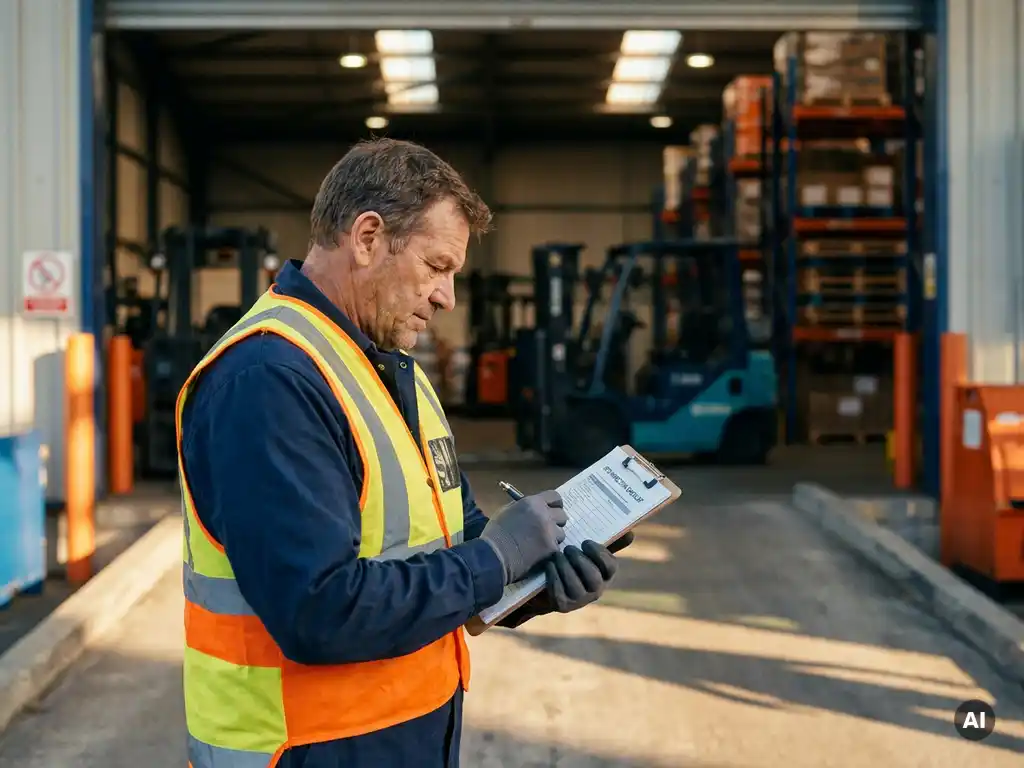



To correctly carry out a VCA workplace inspection, you systematically assess working conditions against predefined safety criteria, document findings, assign corrective actions, and follow up until all issues are resolved. The inspection covers physical hazards, compliance with safety procedures, and the correct use of personal protective equipment. The sections below walk through every key aspect of a proper VCA inspection, from what to check to how digital tools can make the process more consistent.
What items does a VCA workplace inspection cover?
A VCA workplace inspection covers the physical working environment, employee behaviour, the availability and condition of safety equipment, and compliance with documented procedures. The inspection checklist typically spans housekeeping, emergency provisions, machinery guarding, hazardous substances, and the use of personal protective equipment (PPE).
In practice, a thorough VCA inspection checklist works through several categories:
- Order and cleanliness: Are walkways clear, are materials stored safely, and is the workspace free of unnecessary hazards?
- Personal protective equipment: Is the correct PPE available, in good condition, and actually being worn?
- Emergency provisions: Are fire extinguishers accessible, are evacuation routes clearly marked, and is first aid equipment present and up to date?
- Machinery and tools: Are guards in place, are tools in good repair, and are lockout/tagout procedures being followed?
- Hazardous substances: Are safety data sheets available, are substances stored correctly, and is exposure minimised?
- Working at height: Are ladders, scaffolding, and fall protection measures properly used and inspected?
- Toolbox meetings and safety signage: Are safety instructions communicated and visible at the point of work?
The specific items on a VCA inspection checklist will vary depending on the sector and the nature of the work, but the underlying principle is always the same: identify risks before they cause incidents. Learn more about how structured workplace inspections can support your VCA compliance programme.
Who is responsible for carrying out a VCA inspection?
Responsibility for a VCA workplace inspection typically lies with the direct supervisor or team leader on site, supported by a safety officer or VCA-certified employee. In VCA-certified organisations, the management system requires that inspections are carried out by people with the authority and competence to act on what they find.
This means the inspector should not only know what to look for but also have the mandate to stop unsafe work, issue corrective actions, and escalate findings to management when necessary. In larger organisations, safety coordinators or HSE managers often coordinate the inspection schedule and review results, whilst frontline supervisors conduct the actual walkthroughs.
It is worth noting that VCA compliance places obligations on both the contractor and the client organisation. If your company works at a client’s site, both parties share responsibility for safe working conditions, and inspection results may need to be shared across organisations.
How often should a VCA workplace inspection be conducted?
VCA workplace inspections should be conducted at a frequency that matches the risk level of the work. High-risk environments such as construction sites, chemical plants, or heavy manufacturing typically require weekly or even daily checks, whilst lower-risk workplaces may conduct formal inspections monthly or quarterly.
The VCA standard itself does not prescribe a fixed universal frequency, but it does require that inspections happen regularly and that the results are recorded. What matters most is that the inspection cycle is short enough to catch deteriorating conditions before they lead to incidents. Industry experience shows that organisations that inspect more frequently tend to identify smaller issues early, preventing them from escalating into serious safety events.
Beyond scheduled inspections, unannounced spot checks add an important layer of assurance. They reflect actual day-to-day conditions rather than a tidied-up version of the workplace prepared in anticipation of a formal audit.
What are the most common findings during a VCA inspection?
The most common findings during a VCA safety inspection include missing or incorrectly used PPE, inadequate housekeeping, blocked emergency exits, incomplete safety signage, and gaps in documentation such as missing toolbox meeting records or outdated risk assessments.
Other frequently recurring findings include:
- Damaged or unchecked tools and equipment that have not been removed from service
- Hazardous substances stored without proper labelling or safety data sheets nearby
- Employees who have not completed required VCA training or whose certificates have expired
- Inadequate supervision of subcontractors working on site
- Fall protection measures that are present but not being used consistently
Many of these findings are behavioural rather than purely physical, which is why a VCA inspection procedure should include observing how people actually work, not just checking whether the right equipment is present. Equipment on a shelf does not make a workplace safe if it is not being used correctly. Consistent toolbox talks are one of the most effective ways to address behavioural findings before they appear on an inspection report.
How do you document and follow up on VCA inspection results?
VCA inspection results must be documented in a written report that records each finding, its location, the risk level, the corrective action required, the person responsible, and a deadline for resolution. Without structured follow-up, even well-conducted inspections fail to improve safety because findings remain unresolved.
A reliable documentation and follow-up process works as follows:
- Record findings on site: Use a standardised form or digital tool to log each observation immediately during the inspection walkthrough.
- Classify by risk: Distinguish between immediate hazards that require action before work continues and lower-priority improvements that can be scheduled.
- Assign ownership: Every finding needs a named person responsible for resolving it, not just a department or team.
- Set realistic deadlines: Immediate hazards should be resolved within hours or days; structural improvements may take longer but should still have a firm date.
- Verify closure: Follow up to confirm that corrective actions have actually been implemented, not just marked as done on paper.
- Share results with the team: Communicating findings and improvements to the people who work in the area reinforces a safety culture and shows that inspections lead to real change.
Keeping inspection records over time also creates valuable trend analysis. Recurring findings in the same area or category signal a systemic problem that needs a structural solution rather than a repeated quick fix.
How can digital tools make VCA inspections more consistent?
Digital tools make VCA inspections more consistent by standardising the checklist, reducing the risk of missed items, enabling real-time documentation, and ensuring that follow-up actions are tracked and visible to the right people. Paper-based inspection forms are prone to being lost, filled in incompletely, or never acted upon after the inspection is finished.
Beyond the inspection process itself, digital tools play an important role in keeping inspectors and employees up to date with the latest procedures. When safety instructions, updated checklists, or new regulatory requirements need to reach a distributed workforce quickly, the delivery channel matters as much as the content. Inspectors who have not been trained on the latest VCA inspection procedure will produce inconsistent results regardless of how good the checklist is.
Platforms that deliver short, focused training directly to employees via channels they already use, such as mobile messaging apps, make it easier to keep knowledge current without requiring people to log into separate systems or attend classroom sessions. This is especially relevant in sectors like logistics, construction, and manufacturing, where workers are rarely at a desk and turnover can be high. Effective knowledge retention is key to ensuring that VCA inspection standards are consistently applied across your workforce.
How E-Lia helps with VCA workplace inspections
We built E-Lia specifically to solve the knowledge gap that makes safety inspections inconsistent. When inspectors and employees lack up-to-date knowledge of VCA procedures, even the best checklist will not produce reliable results. E-Lia delivers bite-sized training via WhatsApp, the channel your team already uses every day, with no app to download and no login required.
Here is what E-Lia makes possible for organisations that want to improve VCA compliance:
- Send VCA inspection procedures directly to inspectors’ phones before a scheduled walkthrough, so the right knowledge is fresh at the right moment — supported by structured work instructions your team can access instantly
- Onboard new employees with standardised safety instructions via WhatsApp, reducing the risk of knowledge gaps that show up as inspection findings — find out more about how E-Lia supports employee onboarding
- Deliver updates instantly when procedures change, without waiting for the next classroom training session
- Support multilingual teams with automatic translations, so safety knowledge reaches every employee in their own language
- Track completion and comprehension via a dashboard, giving safety managers evidence that training has been received and understood
- Build a new module in 10 to 15 minutes, meaning you can respond to a new finding or regulatory change the same day — including HACCP training for teams operating in food-related environments
If you want to see how E-Lia can make your VCA inspection process more consistent and your team better prepared, plan a demo and we will show you exactly how it works in practice.
Frequently Asked Questions
What is the difference between a VCA inspection and a VCA audit?
A VCA workplace inspection is an internal, operational activity carried out regularly by supervisors or safety officers to identify and resolve hazards in day-to-day working conditions. A VCA audit, on the other hand, is a formal, structured evaluation — often conducted by an external certifying body — that assesses whether your entire safety management system meets the VCA standard. Think of inspections as the ongoing practice that keeps your workplace safe, and audits as the periodic verification that your system as a whole is working.
How do I get started with a VCA inspection if my organisation has never done one before?
Start by obtaining or building a standardised VCA inspection checklist tailored to your sector and the specific hazards present in your workplace. Assign a competent inspector — ideally someone with a VCA Basic or VCA VOL certificate — and conduct a first walkthrough together with a more experienced safety professional if possible. Document every finding, no matter how minor, and use the results of that first inspection to set a baseline and prioritise the most critical corrective actions. From there, establish a regular inspection schedule and refine your checklist based on what you consistently find.
What should I do if workers resist or ignore VCA inspection findings?
Resistance to inspection findings is usually a sign of a cultural issue rather than a knowledge gap — people need to understand why a finding matters, not just that it was flagged. Communicate findings directly to the team involved, explain the specific risk behind each observation, and visibly follow through on corrective actions so employees see that inspections lead to real improvements. Involving workers in identifying solutions, rather than just presenting them with a list of violations, significantly increases buy-in and long-term compliance.
Can a VCA inspection be conducted by someone without a VCA certificate?
The VCA standard requires that inspections are carried out by someone with the competence and authority to act on the findings, which in practice usually means a VCA-certified employee or safety officer. However, uncertified supervisors can and should conduct informal daily checks as part of their normal responsibilities, as long as formal inspections with documented results are handled by qualified personnel. If your organisation is working towards VCA certification, investing in VCA Basic or VCA VOL training for key supervisors is a necessary step.
How do I handle a safety hazard I discover during a VCA inspection that I cannot immediately fix?
If a hazard cannot be resolved on the spot, your first priority is to control the risk — this may mean isolating the area, restricting access, posting clear warning signage, or temporarily halting the relevant work activity. Document the hazard in your inspection report with a clear risk classification, assign it to a named responsible person, and set a firm resolution deadline based on the severity of the risk. Never leave a high-severity finding open without interim control measures in place, and escalate to management immediately if the hazard poses an imminent danger to workers.
How do I ensure that subcontractors on my site meet VCA inspection standards?
Start by contractually requiring that subcontractors hold the appropriate VCA certification level before they begin work on your site, and verify this before they arrive. Include subcontractor work areas and activities in your regular inspection walkthroughs, and make it clear from day one that your inspection findings apply to all parties on site — not just your own employees. Holding joint toolbox meetings and sharing inspection results with subcontractor supervisors creates shared accountability and reduces the risk of gaps that fall between organisational boundaries.
What is the best way to track recurring findings across multiple VCA inspections over time?
The most effective approach is to maintain a centralised log of all inspection findings — ideally in a digital system — that allows you to filter and analyse results by category, location, and responsible person over time. When the same finding reappears across multiple inspection cycles, treat it as a signal of a systemic issue rather than an isolated lapse, and investigate the root cause instead of applying the same quick fix repeatedly. Presenting trend data in regular safety meetings helps management understand where structural investment is needed and demonstrates the value of your inspection programme beyond individual walkthroughs.