


An induction plan for deskless employees should be mobile-first, brief, and delivered through channels workers already use — not through desktop portals or lengthy classroom sessions. Frontline and non-desk workers rarely have access to a computer during their shift, so a traditional onboarding approach simply does not reach them effectively. The sections below answer the most common questions about building an induction programme that actually works for this group.
What makes onboarding deskless employees different?
Onboarding deskless employees is different because these workers have no fixed workstation, limited screen time during shifts, and often work in physically demanding or time-sensitive environments. A standard induction plan built around desktop logins, lengthy PDFs, or scheduled classroom training creates immediate barriers for frontline workers in sectors like logistics, healthcare, retail, and manufacturing.
The core challenge is access. Non-desk employees may share a device, work rotating shifts, or speak a different language from the one your standard materials are written in. Any induction programme that requires a login, a download, or a quiet room to read through slides will lose people before they even start.
There is also a pace difference. Deskless workers are often productive from day one and do not have the luxury of a week-long orientation. Their induction needs to be integrated into the flow of work rather than pulled away from it. Short, targeted content delivered at the right moment is far more effective than a single intensive onboarding day.
What should an induction plan for deskless workers include?
An effective induction plan for deskless workers should include role-specific instructions, safety procedures, team introductions, and compliance information — all broken into short, digestible modules that can be completed in under ten minutes. The plan should be structured around what the employee needs to know to do their job safely and confidently in the first days and weeks.
A strong induction programme for frontline workers typically covers:
- Day one essentials: Where to go, who to speak to, what to wear, and what tools or equipment they will use
- Safety and compliance: Health and safety rules, emergency procedures, and any regulatory requirements specific to the role
- Role-specific tasks: Step-by-step instructions for the most common tasks they will perform
- Company culture and values: A brief, human introduction to how the organisation works and what it stands for
- Escalation paths: Who to contact when something goes wrong or when they have a question
Keep each topic separate and short. A new warehouse operative does not need to read the full employee handbook on day one. They need to know how to use the scanner, where the fire exit is, and who their supervisor is. Build the plan around those priorities first. Learn more about how structured onboarding can support your frontline teams.
How do you deliver induction content to employees without a desk?
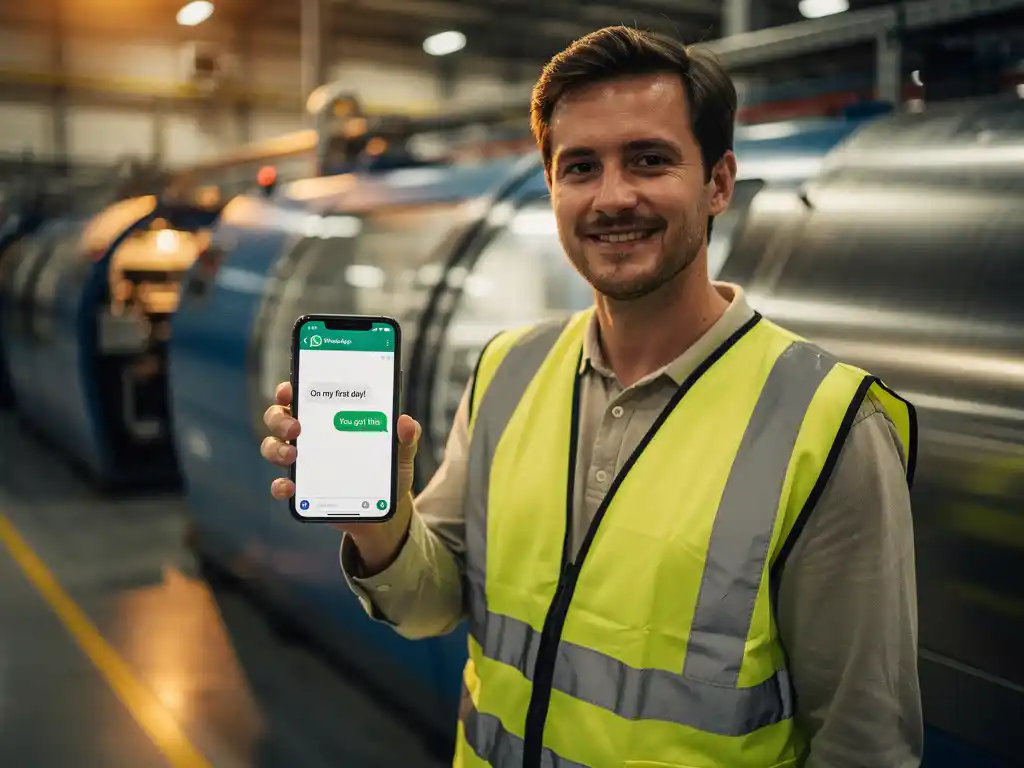
The most effective way to deliver induction content to non-desk employees is through mobile messaging channels they already use daily, such as WhatsApp. This removes the need for logins, app downloads, or access to a computer, making the content immediately accessible regardless of where or when someone is working.
Other delivery methods worth considering include:
- SMS-based microlearning: Short text-based instructions sent directly to a personal phone
- QR codes on-site: Placed at workstations or notice boards, linking to a short instructional video or checklist
- Buddy systems: Pairing a new employee with an experienced colleague for the first few shifts, supported by written prompts
- Pre-shift briefings: Brief verbal walkthroughs supported by a simple one-page reference card
The key principle is that the delivery method should require zero friction. If a new employee has to ask IT for access, remember a password, or find a specific device, the induction has already lost momentum. Wherever possible, push content to the worker rather than expecting them to go and find it. Work instructions delivered directly to a worker’s phone are a practical example of this approach in action.
How long should an induction plan for deskless employees take?
An induction plan for deskless employees should typically run between one and four weeks, with the most critical content delivered in the first two to three days. The exact duration depends on the complexity of the role, but the guiding principle is that learning should be spread out over time rather than front-loaded into a single session.
Research into learning retention consistently shows that spaced repetition — returning to key information across multiple short sessions — produces better long-term recall than a single intensive training day. For a logistics worker or a healthcare support worker, this means receiving a short module on day one, a follow-up on day three, and a check-in in week two, rather than sitting through a four-hour induction on their first morning.
Individual modules should be short. Content that takes three to six minutes to complete fits naturally into a break or the start of a shift without disrupting productivity. If a topic requires more time than that, it is usually a sign the content needs to be split into smaller pieces. Explore how retaining and maintaining knowledge over time keeps frontline workers confident and competent.
How do you track induction progress without a learning management system?
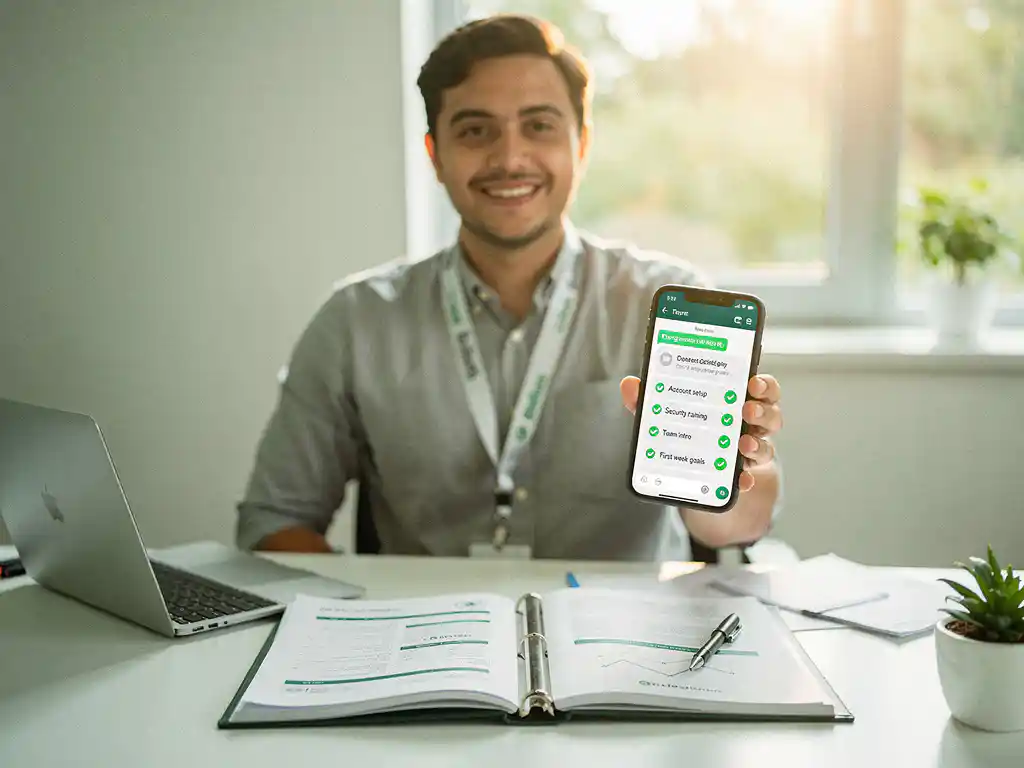
You can track induction progress without a traditional learning management system by using completion data from mobile delivery tools, simple checklists managed by supervisors, or automated confirmation messages that confirm when a worker has viewed or responded to content. A full LMS is not a requirement for effective tracking.
Practical alternatives to an LMS include:
- Supervisor checklists: A printed or digital checklist that a line manager ticks off as each topic is covered
- Response-based confirmation: Asking the employee to reply with a word or answer a quick question after each module, confirming they have engaged with the content
- Dashboard reporting from messaging tools: Many mobile learning platforms provide a simple dashboard showing who has opened, completed, or responded to each module
- HR system integration: Some tools connect directly to existing HR software via API, automatically updating employee records when induction milestones are completed
The most important thing is consistency. Choose a tracking method and apply it to every new starter, so you always have a clear record of what has been completed and what still needs to be done. This also protects the organisation in the event of a compliance audit. Regular toolbox talks are a useful complement to formal tracking, helping reinforce key messages on the ground.
What are common mistakes in deskless employee induction plans?
The most common mistakes in deskless employee induction plans are using desktop-first content, overloading new starters with information on day one, failing to account for language diversity, and not following up after the first week. These mistakes reduce engagement, increase the risk of errors, and contribute to early attrition.
Specific pitfalls to avoid include:
- Assuming everyone reads English: In sectors like manufacturing, logistics, and healthcare support, a significant proportion of frontline workers may have a different first language. Induction content that is only available in one language excludes a large part of the workforce.
- Treating induction as a one-time event: A single onboarding day does not create lasting knowledge. Without reinforcement, most information is forgotten within days.
- Using the same format as desk-based onboarding: Long documents, slide decks, and webinars are not designed for workers on the move. Format matters as much as content.
- No manager involvement: Induction works best when line managers are actively involved, not just HR. If a supervisor does not know what content a new starter has received, they cannot reinforce it.
- Skipping the follow-up: The second and third weeks of employment are when questions and doubts surface. An induction plan that ends after day one misses the period when support is most needed.
For industries with strict compliance requirements, incorporating structured HACCP training and workplace inspections into the induction plan helps ensure safety standards are met from the very first day.
How E-Lia helps with induction plans for deskless employees
We built E-Lia specifically for organisations that need to train and onboard employees who are never at a desk. Our platform delivers microlearning modules directly through WhatsApp, so new starters receive their induction content on the phone they already carry, with no login, no app download, and no computer required.
Here is what working with us looks like in practice:
- Fast content creation: Building a module takes an average of 10 to 15 minutes, so you can get an induction plan live quickly without a large production budget
- Short, effective modules: Workers complete each module in 3 to 6 minutes, fitting naturally into a break or the start of a shift
- Automatic translation: Content can be sent in the employee’s own language, removing the language barrier that affects so many frontline teams
- Progress tracking dashboard: See at a glance who has completed what, without needing a separate LMS
- Flexible scheduling: Send modules immediately or plan them to arrive at the right moment across the first days and weeks of employment
- No new technology for employees: If they have WhatsApp, they are ready to start
Organisations like the University of Utrecht and ETZ already use our platform for effective onboarding and knowledge retention. If you want to see how it works for your team, book a free demo and we will walk you through it.
Frequently Asked Questions
Can I use E-Lia or a WhatsApp-based induction tool if my organisation has strict data privacy policies?
Yes — reputable mobile learning platforms built for frontline workers are designed with GDPR compliance in mind, meaning employee data is handled securely and in line with European data protection regulations. Before rolling out any tool, confirm that the provider offers a Data Processing Agreement (DPA) and stores data within your required jurisdiction. It is also worth checking whether your organisation’s IT or legal team needs to approve third-party messaging integrations before launch.
How do I get buy-in from line managers to actively participate in the induction process?
The most effective approach is to make manager involvement as simple and low-effort as possible — give them a clear checklist, brief them on what content new starters are receiving, and show them how to check progress in under two minutes. Framing induction as a tool that reduces the number of questions they get asked in the first week tends to land well. When managers see that structured induction directly reduces early turnover and on-the-job errors, engagement usually follows.
What if my deskless workforce includes employees who are not confident using smartphones?
For workers with lower digital confidence, pairing mobile content with a buddy system or supervisor-led walkthrough on day one helps bridge the gap. Starting with a single, simple interaction — such as replying to a WhatsApp message with one word — builds familiarity gradually rather than overwhelming new starters. Over time, most employees adapt quickly when the technology is intuitive and the content is genuinely useful to their day-to-day work.
How do I handle induction for employees who start on different days or work irregular shift patterns?
A mobile-first induction plan is particularly well suited to staggered or shift-based starts because content can be scheduled to trigger automatically based on each individual’s start date, regardless of what day that falls on. This means a Monday starter and a Saturday starter both receive the right content at the right moment without any manual coordination from HR. Building your induction as a sequence of timed modules rather than a fixed group event removes the dependency on everyone being available at the same time.
How should I handle induction content for roles with high staff turnover?
For high-turnover roles, the priority is making your induction plan fast to deploy and easy to repeat consistently — which is exactly where short, pre-built mobile modules outperform classroom-based approaches. Once your modules are created, they can be reused for every new starter with minimal admin effort, ensuring quality and compliance standards are met regardless of how frequently people join. It is also worth reviewing your induction content quarterly to check that role-specific instructions and safety information remain accurate as processes change.
Is it possible to personalise induction content for different roles without creating entirely separate programmes?
Yes — the most practical approach is to build a shared core module covering company values, safety basics, and escalation paths, then layer role-specific modules on top for each job type. This way, a warehouse operative and a retail floor assistant both receive the universal content, but their task-specific training is tailored to what they actually do. Most mobile learning platforms allow you to assign different module sequences to different employee groups without duplicating your foundational content.
How do I measure whether my deskless induction plan is actually working?
The most meaningful indicators are completion rates, time-to-competency, early attrition figures, and the number of avoidable errors or safety incidents in the first 90 days. Tracking module completion through your delivery tool tells you whether content is being consumed, but pairing that with a short check-in conversation at the end of week one gives you qualitative insight into whether it is actually landing. If completion rates are high but errors or turnover remain elevated, that is usually a signal to review the quality and relevance of the content itself rather than the delivery method.