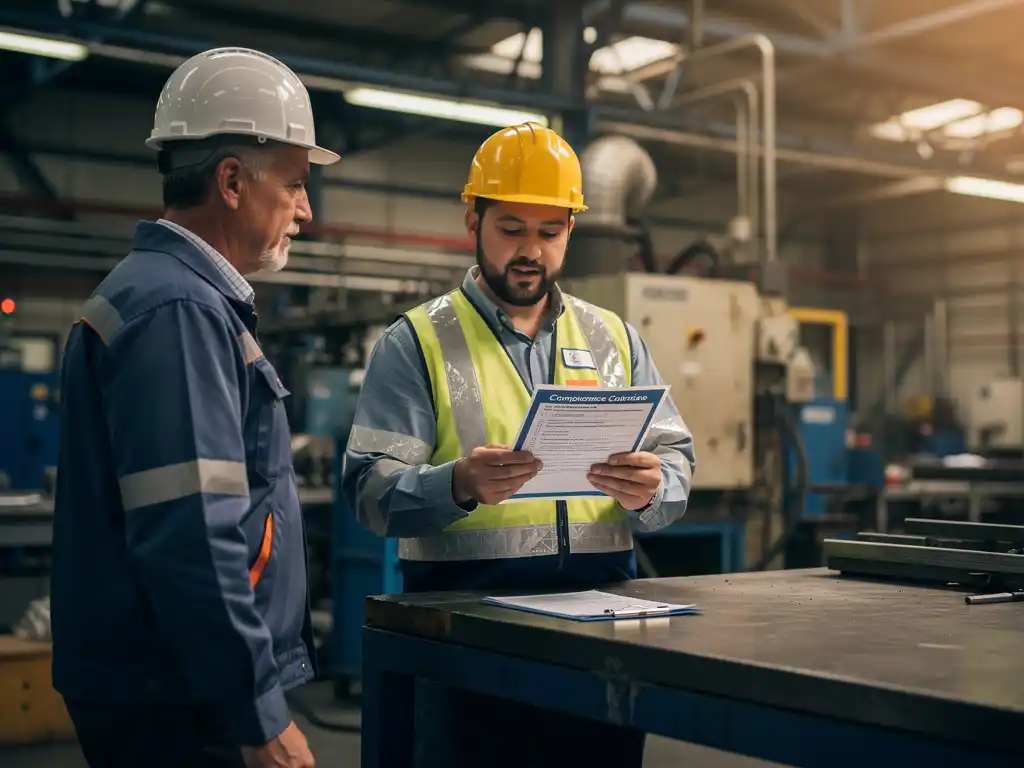
To onboard employees in a food production company, start with safety and hygiene training on day one, follow it with role-specific process instructions, and reinforce knowledge through structured check-ins during the first few weeks. Food production onboarding is more compliance-heavy than most industries, so clarity, consistency, and accessibility are essential from the very first shift. The questions below cover everything from programme structure to multilingual training and measuring results.
What makes onboarding in food production different from other industries?
Onboarding in food production is different because it combines strict regulatory requirements, physical safety risks, and fast-paced shift work into a single environment where errors have immediate consequences. New employees must understand food safety standards, hygiene protocols, and machine procedures before they can work independently, which makes the stakes of poor onboarding significantly higher than in most office-based roles.
In sectors like retail or administration, a new hire can learn gradually on the job with relatively low risk. In a food factory, a misunderstood hygiene rule or an incorrect handling procedure can lead to product contamination, regulatory violations, or workplace injuries. This means the onboarding process for food production workers must be thorough, structured, and verifiable from the start.
Additional factors that set food production onboarding apart include:
- Legal compliance requirements such as HACCP, food safety management systems, and local health regulations
- High workforce turnover and frequent intake of new or temporary staff
- Multilingual teams where language barriers can create real safety risks
- Shift-based schedules that make traditional classroom training difficult to coordinate
- Physical environments where digital devices are often not permitted on the floor
What should a food production onboarding programme include?
A food production onboarding programme should include safety and hygiene training, role-specific process instructions, an introduction to quality standards, and a clear overview of emergency procedures. These are non-negotiable foundations. Beyond compliance, a strong programme also covers team structure, communication channels, and expectations for the first few weeks on the job.
A practical onboarding programme for new employees in a food factory typically covers:
- Food safety and hygiene basics including handwashing protocols, allergen awareness, and personal protective equipment
- HACCP principles and how they apply to the specific production line the employee will work on
- Machine and equipment operation with clear step-by-step instructions for the tasks relevant to their role
- Quality control procedures so employees understand what to check, what to report, and who to contact
- Emergency and incident procedures including evacuation routes, first aid contacts, and reporting processes
- Company culture and team introduction to help new hires feel welcomed and orientated socially
Delivering this content in small, digestible portions rather than in a single full-day session significantly improves retention. Workers who receive information in short, focused modules are more likely to apply what they have learnt correctly on the production floor. Learn more about how structured onboarding can be delivered digitally and at scale.
How long should onboarding take in a food production company?
Onboarding in a food production company should take a minimum of two to four weeks for most roles, with compliance-critical knowledge covered in the first few days. The exact duration depends on the complexity of the role, the production environment, and whether the employee has prior experience in food manufacturing.
A common mistake is treating onboarding as a one-time event rather than a structured process. A new employee might complete their initial safety training on day one, but full competency in their role typically develops over several weeks. A well-designed onboarding timeline might look like this:
- Days 1 to 2: Safety, hygiene, and compliance essentials
- Days 3 to 5: Role-specific process and equipment training
- Week 2: Supervised practice with feedback and clarification
- Weeks 3 to 4: Independent work with check-ins and knowledge reinforcement
- Month 2 and beyond: Ongoing microlearning to reinforce key procedures and introduce updates
Temporary and seasonal workers often receive compressed versions of this timeline, which makes it even more important to prioritise the most critical safety information and deliver it in a format they can access quickly and revisit if needed. Explore how retaining and maintaining knowledge can be built into your onboarding process from day one.
How do you onboard multilingual employees in food production?
To onboard multilingual employees in food production, provide training content in each employee’s preferred language rather than relying solely on translated summaries or verbal explanations. Language barriers in a production environment are not just a communication inconvenience, they are a safety risk. Instructions that are misunderstood can lead to hygiene failures, equipment misuse, or accidents.
Practical approaches to multilingual onboarding in food manufacturing include:
- Translating all core training materials into the languages spoken on your production floor
- Using visual instructions and step-by-step images alongside written text to support comprehension
- Assigning a buddy or mentor who speaks the same language during the first few days on the job
- Using digital tools that support automatic translation so content can be delivered in multiple languages without creating separate versions manually
- Testing comprehension through short knowledge checks rather than assuming understanding based on attendance
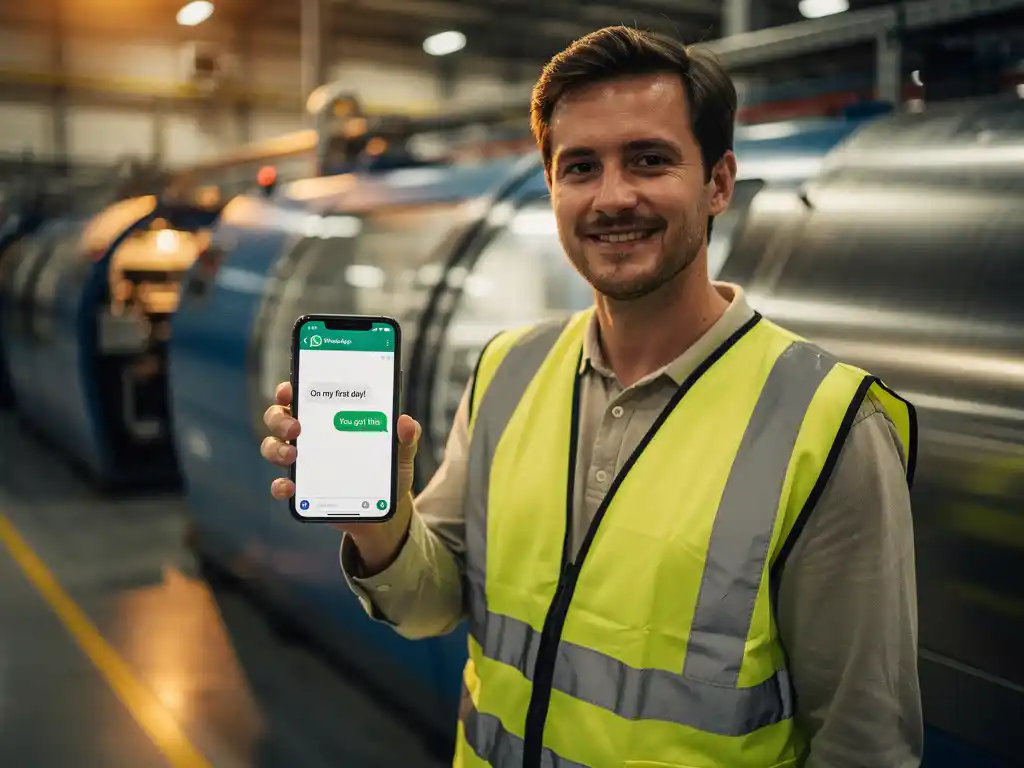
Platforms that support automatic translation make this significantly easier to manage, especially in factories with five or more languages spoken across shifts. Delivering training via a tool employees already use, such as WhatsApp, removes the additional barrier of learning a new system in a language they may not be fully comfortable with yet.
What tools work best for onboarding food production workers?
The best tools for onboarding food production workers are those that are mobile-friendly, require no technical setup, and can deliver short bursts of information that fit around shift schedules. Traditional e-learning platforms that require a computer login or lengthy sessions are poorly suited to the production floor environment.
Effective onboarding tools for food factory workers tend to share these characteristics:
- Accessible on a personal mobile phone without downloading a dedicated app
- Able to deliver content in short modules of three to six minutes
- Supportive of multiple languages without requiring separate content builds
- Capable of tracking completion and comprehension without burdening the worker
- Simple enough for trainers to create and update content quickly, ideally in under fifteen minutes per module
WhatsApp-based learning tools have become increasingly relevant for this audience because they meet workers where they already are. Most production employees already use WhatsApp daily, which removes the adoption barrier entirely. Managers can send instructions, safety updates, or onboarding modules directly to a worker’s phone, and completion can be tracked automatically without requiring the employee to log into any system. See how digital work instructions and toolbox talks can complement your onboarding programme.
How do you measure whether your onboarding programme is working?
You can measure whether your food production onboarding programme is working by tracking a combination of completion rates, knowledge retention scores, time-to-competency, and early turnover figures. Measuring only attendance or module completion tells you whether training happened, but not whether it was effective.
Key metrics to monitor include:
- Knowledge check scores: Are employees answering questions correctly after completing modules? Low scores on food safety or hygiene topics are an immediate signal to revisit the content or delivery method.
- Time to independent performance: How long does it take a new hire to work without supervision? A well-structured onboarding programme should reduce this time compared to informal approaches.
- Early turnover rate: Employees who leave within the first 90 days often cite poor onboarding as a factor. Tracking this number helps identify whether new hires feel adequately prepared and supported.
- Incident and error rates: A reduction in hygiene incidents, quality failures, or equipment misuse after onboarding improvements is one of the strongest indicators of programme effectiveness.
- Manager feedback: Supervisors who work directly with new employees can provide qualitative insight into what knowledge gaps remain after onboarding is complete.
Reviewing these metrics at 30, 60, and 90 days after a new hire’s start date gives you a structured view of what is working and where the programme needs adjustment. The goal is not just to complete onboarding, but to produce employees who are confident, compliant, and capable from their first independent shift. Find out how workplace inspections and HACCP training can strengthen your overall compliance approach.
How E-Lia helps with onboarding in food production
We built E-Lia specifically for organisations where training needs to reach employees quickly, clearly, and without technical barriers. For food production companies, that means delivering onboarding content via WhatsApp, the app your employees already have on their phones, with no login, no app download, and no classroom required. Book a demo to find out how we support food factory teams.
Here is what E-Lia offers for onboarding employees in food production:
- Microlearning modules that take three to six minutes to complete, perfectly suited to shift breaks and pre-shift briefings
- Automatic translation so every employee receives onboarding content in their own language without manual rework
- Scheduled and instant delivery via WhatsApp, meaning you can send day-one safety training before a new hire even walks through the door
- Progress tracking dashboard so managers can see exactly who has completed which modules and who needs a follow-up
- Fast content creation with an average build time of ten to fifteen minutes per module, so updating procedures or adding new instructions takes minimal effort
Whether you are onboarding ten new seasonal workers or rolling out updated HACCP procedures across multiple shifts, E-Lia makes it simple to deliver consistent, trackable, multilingual training at scale. Plan a demo and see how it works in practice.
Frequently Asked Questions
Can we onboard seasonal or temporary workers using the same program as permanent staff?
Yes, but the program should be adapted rather than copied directly. Seasonal and temporary workers need the same compliance-critical content — food safety, hygiene, and emergency procedures — but delivered in a compressed, high-priority format that focuses on what they need to know before their first shift. Consider creating a dedicated fast-track onboarding track that covers the essentials in the first one to two days, with optional deeper modules available for those who stay longer or transition to permanent roles.
What are the most common mistakes food production companies make during onboarding?
The most common mistakes are front-loading all information into a single day, relying on verbal instruction without written or visual backup, and failing to verify comprehension before a new hire works independently. Another frequent error is treating onboarding as complete after the initial training session, when in reality reinforcement over the first four to eight weeks is what drives lasting competency. Building in structured check-ins and short knowledge refreshers significantly reduces the risk of these gaps showing up on the production floor.
How do we keep onboarding content up to date when procedures change frequently?
The key is to use a content system that allows quick edits without requiring a full rebuild of the training material. If your onboarding relies on printed manuals or static PDFs, updating them across multiple shifts and languages becomes a significant administrative burden. Digital tools that allow module-level edits — where you can update a single step in a procedure and push it to all employees instantly — are far better suited to the pace of change in food production environments.
At what point should a new employee be considered fully onboarded?
A new employee can be considered fully onboarded when they can perform their core tasks independently, accurately, and consistently without requiring supervision or prompting. This is not a fixed date but a competency milestone, and it typically takes four to eight weeks depending on role complexity. Using a simple checklist of observable behaviours — such as correctly following hygiene procedures, accurately completing quality checks, and knowing who to contact in an incident — gives managers a concrete and objective way to assess readiness.
How do we handle onboarding for employees who have prior food industry experience?
Prior experience is valuable, but it should never be used to skip compliance-critical training. Experienced hires may have learnt different procedures, worked under different regulatory frameworks, or developed habits that do not align with your specific production standards. A practical approach is to use a short pre-assessment to identify genuine knowledge gaps and tailor the onboarding path accordingly — fast-tracking areas where competency is already demonstrated while still covering your site-specific safety and hygiene requirements in full.
What role should line managers and supervisors play in the onboarding process?
Line managers and supervisors are critical to onboarding success because they bridge the gap between formal training and real-world application on the production floor. Their role should include welcoming new hires, reinforcing key safety behaviours during early shifts, providing feedback during supervised practice, and flagging knowledge gaps to the training team. Onboarding programmes that rely entirely on HR or Lu0026D without active supervisor involvement tend to produce employees who know the theory but struggle to apply it correctly under production conditions.
Is it possible to run a compliant onboarding program without a dedicated training team?
Yes, and many food production companies do exactly that. The most effective approach for smaller operations or sites without a dedicated Lu0026D function is to build a library of standardised onboarding modules that line managers can assign and track without specialist support. Tools that allow non-technical users to create, update, and monitor training content — ideally in under fifteen minutes per module — make it realistic for a production manager or HR generalist to own the onboarding process without it becoming a full-time responsibility.