

The most effective way to use video in your onboarding programme for production employees is to keep clips short, task-specific, and easy to access on the production floor — no login, no long modules, no sitting at a desk. Video works best when it shows exactly what a new employee needs to do, in the environment where they will actually do it. The sections below cover the key questions teams face when building a video onboarding programme for manufacturing and production settings.
What types of videos work best for production floor onboarding?
The video formats that work best for production floor onboarding are short task demonstrations, safety walkthroughs, and equipment operation guides. These formats mirror the actual work environment and give new employees a visual reference they can connect directly to their daily responsibilities, which accelerates both confidence and competence.
Abstract or lecture-style videos tend to underperform in manufacturing settings because production workers learn by doing. Video onboarding works when it replicates that hands-on experience as closely as possible. The most effective formats include:
- Step-by-step process demonstrations: A camera follows the exact sequence of actions a worker needs to perform, filmed on the actual production floor or workstation.
- Safety procedure walkthroughs: Visual walkthroughs of hazard zones, protective equipment use, and emergency procedures are far more memorable than written safety manuals.
- Equipment orientation clips: Short videos showing how to start, operate, and safely shut down specific machines reduce errors and give new hires something to rewatch when they are unsure.
- Scenario-based examples: Brief clips showing common mistakes and how to correct them help employees recognise and avoid problems before they happen.
Avoid polished corporate-style productions with heavy branding and narration. Production employees respond better to authentic, practical content filmed in their real work environment, even if the production quality is modest.
How long should onboarding videos be for production workers?
Onboarding videos for production workers should be between two and five minutes long. This length is short enough to watch during a break or between tasks, and long enough to cover one clear skill or procedure. Videos longer than five minutes see significantly lower completion rates in high-paced production environments.
The principle behind this is straightforward: production workers rarely have extended time away from their station. A video that covers one focused topic in under five minutes fits naturally into the rhythm of a shift. If a topic genuinely requires more depth, break it into a series of short clips rather than creating one long video.
Think in terms of one video, one skill. A new employee learning to operate a packaging line does not need a fifteen-minute overview of the entire facility. They need a three-minute clip on their specific task, followed by another short clip on the adjacent safety protocol. This modular approach also makes it easier to update individual videos when processes change, without rebuilding an entire onboarding module. Learn more about how structured onboarding and work instructions can support this approach.
When in the onboarding process should video be introduced?
Video should be introduced at two key moments: during pre-onboarding, before the employee’s first day, and again at the point of need during the first weeks on the job. Pre-onboarding video reduces first-day anxiety and ensures new hires arrive with basic context. Point-of-need video reinforces learning exactly when a worker is about to perform a task for the first time.
Many organisations make the mistake of front-loading all onboarding content into day one or week one, which leads to information overload. A more effective approach distributes video content across the onboarding timeline:
- Before the first day: Send a short welcome video and a brief overview of the facility layout, team structure, and what to expect. This reduces the cognitive load on day one.
- First day on the floor: Provide safety videos and an overview of the immediate work area. Keep this to the essentials the employee needs to stay safe and orientated.
- First two weeks: Introduce task-specific videos progressively, aligned with the tasks the employee is actually being trained to perform. Watching a video just before attempting a task improves retention significantly.
- Ongoing: Keep a library of short reference videos accessible for moments when an employee needs a quick reminder without having to ask a supervisor.
Explore how E-Lia supports retaining and maintaining knowledge across the full onboarding timeline.
How do you make onboarding videos accessible for multilingual production teams?
To make onboarding videos accessible for multilingual production teams, use automatic subtitles or translated voiceovers, and deliver content through a channel employees already use in their own language. Written text overlays and visual demonstrations reduce language dependency, while translated versions of the same video ensure every employee receives equivalent information regardless of their native language.
Production workforces are often highly diverse, and a video onboarding programme that only works in one language leaves a significant portion of the team underserved. Practical steps to address this include:
- Subtitle every video by default: Even for native speakers, subtitles improve comprehension in noisy production environments where audio is difficult to hear.
- Use visual instruction as much as possible: Well-filmed demonstrations of physical tasks communicate across language barriers more effectively than spoken explanation alone.
- Offer translated versions of critical content: Safety procedures and compliance-related videos in particular should be available in every language spoken by your workforce.
- Deliver content in the employee’s preferred language: If your onboarding platform supports automatic translation or multilingual delivery, use it. Employees engage more deeply with content they can fully understand.
Automatic translation tools have improved considerably and can now handle a wide range of languages reliably. For teams with employees speaking five or more different languages, manual translation of every video is not realistic. Platforms that support multilingual delivery at scale make this manageable without a large additional workload for the L&D team.
How do you measure whether onboarding videos are actually working?
You measure the effectiveness of onboarding videos by tracking completion rates, knowledge check scores, time-to-competency, and error rates in the first weeks of employment. These metrics together give you a clear picture of whether employees are watching the content, retaining it, and applying it correctly on the floor.
Completion rate is the most basic indicator. If employees are not finishing videos, the content is either too long, poorly timed, or not relevant enough to their immediate work. Low completion is a signal to revisit format and delivery rather than content depth.
Knowledge checks embedded at the end of a video module give you direct evidence of retention. Keep these short, and three to five questions is sufficient, focusing on the most safety-critical or error-prone aspects of the task. If scores are consistently low on a particular topic, the video covering that topic needs to be reworked.
Time-to-competency measures how quickly a new employee reaches acceptable performance levels compared to a baseline. If employees who completed the video onboarding programme reach competency faster than those who did not, the programme is delivering measurable value. This metric requires coordination with floor supervisors but is one of the most convincing ways to demonstrate return on investment to leadership.
Error rates and safety incidents in the first ninety days are the ultimate measure of whether onboarding content is working. A well-designed video onboarding programme for production employees should reduce the frequency of process errors and near-miss incidents during the critical early period. See how toolbox talks and workplace inspections can complement your video onboarding to further reduce risk.
How E-Lia helps with video onboarding for production employees
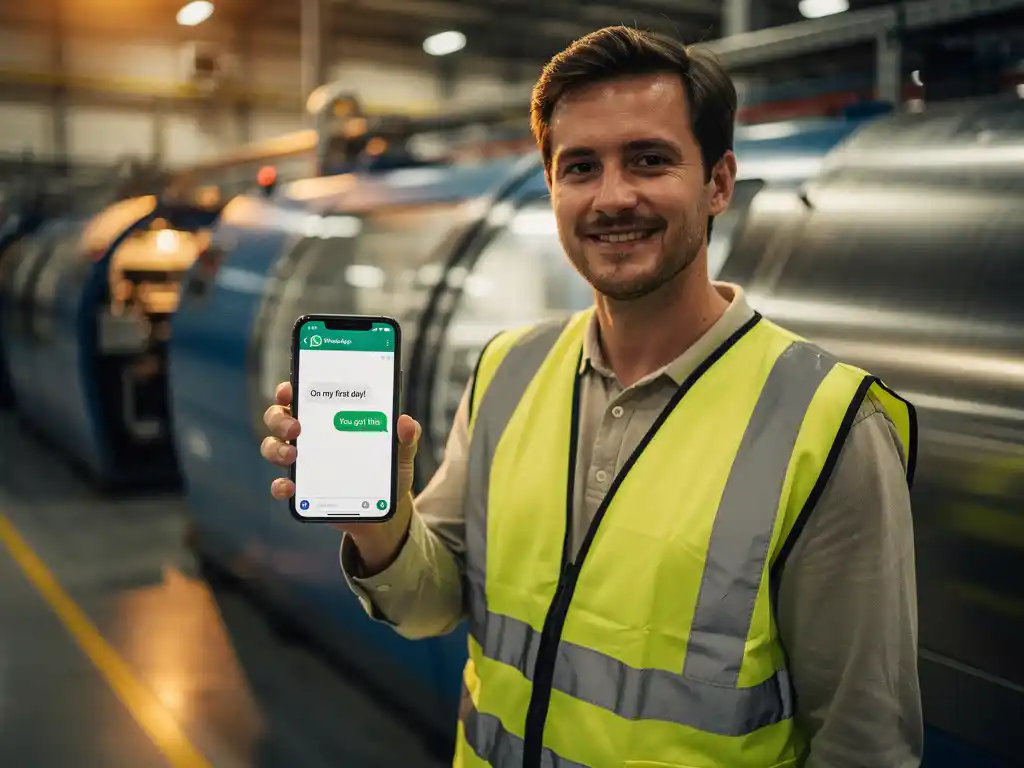
We built E-Lia specifically for teams that need fast, accessible, and multilingual training without the overhead of a traditional LMS. Our platform delivers short video-based microlearning modules directly via WhatsApp, the channel your production employees already use, with no app to download, no login required, and no computer needed on the floor.
Here is what makes E-Lia a practical fit for production onboarding:
- Build a module in 10 to 15 minutes: Create task-specific video modules quickly, without specialist design skills or a large content team.
- Employees complete modules in 3 to 6 minutes: Short, focused content that fits into a break or the moments before a new task begins.
- Automatic multilingual delivery: Send the same module to your entire team and each employee receives it in their own language.
- Progress tracking via dashboard: See exactly who has completed what, without chasing supervisors for updates.
- Pre-onboarding and scheduled delivery: Send the right content at the right moment in the onboarding timeline, automatically.
- No new app or login: Removes the friction that causes low engagement in traditional video onboarding programmes.
E-Lia also supports HACCP training for teams in food production and other regulated environments. If you want to see how this works in practice for a production or manufacturing team, plan a demo and we will walk you through it.
Frequently Asked Questions
Can we create effective onboarding videos without a professional camera crew or video production budget?
Yes — and in most cases, a smartphone and a basic tripod are all you need. Production employees respond better to authentic, floor-level footage than polished corporate video, so a modest setup filmed in the actual work environment will outperform an expensive studio production. Focus on clear framing, decent lighting, and minimal background noise. Many teams get strong results by having an experienced operator film themselves performing the task while a colleague holds the camera.
What is the biggest mistake companies make when rolling out video onboarding on the production floor?
The most common mistake is front-loading too much content before an employee ever sets foot on the floor, then providing no video support once they start working. Dumping ten videos on day one creates information overload and low retention. The more effective approach is to distribute content progressively — delivering each video just before the employee needs to perform that specific task, which is when learning sticks best.
How do we handle updating videos when processes or safety procedures change?
This is exactly why keeping videos short and task-specific pays off — when a process changes, you only need to reshoot a two-to-three minute clip rather than rebuild an entire module. Establish a simple version control habit: name files with a date or version number, archive outdated clips so they cannot be accidentally accessed, and assign one person ownership of each video topic so updates do not fall through the cracks. Building your library in modular segments from the start makes ongoing maintenance significantly easier.
How do we get buy-in from floor supervisors who are sceptical about video onboarding replacing hands-on training?
Video onboarding is not a replacement for hands-on training — it is preparation for it. Frame it to supervisors as a tool that reduces the number of times a new hire interrupts them with basic questions, and that ensures every employee arrives at their first task with the same baseline knowledge. Supervisors who pilot the programme typically become its strongest advocates once they see new hires performing with greater confidence and fewer early errors.
What should we do if employees are not completing the videos we send them?
Low completion is almost always a delivery or relevance problem, not a motivation problem. First, check whether the videos are reaching employees through a channel they actually use during their shift — a link sent to a work email account that production employees rarely check will be ignored. Second, review whether the content feels directly relevant to what the employee is doing that day. Videos that feel abstract or disconnected from immediate tasks get skipped; videos that answer a question the employee is about to face get watched.
How many videos should a complete production onboarding programme include?
A practical starting point is eight to twelve videos covering the core tasks, safety essentials, and equipment an employee will encounter in their first thirty days. Avoid the temptation to document every possible scenario before launching — start with the highest-risk and most frequently performed tasks, measure engagement and competency outcomes, and expand the library based on where gaps appear. A focused library of ten well-targeted videos will outperform a sprawling catalogue of forty that no one watches.
Is video onboarding compliant with workplace safety training requirements?
Video can form part of a compliant safety training programme, but whether it satisfies legal requirements depends on your jurisdiction and the specific regulation involved. In many cases, regulators require documented evidence that training was received and understood, which means completion tracking and knowledge check records are essential. Always cross-reference your video onboarding content against the specific safety standards that apply to your facility — in some cases, a practical sign-off by a supervisor will still be required alongside the video component.