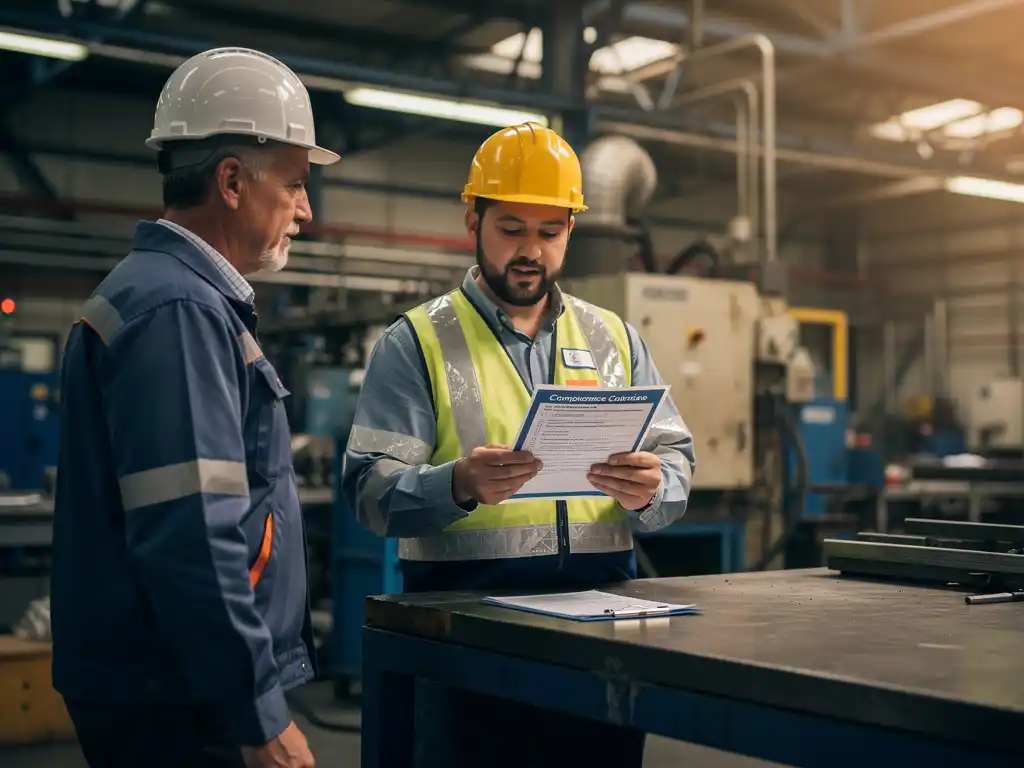



An effective onboarding programme for manufacturing companies combines safety training, hands-on skills development, clear process documentation, and structured mentoring into a cohesive experience that gets new workers productive quickly and safely. Unlike office-based onboarding, manufacturing onboarding must account for physical hazards, equipment operation, and compliance requirements from day one. The questions below break down exactly what that looks like in practice, from pre-onboarding through measuring results. If you want to explore how modern tools support this, book a demo to learn more.
What makes onboarding in manufacturing different from other industries?
Manufacturing onboarding is different because it carries immediate physical and operational consequences. A new office employee who misses a process step creates an inconvenience; a factory worker who misses a safety protocol can cause injury, equipment damage, or production downtime. This raises the stakes for every element of the onboarding process.
Several factors make employee onboarding in manufacturing uniquely demanding:
- Safety compliance is non-negotiable. Workers must understand hazard protocols, personal protective equipment requirements, and emergency procedures before they set foot on the production floor.
- Equipment proficiency is required quickly. Unlike knowledge-work roles where learning can happen over weeks, factory workers often need to operate machinery within their first days on the job.
- Shift patterns complicate scheduling. With rotating shifts and 24-hour operations, delivering consistent onboarding to every new hire at the right time is logistically challenging.
- Workforce diversity is the norm. Manufacturing teams frequently include workers with varying levels of formal education, different native languages, and mixed levels of digital literacy.
These characteristics mean that a generic onboarding programme borrowed from another industry will fall short. Manufacturing companies need purpose-built approaches that match the pace, environment, and risk profile of their operations. Learn more about how a dedicated onboarding solution can support your team.
What are the core elements of an effective manufacturing onboarding programme?
An effective manufacturing onboarding programme has six core elements: safety orientation, role-specific skills training, process and procedure documentation, a mentoring or buddy system, compliance sign-off, and clear performance milestones. Together, these ensure new employees are safe, capable, and confident in their roles.
Here is what each element contributes:
- Safety orientation: The foundation of any factory onboarding. Covers hazard identification, emergency exits, PPE use, and incident reporting before any other training begins.
- Role-specific skills training: Practical, hands-on instruction tied directly to the tasks the employee will perform. This should be broken into manageable steps rather than delivered as a single overwhelming session.
- Process and procedure documentation: Clear written or visual work instructions that employees can refer back to independently, reducing reliance on colleagues for every question.
- Mentoring or buddy system: Pairing new hires with experienced workers accelerates learning and builds team cohesion. It also gives new employees a trusted person to ask questions without fear of judgement.
- Compliance sign-off: Formal acknowledgement that employees have completed required training, protecting both the worker and the organisation from liability.
- Performance milestones: Defined checkpoints at 30, 60, and 90 days that give managers visibility into progress and give new hires a sense of direction.
Skipping any of these elements creates gaps that tend to show up later as safety incidents, quality issues, or early employee turnover.
How long should onboarding take for manufacturing employees?
Onboarding for manufacturing employees typically spans 30 to 90 days, with the most intensive phase in the first two weeks. The exact duration depends on role complexity, equipment requirements, and regulatory compliance obligations. A machine operator on a complex production line will need longer than a general warehouse operative.
A practical timeline looks like this:
- Days 1 to 5: Safety induction, site orientation, introduction to team and direct manager, and basic process overview.
- Weeks 2 to 4: Role-specific equipment training, shadowing experienced colleagues, and completing any mandatory certifications.
- Month 2: Supervised independent work, with regular check-ins to address gaps and reinforce correct procedures.
- Month 3: Full independent performance, with a structured review to confirm competency and identify any remaining development needs.
One common mistake is treating onboarding as complete after the first week. Research consistently shows that employees who receive structured support through their first 90 days are significantly more likely to stay with the organisation long-term. In manufacturing, where recruitment and training costs are high, this retention impact is a strong argument for investing in a thorough onboarding process for factory workers. Explore how the right tools help you retain and maintain knowledge across your workforce.
What role does pre-onboarding play in manufacturing readiness?
Pre-onboarding, the period between a job offer being accepted and the employee’s first day, plays a significant role in manufacturing readiness by reducing the information overload that typically hits new starters on day one. When companies share key information in advance, new employees arrive already familiar with safety basics, site rules, and what to expect.
Effective pre-onboarding for manufacturing typically includes:
- A welcome message that confirms logistics and sets a positive tone
- An overview of the facility, including a site map or virtual tour where possible
- Basic safety rules and PPE requirements so workers know what to bring or prepare
- An introduction to the team structure and direct line manager
- Any paperwork or compliance forms that can be completed before arrival
The practical benefit is significant. When a new factory worker arrives already knowing where to go, what to wear, and what the first day looks like, managers spend less time on administration and more time on hands-on training. Pre-onboarding also signals to new hires that the organisation is organised and values their time, which positively influences early engagement. See how a structured onboarding platform can make this process seamless.
How can manufacturing companies onboard multilingual workers effectively?
Manufacturing companies can onboard multilingual workers effectively by delivering training materials in each worker’s native language, using visual work instructions alongside text, and avoiding jargon-heavy content that creates barriers even for fluent speakers. Language should never be the reason a worker misses a critical safety instruction.
Practical strategies that work in multilingual manufacturing environments include:
- Translated training content: Core safety and process materials should be available in the languages spoken by your workforce, not just the official company language.
- Visual and icon-based instructions: Diagrams, photos, and step-by-step visual guides reduce dependence on text and work across language barriers. Structured work instructions are particularly effective here.
- Multilingual buddies: Where possible, pair new hires with a mentor who shares their language during the first critical weeks.
- Short, focused modules: Shorter training units are easier to process in a second language than long, dense documents. Breaking content into small steps reduces cognitive load.
- Comprehension checks: Use simple quizzes or practical demonstrations to confirm understanding rather than relying on a worker nodding along.
Multilingual manufacturing employee training is not just a courtesy; it is a safety obligation. An employee who does not fully understand a hazard warning because it was only delivered in a language they are still learning poses a real risk to themselves and their colleagues. Regular toolbox talks delivered in each worker’s own language can reinforce critical safety messages on an ongoing basis.
How do you measure whether a manufacturing onboarding programme is working?
You measure the effectiveness of a manufacturing onboarding programme by tracking a combination of safety metrics, productivity indicators, completion rates, and retention data. No single metric tells the full story, but together they give a clear picture of whether new employees are becoming safe, competent, and engaged members of the team.
Key metrics to monitor include:
- Training completion rates: Are new hires completing all required modules within the expected timeframe? Low completion rates signal a content or delivery problem.
- Time to full productivity: How long does it take a new employee to reach the expected output level for their role? A well-designed onboarding programme shortens this window.
- Safety incidents in the first 90 days: New employees are statistically more vulnerable to workplace accidents. Tracking incidents in this window reveals whether safety training is landing effectively. Structured workplace inspections can help identify risks before they result in incidents.
- 90-day retention rate: Early turnover is expensive and often signals that onboarding failed to meet expectations or left workers feeling unsupported.
- Manager and new hire feedback: Structured surveys at the 30 and 90-day marks surface qualitative insights that numbers alone cannot capture.
Regular review of these indicators allows organisations to continuously improve their onboarding elements for manufacturing rather than assuming a programme that worked last year still works today. In fast-moving production environments, processes change, equipment is updated, and compliance requirements evolve, so onboarding content needs to keep pace. Where food safety is involved, HACCP training should be built directly into the onboarding programme and reviewed regularly.
How E-Lia helps with onboarding in manufacturing
We built E-Lia specifically to solve the onboarding challenges that manufacturing companies face every day. Our platform delivers microlearning modules and work instructions directly via WhatsApp, meaning no app to download, no login to remember, and no computer required. New factory workers receive the right information at the right moment, in the language they understand best.
Here is what we offer manufacturing organisations:
- Fast content creation: Build a complete onboarding module in 10 to 15 minutes, and employees complete it in 3 to 6 minutes, keeping training time lean without sacrificing quality.
- Automatic translations: Train multilingual teams in their own language without creating separate versions of every module manually.
- Pre-onboarding via WhatsApp: Send safety basics, site introductions, and logistics information before day one, so new hires arrive prepared.
- Progress tracking dashboard: Monitor completion rates and results in real time, giving L&D managers and team leads the visibility they need to act quickly if someone falls behind.
- Scheduled and instant delivery: Send modules at the moment they are most relevant, whether that is the day before a first shift or immediately after a process change.
If you want to see how this works in practice for your production environment, plan a demo and we will walk you through it.
Frequently Asked Questions
What should we do if new hires fail a compliance sign-off or competency check during onboarding?
If a new hire fails a compliance check, treat it as a signal rather than a setback. Identify whether the gap is due to unclear training content, a language barrier, or insufficient practice time, then address the root cause before repeating the assessment. Avoid simply re-testing without additional support, as this rarely changes the outcome. Document the remediation steps taken to protect both the worker and the organisation from a compliance standpoint.
How do we onboard new employees who join mid-shift or outside of standard business hours?
The key is building an onboarding programme that does not depend on a trainer or manager being physically present at a specific time. Pre-recorded microlearning modules, digital work instructions, and WhatsApp-based training delivery allow new starters on night shifts or rotating schedules to complete core content independently at the right moment. Pair this with a designated buddy on each shift who can answer live questions and provide hands-on guidance. This approach ensures consistency regardless of when a new hire begins.
How do we keep onboarding content up to date when processes or equipment change frequently?
Assign clear ownership of each onboarding module to a specific role, such as a process engineer or team lead, who is responsible for updating content whenever a change occurs. Choose a training platform that makes editing quick and straightforward, so updates do not require specialist technical skills or long turnaround times. Build a review cycle into your change management process so that onboarding materials are automatically flagged for revision whenever a standard operating procedure is updated. Outdated onboarding content is one of the most common and most preventable causes of quality errors in manufacturing.
What are the most common mistakes manufacturing companies make when designing an onboarding programme?
The three most common mistakes are front-loading all training into day one, relying entirely on verbal instruction without written or visual support, and treating onboarding as finished after the first week. Front-loading overwhelms new hires and leads to poor retention of critical safety information. Verbal-only instruction leaves workers without a reference point when they encounter a situation independently on the floor. Cutting onboarding short at one week is particularly costly in manufacturing, where the 30 to 90-day window is when most early accidents and quality errors occur.
How do we get experienced workers to take the buddy or mentor role seriously?
Frame the buddy role as a recognition of expertise rather than an administrative task, and make sure experienced workers understand the direct impact they have on team safety and cohesion. Provide a brief structured guide outlining what the buddy is expected to cover and when, so the role has clear boundaries rather than being open-ended. Consider recognising strong mentors formally, whether through performance reviews, team acknowledgement, or small incentives. When experienced workers see that the role is valued and well-defined, engagement with it increases significantly.
At what point should we consider digitising our manufacturing onboarding programme?
If your current onboarding relies heavily on paper checklists, in-person briefings that are difficult to schedule consistently, or binders of procedures that workers rarely consult after day one, digitising is worth prioritising now rather than later. The clearest signals are high early turnover, recurring safety incidents among new starters, inconsistent training delivery across shifts, or difficulty proving compliance during audits. Digital onboarding does not have to mean a complex learning management system; lightweight tools delivered via familiar channels like WhatsApp can be implemented quickly and adopted easily even by workers with low digital literacy.
How do we balance thorough onboarding with the pressure to get new hires productive as quickly as possible?
The most effective approach is to sequence onboarding so that safety-critical and role-specific content comes first, enabling new hires to contribute to real work earlier while less urgent topics are covered in parallel over the following weeks. Microlearning modules, which take three to six minutes to complete, can be delivered during natural breaks in the working day without pulling workers off the floor for long sessions. Structured onboarding actually accelerates time to productivity rather than delaying it, because workers who understand their tasks and environment from the start make fewer errors and require less supervision. The short-term investment in thorough onboarding consistently outweighs the cost of mistakes, rework, and turnover caused by rushing it.