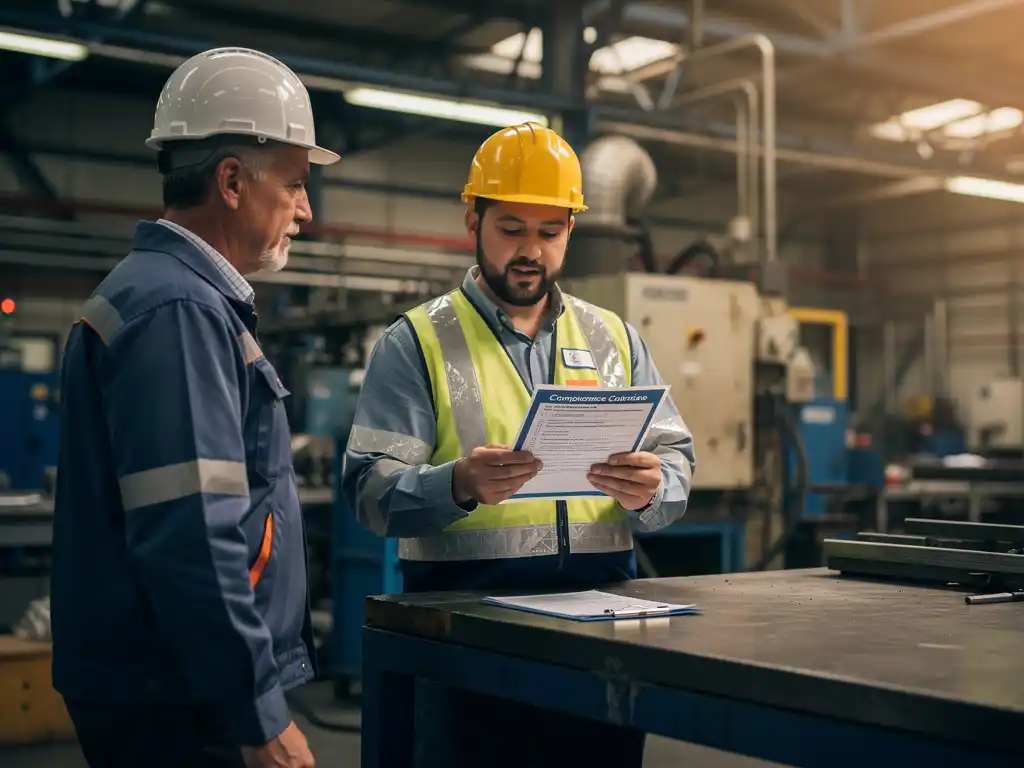



The most effective onboarding tips for HR managers in manufacturing companies centre on speed, clarity, and accessibility. New employees on the shop floor need practical, role-specific information fast, delivered in a format that fits their working environment rather than a classroom or desk. The questions below unpack each stage of the manufacturing onboarding process, from structuring day one to measuring long-term results, so you can build a programme that actually sticks. For more information or to speak with our team, book a meeting with us here.
Why is onboarding in manufacturing different from other sectors?
Manufacturing onboarding is different because new employees must become operationally safe and productive within days, not weeks. Unlike office roles where mistakes are easily corrected, errors on the shop floor carry real safety and quality consequences. This makes structured, role-specific onboarding not just a nice-to-have but a genuine operational necessity for manufacturing companies.
The physical environment adds another layer of complexity. Workers are rarely sitting at a desk with time to read through lengthy manuals or complete multi-hour e-learning courses. Onboarding content needs to be short, visual, and accessible from wherever the employee is standing. Add to this the reality that many manufacturing workforces are multilingual, shift-based, and experience high turnover, and it becomes clear why a generic HR onboarding approach rarely translates well to this sector.
Finally, manufacturing onboarding must align tightly with compliance and certification requirements. Whether that involves machine operation protocols, hygiene standards, or safety procedures, new employees need to demonstrate competence quickly, and HR managers need a reliable way to track that. Learn more about how a structured onboarding programme can support this process.
What are the most common onboarding mistakes HR managers make in manufacturing companies?
The most common onboarding mistakes in manufacturing include information overload on day one, relying on paper-based materials, and failing to follow up after initial training. These mistakes leave new employees feeling overwhelmed or underprepared, which directly affects both safety and early retention.
Here are the mistakes that come up most often in manufacturing onboarding programmes:
- Dumping everything at once: Handing new starters a thick folder of procedures on their first day rarely leads to retention. People absorb information better when it is spaced out and tied to what they are actually doing.
- Relying on a single experienced colleague: Buddy systems have value, but when onboarding depends entirely on one person’s availability and communication style, quality becomes inconsistent.
- Skipping pre-onboarding: Many HR managers wait until day one to start. Sending key information before the first shift, such as what to wear, where to park, and what to expect, reduces first-day anxiety and saves time.
- No structured follow-up: Onboarding that stops after week one leaves employees to figure things out on their own. Regular check-ins and short refresher moments in the first month make a measurable difference.
- Ignoring language barriers: In multilingual teams, assuming everyone understood the same message is a significant risk, both for safety and for employee confidence.
How can HR managers structure the first week for new manufacturing employees?
HR managers should structure the first week of manufacturing onboarding by spreading content across each day in small, focused doses rather than front-loading everything. A well-paced first week builds confidence, reinforces safety awareness, and gives employees time to practise what they learn before moving on to the next topic.
A practical first-week structure might look like this:
- Day one: Welcome, safety essentials, facility orientation, and a brief introduction to the team and shift structure. Keep it focused on what the employee needs to know to stay safe and feel settled.
- Day two: Role-specific procedures, equipment basics, and a walkthrough of the most common tasks they will perform. Pair this with a short practical demonstration.
- Day three: Quality standards, reporting procedures, and an introduction to any relevant compliance requirements. Use real examples from the floor where possible.
- Day four: Reinforce earlier content with a short knowledge check or recap, then introduce communication channels, shift handover processes, and who to contact for what.
- Day five: A brief review of the week, space for questions, and a clear outline of what the first month will involve. Set expectations for any upcoming assessments or certifications.
The key principle is not to overwhelm. Each day should have a clear theme, and each topic should connect directly to what the employee will encounter on the floor that same day or the next. Explore how retaining and maintaining knowledge can be built into your onboarding structure from day one.
What training formats work best on the manufacturing shop floor?
The training formats that work best on the manufacturing shop floor are short, mobile-friendly, and visual. Microlearning modules, short instructional videos, and step-by-step visual guides consistently outperform long written manuals in environments where employees are on their feet, working in shifts, and often under time pressure.
The format matters as much as the content. If new employees need to stop work, find a computer, log in to a system, and navigate a course platform just to access training, most will not bother. Training that arrives directly on a device they already use, in bite-sized pieces they can complete in a few minutes, fits naturally into the rhythm of a manufacturing day.
Effective formats include:
- Microlearning modules: Short, focused lessons covering one topic at a time. Completing a module in three to five minutes makes it realistic to train during a break or before a shift starts.
- Visual work instructions: Step-by-step guides with images or short video clips are particularly effective for machine operation, assembly tasks, and hygiene procedures. See how digital work instructions can replace paper-based guides on the floor.
- Scenario-based questions: Brief knowledge checks that present a realistic situation and ask the employee to choose the correct response reinforce learning without feeling like a formal exam.
- On-the-job coaching: Structured moments where a team leader or trainer observes and gives feedback remain valuable for hands-on skills that cannot be fully captured in digital content.
How do you onboard multilingual workers in a manufacturing environment?
To onboard multilingual workers effectively in manufacturing, deliver training content in each employee’s preferred language rather than relying on translation by colleagues or supervisors. Language barriers in onboarding are not just a communication inconvenience, they are a direct safety risk when employees misunderstand procedures, equipment warnings, or emergency protocols.
Practical steps for multilingual onboarding in manufacturing include:
- Identify language needs before day one: Know which languages are represented in your workforce and plan your content accordingly. This is especially important for safety-critical information.
- Use automatic translation in your training tools: Platforms that support automatic translation allow HR managers to create a module once and deliver it in multiple languages without rebuilding content from scratch.
- Prioritise visual content: Images, diagrams, and short video demonstrations reduce language dependency for procedural tasks. A worker who sees the correct sequence of steps needs less text-based instruction.
- Avoid relying on bilingual colleagues as informal translators: This creates inconsistency and puts an unfair burden on those employees. Structured multilingual content ensures every worker receives the same information.
- Check comprehension, not just completion: A worker who has completed a module in their own language should still be asked to demonstrate understanding, either through a knowledge check or a practical observation.
How do you measure whether your manufacturing onboarding programme is working?
You measure the effectiveness of a manufacturing onboarding programme by tracking a combination of completion rates, knowledge retention, time-to-productivity, and early turnover. No single metric tells the full story, but together they reveal whether new employees are genuinely prepared or just going through the motions.
Key indicators to monitor include:
- Module completion rates: Are employees finishing the training they are assigned? Low completion often signals that the format is inconvenient or the content is not relevant to their role.
- Knowledge check scores: How well do employees perform on post-module questions? A pattern of low scores on a specific topic may indicate the content needs to be clearer or more visual.
- Time to independent performance: How long does it take a new employee to carry out their core tasks without supervision? A shorter timeline generally reflects a more effective onboarding process.
- Safety incidents in the first 90 days: New employees are statistically more vulnerable to workplace accidents. Tracking incidents in this period helps you identify gaps in safety onboarding. Regular workplace inspections and toolbox talks can help close those gaps.
- 30, 60, and 90-day retention: High early turnover is often a sign that onboarding failed to set clear expectations or make employees feel supported.
Collecting this data requires a system that tracks progress automatically and presents it in a way that HR managers can act on. Manual tracking through spreadsheets is time-consuming and prone to gaps, particularly in large or shift-based teams.
How E-Lia helps with onboarding in manufacturing
We built E-Lia specifically to solve the onboarding challenges that manufacturing HR managers face every day. Our platform delivers microlearning modules, work instructions, and knowledge checks directly via WhatsApp, without requiring employees to download an app, create an account, or find a computer. This makes training genuinely accessible on the shop floor, during breaks, or before a shift begins.
Here is what E-Lia brings to manufacturing onboarding:
- Fast module creation: Build a complete onboarding module in 10 to 15 minutes. Employees complete it in 3 to 6 minutes.
- Automatic translation: Deliver the same content in multiple languages so every employee, regardless of their background, receives clear and accurate information.
- Scheduled delivery: Plan modules to arrive at the right moment, whether that is before day one, at the start of each shift, or as a 30-day follow-up.
- Progress dashboard: Track completion rates and knowledge check results across your entire team in real time, without chasing individuals for updates.
- No login required: Because training arrives via WhatsApp, there is no barrier between the employee and the content. They open a message, complete the module, and move on.
E-Lia also supports HACCP training for manufacturing environments where food safety compliance is a requirement. Whether you are onboarding five new starters or five hundred, E-Lia makes the process consistent, measurable, and genuinely easy to manage. Plan a demo to see how it works in practice.
Frequently Asked Questions
How long should a manufacturing onboarding programme last in total?
A structured manufacturing onboarding programme typically spans 90 days, with the most intensive training concentrated in the first two weeks. After the initial week of role-specific and safety content, the following weeks should include spaced repetition, short refresher modules, and regular check-ins to reinforce what was learned on the floor. The 90-day mark is a natural milestone for a formal review, as it aligns with when most early turnover decisions are made and gives you a meaningful window to assess time-to-productivity.
What should we do if a new employee fails a knowledge check during onboarding?
A failed knowledge check should trigger a targeted follow-up, not a full restart of the onboarding programme. Identify the specific topic or module where the employee struggled and reassign only that content, ideally in a slightly different format such as a visual guide or a short video if the original was text-based. Treat low scores as a signal about the content as much as the learner — if multiple employees fail the same check, the module likely needs to be clearer or more practical.
How do we handle onboarding for temporary or seasonal workers without overloading our HR team?
The key is building a reusable, standardised onboarding flow that can be triggered for any new starter without manual setup each time. Using a platform that allows you to schedule and automate module delivery means your HR team only needs to build the content once and assign it as needed, regardless of how many temporary workers join at once. Focus the content for short-term workers on safety essentials, role-specific procedures, and compliance requirements, keeping it lean and directly relevant to their specific tasks.
At what point should onboarding transition into ongoing training or development?
Onboarding should naturally transition into ongoing training once a new employee can perform their core tasks independently and has met any initial compliance or certification requirements — typically around the 60 to 90-day mark. From that point, training shifts from foundational knowledge to performance improvement, skills development, and keeping employees up to date with procedure changes or new equipment. The most effective programmes make this transition seamless by using the same training format and tools employees already know from onboarding.
How do we get buy-in from team leaders and supervisors to support the onboarding process?
Team leaders are far more likely to support onboarding when their role in it is clearly defined, time-efficient, and tied to outcomes they care about, such as fewer errors, faster independent performance, and reduced interruptions from new starters asking basic questions. Brief them on what the digital training covers so they know what employees have already learned before arriving on the floor, and give them visibility into completion data so they can follow up with confidence. When supervisors see onboarding as something that reduces their workload rather than adding to it, engagement follows naturally.
Can we use the same onboarding content for different roles or production lines, or does everything need to be built from scratch?
A well-structured manufacturing onboarding programme should have a modular architecture: a core track covering company-wide safety, compliance, and culture that applies to every new employee, plus role-specific modules that are swapped in depending on the position. This approach means you build shared content once and only create new material for what is genuinely different between roles. Most platforms that support manufacturing training allow you to clone and adapt existing modules, which significantly reduces the time needed to onboard workers across different departments or production lines.
What is the best way to collect feedback from new employees about the onboarding experience?
The most practical approach is to embed a short feedback moment directly into the onboarding flow, such as a two or three-question pulse check at the end of week one and again at the 30-day mark. Keep it brief and specific — ask whether the training was clear, whether they felt prepared for their tasks, and what was missing. This feedback loop not only helps you improve the programme over time but also signals to new employees that their experience matters, which itself contributes to early retention.