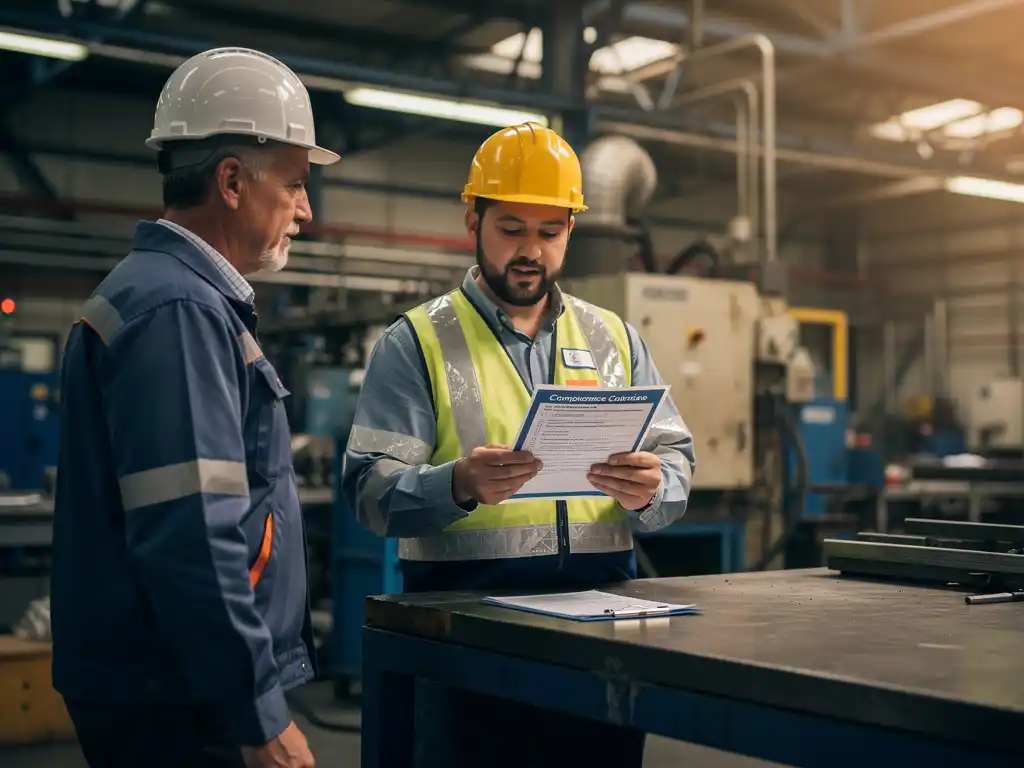



A strong onboarding checklist for the production floor must include safety training, equipment handling procedures, emergency protocols, role-specific task instructions, and a clear introduction to team workflows. Unlike office onboarding, production floor onboarding is hands-on, time-sensitive, and directly tied to workplace safety and operational output. The sections below break down each essential element so you can build a checklist that actually prepares new employees to hit the ground running.
What makes onboarding on the production floor different from office onboarding?
Production floor onboarding is fundamentally different from office onboarding because the stakes are higher from day one. A new office employee who misses a process can catch up gradually. A new production employee who misses a safety instruction or operating procedure can put themselves and their colleagues at risk immediately. The environment is physical, fast-paced, and often loud, which changes how and when learning needs to happen.
Office onboarding typically relies on reading documents, attending meetings, and exploring software at a desk. On the production floor, employees need to absorb information quickly and apply it on the move. They often cannot pause for long training sessions mid-shift, and many will not have access to a computer or company email during working hours.
This means your production employee onboarding approach needs to be bite-sized, practical, and accessible on the spot. Information must be delivered in short bursts, tied directly to tasks, and easy to revisit without disrupting the workflow. A checklist that works for a marketing hire will not serve a machine operator, a warehouse picker, or a line supervisor. Learn more about how a structured onboarding programme can support your production teams.
What safety items must be on every production floor onboarding checklist?
Every manufacturing onboarding checklist must include safety as its foundation. Before a new employee touches any equipment or joins a production line, they need to understand the rules that keep them and their colleagues safe. Skipping or rushing this part is not just a compliance risk — it is a genuine hazard.
The non-negotiable safety items for any production floor onboarding checklist include:
- Personal protective equipment (PPE) requirements — what to wear, when, and why
- Emergency exit locations and evacuation procedures
- Fire safety and first aid point locations
- Machine-specific hazard warnings and lockout/tagout procedures
- Incident and near-miss reporting processes
- Hygiene and contamination rules (especially relevant in food production or healthcare manufacturing)
- Noise and chemical exposure guidelines
Beyond the basics, safety onboarding should also cover the specific risks of each role. A forklift operator needs different safety knowledge than someone working on a packaging line. Tailor the safety section of your checklist to the actual tasks the employee will perform, not just the general site rules. Regular toolbox talks are an effective way to reinforce safety awareness after the initial onboarding phase.
How do you onboard production employees who speak different languages?
To onboard production employees who speak different languages, deliver training materials in each employee’s native language rather than expecting them to manage in a language they are still learning. This is not just about inclusion — it is about safety. An employee who does not fully understand a machine instruction or emergency protocol is a risk to themselves and the team.
In practice, this means your onboarding new employees in manufacturing process should include translated versions of all critical documents: safety procedures, task instructions, emergency protocols, and team communication norms. The challenge is keeping these translations up to date when processes change.
Digital tools that support automatic translation make this significantly easier. Rather than maintaining separate document versions for each language, you can create one piece of content and have it automatically delivered in the language each employee understands best. This keeps your checklist consistent while removing language as a barrier to learning and compliance.
It also helps to pair new multilingual employees with a buddy or team lead who speaks their language during the first few shifts. Written or digital materials cover the structured knowledge, but real-time support during the first days builds confidence and catches misunderstandings before they become problems.
What role do digital tools play in production floor onboarding?
Digital tools play a critical role in making production floor onboarding consistent, scalable, and trackable. Without them, onboarding quality depends entirely on which supervisor is available on a given day, how much time they have, and how well they communicate. Digital tools remove that variability by ensuring every new employee receives the same information in the same structured format.
The most effective digital tools for production onboarding share a few key characteristics. They are mobile-friendly, because production employees rarely work at a desk. They are easy to access without logging into a system, because friction reduces completion rates. And they deliver information in short, focused modules rather than long documents, because attention is limited during a busy shift.
Tools that work through channels employees already use — like messaging apps — tend to see much higher engagement than platforms that require a new login or app download. When an employee receives a short training module on a familiar interface, they are far more likely to complete it than if they are directed to a separate learning management system they have never seen before.
Progress tracking is another major advantage of digital tools. Instead of relying on a paper sign-off sheet, managers can see in real time who has completed which modules, where people are getting stuck, and who needs a follow-up. This makes the onboarding checklist for the production floor far easier to manage at scale. Digital tools can also support clear work instructions and help employees retain and maintain knowledge long after their first week.
How long should onboarding take for a production floor employee?
For most production floor roles, effective onboarding takes between one and four weeks, depending on the complexity of the role and the pace of the production environment. The first few days should focus on safety and orientation. The following days and weeks build role-specific knowledge, equipment handling, and integration into team workflows.
That said, formal onboarding and ongoing learning are not the same thing. A new employee might be independently operational after two weeks, but they will continue to absorb nuances of the role, pick up efficiency habits, and deepen their product or process knowledge for months after that. Your checklist should cover the structured phase, but your learning culture should support the rest.
One common mistake is front-loading too much information in the first day or two. A new employee on a production floor is already processing a huge amount of sensory and social information — new sounds, new faces, new physical demands. Spreading onboarding content across the first two to four weeks in short, focused sessions leads to better retention than a full-day information dump on day one.
Short modules of three to six minutes, delivered at relevant moments during the working day, are far more effective than hour-long training blocks. This approach respects the employee’s time and cognitive load whilst still covering everything on your checklist.
How do you measure whether production floor onboarding is working?
You measure the effectiveness of production employee onboarding by tracking both completion data and real-world outcomes. Completion rates tell you whether employees are engaging with the content. Outcome data tells you whether that engagement is translating into the behaviour and performance you need on the floor.
Key metrics to track include:
- Module completion rates — are employees finishing the onboarding content?
- Quiz or knowledge check scores — are they understanding what they have learnt?
- Time to full productivity — how quickly does a new hire reach the expected output level?
- Safety incident rates among new employees — are onboarded employees following safety protocols?
- Early turnover rates — employees who leave within the first 90 days often signal an onboarding problem
- Manager feedback — are supervisors noticing gaps in knowledge or behaviour after onboarding?
If completion rates are high but performance gaps remain, the content itself may need updating. If completion rates are low, the delivery method is the likely problem. A checklist that lives in a folder no one opens is not an onboarding tool — it is a document.
Regular reviews of your onboarding checklist, at least once or twice per year, help you stay aligned with any process changes, new equipment, updated safety regulations, or shifts in team composition. Onboarding is not a one-time build — it is a living system. Incorporating regular workplace inspections into your review cycle also helps identify gaps between what employees have learnt and what is actually happening on the floor.
How E-Lia helps with production floor onboarding
We built E-Lia specifically for the kind of onboarding challenges that production environments face every day. Our platform delivers microlearning modules directly via WhatsApp — no app to download, no login required, no computer needed. That means your production employees can receive and complete onboarding content on the same phone they already use, during a break or between tasks, in a format that feels natural rather than forced.
Here is what makes E-Lia a practical fit for manufacturing and production onboarding:
- Modules take 10 to 15 minutes to build and three to six minutes to complete — fast for you, easy for new hires
- Automatic translation means multilingual teams receive content in their own language without extra manual work
- Scheduled delivery lets you spread onboarding across the first days or weeks instead of overwhelming employees on day one
- Progress tracking via a dashboard shows you exactly who has completed what, so nothing falls through the cracks
- No login or app required removes the friction that causes low completion rates on traditional platforms
- Works across sectors including healthcare, logistics, retail, and production — already trusted by organisations like Erasmus MC and the University of Utrecht
E-Lia also supports HACCP training for food production environments, making it straightforward to meet compliance requirements as part of your standard onboarding flow. If you want to see how this works in practice, plan a demo and we will walk you through a live example.
Frequently Asked Questions
Can we use the same onboarding checklist for every role on the production floor?
No — while a core checklist covering site safety, emergency procedures, and general orientation can apply to all new hires, the role-specific sections must be tailored. A forklift operator, a line technician, and a quality control inspector each face different hazards and follow different workflows. Using a single generic checklist for all roles increases the risk of knowledge gaps that only show up once someone is already on the floor unsupervised.
What is the biggest mistake companies make when onboarding production employees?
The most common mistake is front-loading all onboarding content into the first day or two, then assuming the job is done. New production employees are already dealing with unfamiliar physical environments, new colleagues, and high sensory input — adding hours of training on top of that leads to poor retention, not better preparation. Spreading content across the first two to four weeks in short, focused sessions consistently produces better results than a single information-heavy induction day.
How do we keep our onboarding checklist up to date when processes or equipment change?
Assign a clear owner for the onboarding checklist — typically a production manager or HR lead — and schedule a formal review at least twice a year, or immediately after any significant process change, equipment upgrade, or regulatory update. Digital onboarding tools make this much easier, since you can update a module once and it automatically reflects the change for all future employees, rather than having to reprint or redistribute paper documents.
How do we onboard temporary or seasonal production workers without sacrificing quality?
The key is having a streamlined version of your full checklist ready specifically for short-term workers — one that prioritises the non-negotiables (safety, PPE, emergency procedures, core task instructions) without the deeper role integration content that longer-term employees need. Digital microlearning tools are particularly effective here because modules can be assigned and completed quickly, tracked automatically, and don’t require a supervisor to be physically present for every step of the process.
At what point during onboarding should a new production employee start working independently?
There is no universal answer, but a practical approach is to use a supervised buddy period for the first three to five shifts before allowing any independent operation of machinery or equipment. Independence should be tied to demonstrated competency — confirmed through a practical check or knowledge assessment — rather than simply the number of days elapsed. Rushing this step to fill a productivity gap is one of the leading causes of early-tenure safety incidents.
How do we get buy-in from floor supervisors to actually follow the onboarding checklist?
Supervisors are more likely to follow a checklist they helped shape, so involve them in the design process and ask for feedback on what is missing or impractical. It also helps to reduce the manual burden on their end — if completing the checklist means filling out paperwork or running hour-long training sessions, compliance will be inconsistent. Digital tools that handle delivery, tracking, and reminders automatically free supervisors to focus on hands-on mentoring rather than administrative oversight.
What should we do if a new employee fails a knowledge check during onboarding?
A failed knowledge check is a signal to revisit the content, not to penalise the employee. First, check whether the question or module was clear and well-structured — sometimes a low score reflects a content problem rather than a knowledge gap. If the content is sound, schedule a brief one-on-one with the employee or their buddy to walk through the material again before retesting. Never allow an employee to move on to unsupervised equipment operation until they have demonstrated sufficient understanding of the relevant safety and task procedures.