

Safety communication works best as an ongoing process, not as a monthly obligation. When safety only appears on the agenda at fixed moments, information is less likely to stick and employees do not become familiar with it in their day-to-day work. The questions below help you understand why that is and how to approach it differently.
Why does safety communication fail as a monthly obligation?
Safety communication fails as a monthly obligation because employees do not connect the information to their daily working practice. A single session per month is too far removed from the moments when risks actually occur. As a result, the message quickly fades into the background and little changes in behaviour on the work floor.
There are a few patterns that reinforce this problem. First, the timing is rarely ideal. A toolbox that takes place on a fixed day of the month rarely aligns with current risks or recent incidents. Second, the format is often passive: employees sit, listen, and sign a list. Active involvement is absent. Third, the information is rarely repeated or reinforced, so the effect quickly fades.
Safety behaviour does not change through a single exposure to information. It requires repetition, relevance, and recognition in practice. When safety communication is treated purely as an administrative obligation, employees sense that too. The toolbox becomes something you “tick off”, not something that helps you work more safely.
What is the difference between safety training and safety communication?
Safety training is focused on acquiring knowledge and skills, such as the correct use of personal protective equipment or recognising hazardous situations. Safety communication is broader: it encompasses all the ways in which an organisation shares safety information, makes it open for discussion, and keeps it alive on the work floor, including outside formal training moments.
The distinction matters because both require a different approach.
- Safety training has a beginning and an end. You learn something, you check whether it has been understood, and you complete the training. Think of an onboarding module on safe lifting or an instruction on hazardous substances.
- Safety communication has no endpoint. It concerns the daily flow of information: a reminder about a changed work procedure, a notification about a near-miss, a brief update about a new risk situation on site.
Organisations that focus solely on training miss the communicative element. They build knowledge but do not maintain it. Safety communication is what keeps the knowledge from training alive and applicable in everyday practice. Both are necessary, but they complement each other rather than one replacing the other.
How do you make safety a daily part of the work floor?
Making safety a daily part of the work floor requires short, frequent moments of contact that fit the rhythm of the work floor. Not one large session per month, but small, targeted signals that regularly remind employees of relevant risks and safe behaviour. The key lies in repetition and recognisability, not in scale.
Practical ways to achieve this:
- Link safety information to current situations. Share a brief instruction immediately after an incident or near-miss has occurred. That makes the information concrete and relevant.
- Use microlearning. Short modules of a few minutes are easier to absorb than long sessions. Employees can complete them at their own time, without work needing to stop.
- Make managers part of the communication. When a team leader raises safety topics during work, that reinforces the message more than a formal session does.
- Repeat key messages at different moments. Hearing something once is not enough. Repetition through different channels and at different moments helps to embed information.
- Make it two-way. Ask employees to report signals, near-misses, and areas for improvement. Those who feel heard are more engaged with safety.
Daily safety communication does not have to take up much time. It is about regularity and relevance, not about extensive programmes.
Which channels work best for continuous safety communication?
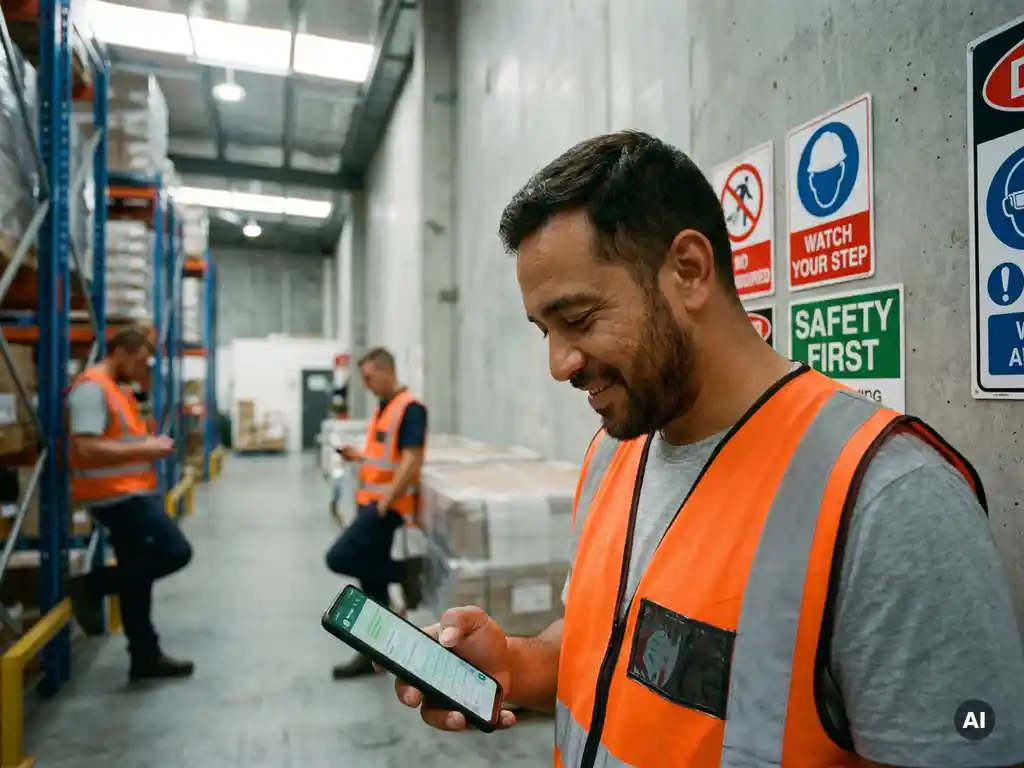
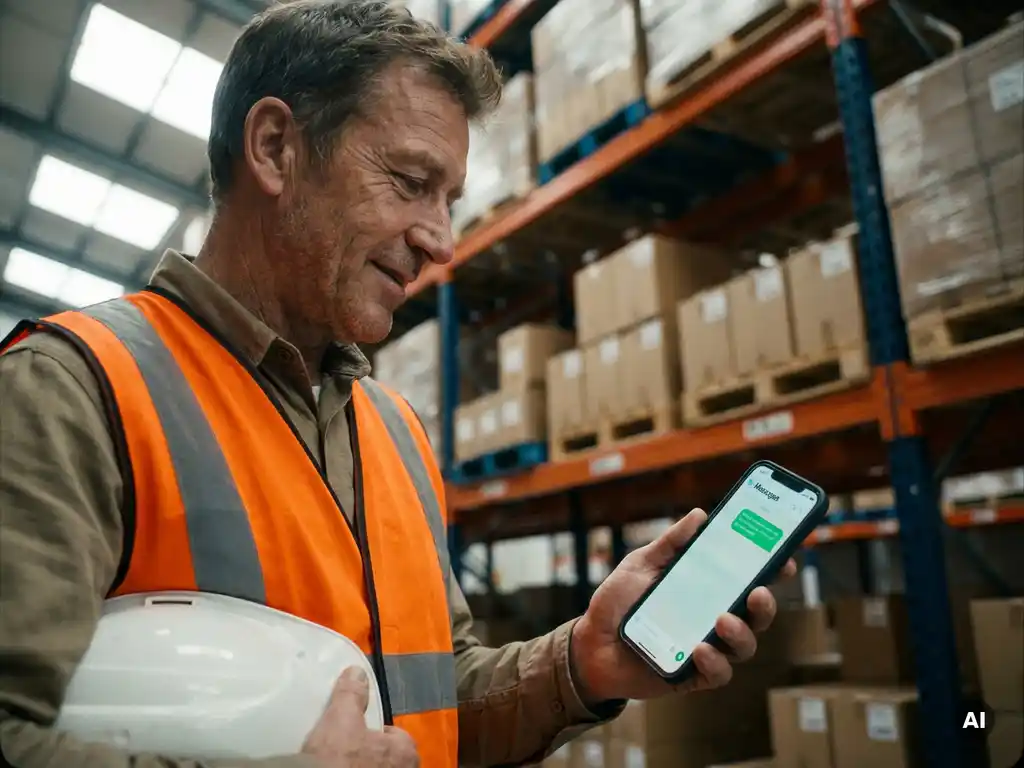
The best channels for continuous safety communication are the channels employees already use every day. For employees on the work floor, without a fixed workstation or business email address, that almost always means their smartphone. A channel that requires extra steps, such as logging into a system or downloading a new app, raises the barrier to participation.
Channels that work well for operational employees
WhatsApp is a familiar and accessible way of communicating for many employees. Instructions, toolboxes, and knowledge checks delivered via WhatsApp reach employees directly on their phone, without any additional steps. That makes the channel particularly suitable for organisations in construction, logistics, manufacturing, and healthcare, where employees work in dispersed locations and have no fixed workstation.
Channels that are less suited to continuous communication
Email works well for employees with a business address, but does not reach a large proportion of the operational workforce. Intranets and LMS systems often require a login and are therefore less suited to fast, frequent communication. Printed materials are difficult to update and offer no way to register or assess participation.
The channel partly determines whether safety communication actually gets through. A good message on the wrong channel does not reach the employee.
How do you measure whether safety communication is actually having an effect?
You measure the effect of safety communication by looking at three levels: reach, understanding, and behaviour. Reach tells you how many employees have received and opened the information. Understanding is measured through knowledge checks or brief questions after an instruction. Behaviour is the hardest to measure, but is visible through signals such as the number of near-misses reported, observations on the work floor, and trends in safety incidents.
Concrete measurement points you can track:
- Participation rate: how many employees have actually received and completed an instruction or toolbox?
- Results of knowledge checks: do employees understand the content, or are there topics that need to be repeated?
- Reporting behaviour: are employees reporting near-misses or unsafe situations more frequently? That is a positive sign of engagement.
- Repeat behaviour after incorrect answers: when an employee does not pass a knowledge check, is a repeat offered? And do they pass it afterwards?
Measuring is also a way to make adjustments. When a topic scores poorly on understanding, that is a signal that the communication needs to be sharpened, not that employees are unwilling to understand it. Good data help you make safety communication more targeted and effective.
How E-lia helps with continuous safety communication
With our platform, you transform safety communication from a monthly moment into an ongoing process, delivered directly via WhatsApp. Employees receive instructions, toolboxes, and knowledge checks straight on their phone, without an additional app or login procedure. That makes it accessible for everyone on the work floor, including employees without a business email address or laptop.
What you can concretely do with E-lia:
- Send toolbox meetings digitally and automatically register participation, including knowledge checks
- Schedule or immediately send safety instructions, tailored to current situations
- Offer content in more than 50 languages via AI-supported translations, so that employees who speak other languages also receive the information in their own language
- Make progress and participation visible via a live dashboard, so you can immediately see who has not yet participated
- Choose from a library of practical safety topics, updated monthly
Would you like to see what continuous safety communication looks like in practice for your organisation? Get in touch with us and discover what E-lia can mean for your work floor.