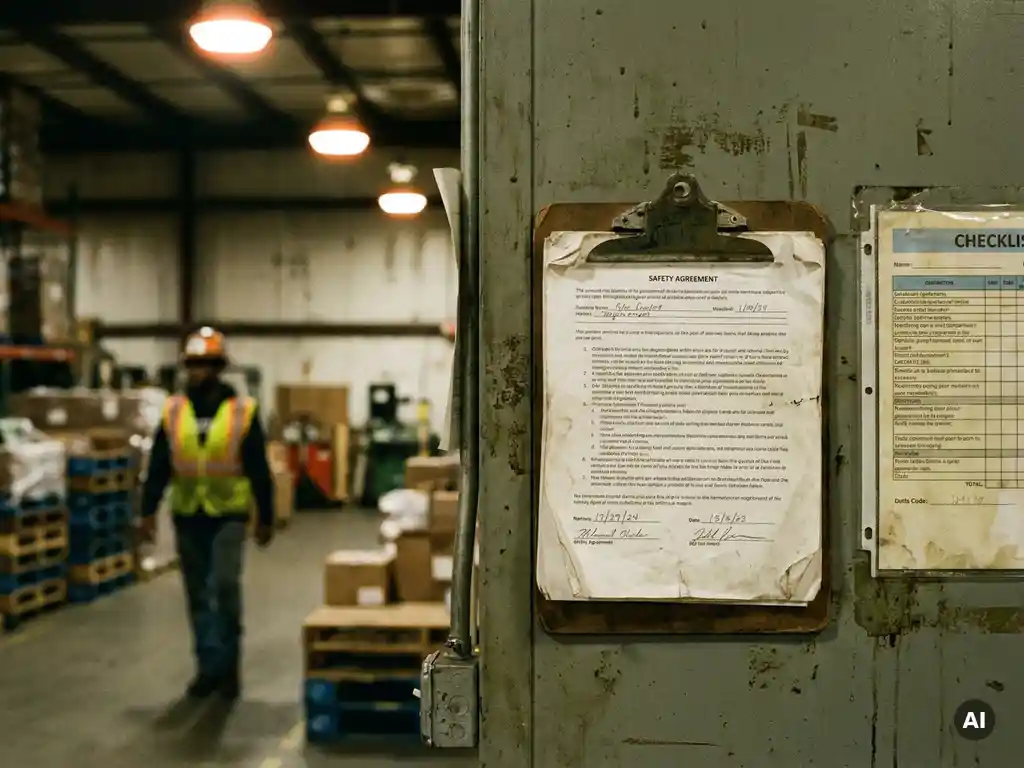
Maintaining safety agreements over months requires more than a one-off instruction. The core of the problem is that knowledge fades and routines deteriorate, particularly when there is no regular repetition and active follow-up. In this article, we answer the most frequently asked questions about how to keep safety agreements structurally alive on the work floor.
Why do employees forget safety agreements over time?
Employees forget safety agreements over time because human memory gradually allows information that is not regularly repeated or applied to fade into the background. This is not a matter of unwillingness, but of how learning works. Without repetition and practical application, even well-understood information recedes into the background.
Added to this is the fact that safety rules in day-to-day work pressure often compete with other priorities. When an employee carries out the same actions day after day without anything going wrong, the sense of urgency diminishes. Safety agreements then tend to be seen as something that applies to “new people”, not as something that needs to be actively maintained.
The way in which instructions are delivered also plays a role. A lengthy presentation or a thick folder of rules makes little impression on the work floor. Information that does not connect with the employee’s daily practice sticks less well than concrete, recognisable examples.
How long do safety instructions remain retained after a one-off training?
After a one-off training, memory begins to fade quickly. Without repetition or application, a large portion of the information provided is no longer actively available within days or weeks. How quickly this happens depends on the complexity of the instruction, its relevance to daily work, and whether the employee has used the knowledge afterwards.
This means that a one-off safety training during onboarding or at the start of a project is insufficient to ensure compliance in the long term. It is a good starting point, but not an endpoint. Safety instructions need to be repeated, preferably at moments that connect with current work activities or recent situations on the work floor.
Short, focused repetitions work better than lengthy sessions. A brief reminder of a specific agreement, linked to a concrete situation, has more effect than an extensive repetition of all the rules at once. Frequency and relevance are the two most important factors in this.
What is the difference between knowing safety rules and complying with them?
Knowing safety rules means that an employee understands the content of the agreements and can articulate them. Complying means that the same employee also actually applies those agreements in their daily work, even when no one is watching. That difference is greater than it appears.
Knowledge is a prerequisite for compliance, but not a guarantee. An employee may know exactly that they must wear personal protective equipment, but still fail to do so because it is uncomfortable, because colleagues do not do so either, or because there are no visible consequences. Behaviour is not determined solely by knowledge, but also by habit, social norms, and the working environment.
Compliance therefore requires more than instruction alone. It requires a work culture in which safe behaviour is the norm, managers who lead by example, and an environment that makes safe working easy. Only when those elements come together does knowledge translate into consistent behaviour.
How do you ensure regular repetition without overwhelming employees?
Regular repetition works best when you offer small amounts of information at moments that connect with the work. Short, focused safety instructions that address one topic are more effective than extensive sessions that try to cover everything at once. This keeps the repetition manageable and relevant.
Toolbox talks as a regular safety discussion are a tried-and-tested approach for this. A toolbox talk is a short safety discussion in which one current topic takes centre stage, directly linked to the work activities of that moment. Because the topic is recognisable and concrete, the instructions land better than abstract rules from a handbook.
Practical tips for repetition without overload:
- Choose one specific topic per repetition, not an overview of all the rules
- Link the topic to a current situation, a recent near-miss, or a seasonal risk
- Keep the instruction short and self-contained, so that employees can act on it immediately
- Vary the topics, so that repetition is not experienced as monotonous
- Use a regular rhythm, so that employees know when to expect an instruction
Digital tools can provide support here. When instructions arrive directly on employees’ phones, via a channel they already use daily, you significantly lower the barrier to participation. This makes regular repetition practically achievable, even for dispersed teams.
What role does the manager play in complying with safety agreements?
The manager has a direct influence on the extent to which safety agreements are complied with. When a manager themselves complies with safety rules, raises them for discussion, and actively follows up, this sends a clear signal to the team that safety is taken seriously. The reverse applies equally: when a manager ignores or fails to enforce rules, employees will mirror that behaviour.
Managers fulfil several roles simultaneously in this regard:
- Role model: visible behaviour that demonstrates how safety agreements are applied in practice
- Accountability role: addressing employees when agreements are not being complied with, without this being experienced as punitive
- Facilitating role: ensuring that employees have the means, time, and space to work safely
- Signalling role: noticing when agreements are deteriorating or when there are situations that call for adjustment
A manager who regularly organises toolbox talks and actively participates in them reinforces the message that safety is not a paper obligation, but a shared responsibility. This has more effect than an annual refresher training without further follow-up.
How do you measure whether safety agreements are actually being complied with?
You measure compliance with safety agreements through a combination of direct observation, recording participation in instructions, and monitoring signals such as near-misses and deviations from the working method. None of these methods provides a complete picture on its own, but together they give insight into how safety agreements are lived out in practice.
Observation and workplace inspections
Regular workplace inspections provide a direct picture of how employees work in practice. Are personal protective equipment being worn? Are procedures being followed? Are workplaces set up as agreed? Observation is the most direct way to assess compliance, but it does require a systematic approach and a safe atmosphere in which employees do not feel watched.
Registration and knowledge checks
In addition to observation, it is useful to keep track of who has received which instructions and whether the content has been understood. Knowledge checks after a toolbox talk or instruction provide insight into whether the message has landed. Digital registration makes it possible to keep track of participation and results in a clear overview, so that you can quickly see where follow-up is needed.
Signals from practice are also a valuable source of measurement. Near-misses, reports from employees, and recurring deviations are indicators that certain agreements are not being properly complied with. By taking those signals seriously and analysing them, you can make targeted adjustments before something goes wrong.
How E-lia helps with the structural compliance of safety agreements
Keeping safety agreements alive requires regular repetition, good registration, and a low-threshold way to reach employees. That is precisely where our platform helps. Via WhatsApp, you send toolbox talks and safety instructions directly to employees’ phones, without them needing to download an extra app or create an account.
- Short, focused modules: build a toolbox talk in a few minutes and send it immediately or scheduled to your team
- Knowledge checks: test whether the content has been understood with interactive questions after each instruction
- Automatic registration: participation and results are tracked in real time in a clear dashboard
- Multilingual support: instructions are automatically translated into more than 50 languages, so that employees who speak other languages also receive the content in their own language
- Physical and digital toolbox talks: physical safety discussions can also be easily recorded via the platform
Would you like to see how this works for your organisation? Contact us for a no-obligation demonstration.