


On a construction site, responsibility for workplace inspections is shared across multiple parties, but the principal contractor holds the primary legal duty to ensure regular safety inspections take place. Employers, site managers, and appointed health and safety coordinators each carry specific obligations depending on the size and nature of the project. This article unpacks who does what, what inspectors look for, and how modern tools are making the whole process easier to manage.
What legal framework governs construction site inspections?
Construction site inspections are governed by a combination of national health and safety legislation and, in many countries, sector-specific construction regulations. In the UK, for example, the Construction (Design and Management) Regulations 2015 set out clear duties for clients, principal designers, and principal contractors. In the EU, the Temporary or Mobile Construction Sites Directive provides a comparable framework. These regulations establish who must plan, manage, and monitor site safety throughout a project’s lifecycle.
Beyond construction-specific rules, general workplace health and safety law applies. In the UK, the Health and Safety at Work Act 1974 places a broad duty on employers to ensure the safety of their workers and anyone else affected by their work activities. Similar this foundational duty is set out in the Health and Safety at Work etc. Act 1974 and the regulations made under it.
The practical effect of this legal framework is that construction site safety inspection is not optional. Failure to comply with inspection requirements can result in enforcement action, project shutdowns, and significant financial penalties. Understanding which regulations apply in your specific country and project context is an essential first step.
Who has the primary duty to carry out site inspections?
The principal contractor has the primary duty to carry out and coordinate construction site inspections. This is the organisation with overall control of the construction phase. They are legally required to plan, manage, and monitor all site activities, which includes scheduling regular workplace inspections and ensuring that findings are acted upon promptly.
However, responsibility does not rest with the principal contractor alone. Several other parties share specific inspection duties:
- Site managers and supervisors conduct day-to-day inspections of their immediate work areas and teams
- Subcontractors are responsible for inspecting their own work areas and ensuring their employees follow safe working practices
- Appointed health and safety coordinators or advisors carry out formal inspections and report findings to management
- Competent persons must inspect specific high-risk elements such as scaffolding, excavations, and lifting equipment at legally defined intervals
- Clients have a duty to satisfy themselves that suitable management arrangements are in place, though they do not typically carry out inspections directly
The key principle in construction site safety inspection responsibility is that the person with control over a particular activity or area bears the duty to inspect it. The more control an organisation or individual has, the greater their inspection obligations.
What does a health and safety inspector check on a construction site?
A health and safety inspector on a construction site checks whether legal duties are being met and whether workers are adequately protected from foreseeable risks. Inspections cover both physical conditions on site and the management systems in place to control hazards. Inspectors from regulatory bodies such as the HSE in the UK or equivalent authorities elsewhere have the power to enter sites unannounced.
During a construction site safety inspection, the following areas are typically examined:
- Scaffolding and working at height arrangements, including edge protection and access routes
- Excavation safety, including whether trenches are adequately supported or battered back
- Plant and machinery, checking that equipment is maintained, operators are competent, and exclusion zones are in place
- Personal protective equipment availability and correct use
- Fire safety, including emergency exits, fire extinguisher placement, and hot work controls
- Welfare facilities, such as toilets, washing facilities, and rest areas
- Site documentation, including the construction phase plan, risk assessments, method statements, and training records
- Worker competence, checking that individuals have appropriate qualifications and inductions
Internal site inspections follow a similar checklist, though they are conducted by the principal contractor or their appointed representative rather than an external authority. Both types of inspection aim to identify hazards before they cause harm.
Can workers or trade unions request a construction site inspection?
Yes, workers and trade union safety representatives have the legal right to request a construction site inspection in most jurisdictions. In the UK, the Safety Representatives and Safety Committees Regulations 1977 give trade union-appointed safety representatives the right to inspect the workplace at least every three months, or more frequently following a notifiable accident or dangerous occurrence.
Workers who are not represented by a trade union may also raise concerns with their employer or directly with the relevant regulatory authority. In many countries, regulatory bodies operate confidential reporting systems that allow workers to flag unsafe conditions without fear of retaliation.
Employers are legally prohibited from penalising workers for raising genuine safety concerns or requesting an inspection. If a worker believes that a construction site inspection has been refused or that serious hazards are being ignored, they have the right to contact the relevant enforcement authority directly.
What happens if construction site inspections are not carried out?
If workplace inspections on a construction site are not carried out as required, the consequences can be severe for both the organisation and the individuals responsible. Regulatory inspectors can issue improvement notices, prohibition notices (stopping work immediately), and prosecute duty holders. Fines for serious breaches can run into hundreds of thousands of pounds or euros, and in cases involving fatalities, custodial sentences are possible.
Beyond regulatory consequences, failing to conduct proper inspections creates a direct risk of accidents, injuries, and fatalities. Construction remains one of the highest-risk industries, and undetected hazards quickly become serious incidents. The reputational damage from a major site accident, combined with civil claims from injured workers, can be existential for smaller contractors.
From a practical standpoint, poor inspection records also undermine a company’s ability to demonstrate due diligence. Courts and regulators look closely at whether an organisation had a functioning inspection regime in place. Documented, regular inspections are one of the strongest defences available when an incident is investigated.
How can digital tools streamline construction site inspection processes?
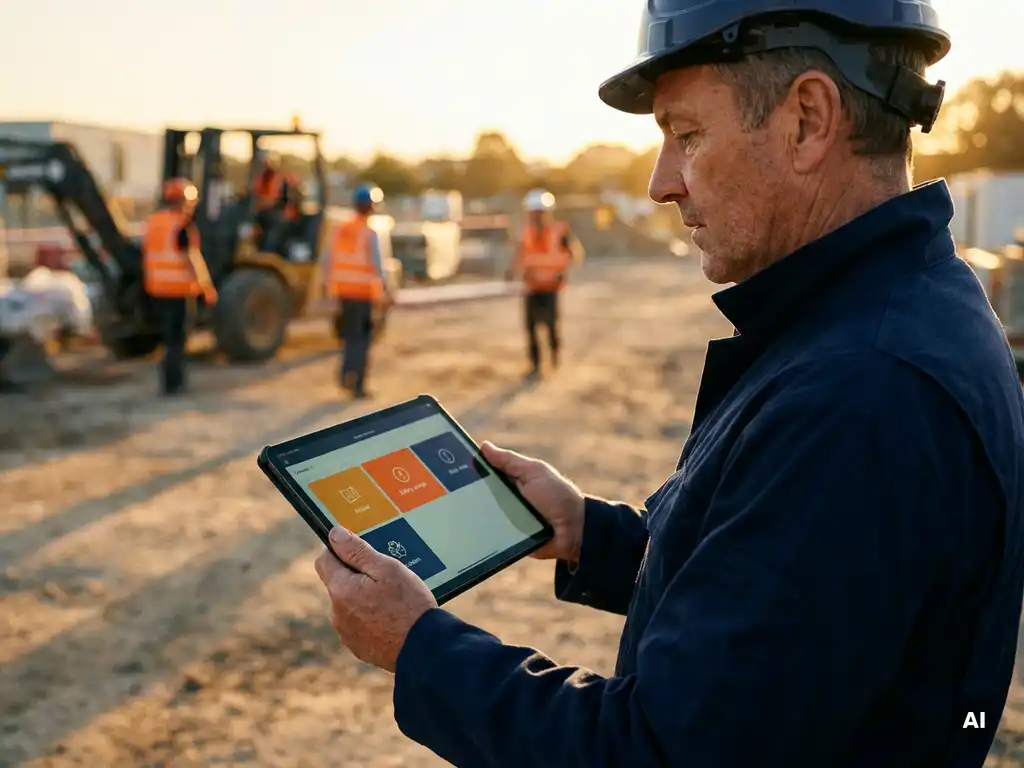
Digital tools streamline construction site inspections by replacing paper-based checklists with mobile-accessible systems that capture findings in real time, assign corrective actions instantly, and create an automatic audit trail. Rather than collecting paper forms and manually entering data later, site managers can complete inspections on a smartphone and share results immediately with the relevant teams.
Key benefits of digital inspection tools include:
- Faster reporting with findings available to management the moment an inspection is completed
- Automated reminders so that scheduled inspections are never missed
- Photo evidence attached directly to specific findings for clearer documentation
- Trend analysis across multiple sites to identify recurring hazards
- Integration with training records so that gaps in worker competence identified during inspections trigger automatic learning interventions
One area where digital tools add particular value is in linking inspection outcomes to worker training. When an inspection reveals that a team is not following a particular procedure correctly, the fastest corrective action is often targeted, accessible training delivered without delay. Tools that support toolbox talks, work instructions, and knowledge retention can make this process significantly more effective.
How E-Lia helps with construction site safety and training
We understand that construction teams are mobile, multilingual, and often working in environments where sitting down at a computer to complete training is simply not realistic. That is exactly why we built E-Lia to deliver microlearning and work instructions directly via WhatsApp, with no app download, no login, and no technical barrier.
When a site inspection identifies a knowledge gap or a procedure that needs reinforcing, E-Lia makes it straightforward to respond quickly and effectively:
- Build a targeted microlearning module in 10 to 15 minutes and send it directly to the relevant team members
- Workers complete the module in 3 to 6 minutes on their own phone, in their own language, at a time that fits their shift
- Automatic translation ensures that multilingual construction teams all receive the same information in the language they understand best
- Progress tracking via a simple dashboard gives managers a clear view of who has completed what, creating a documented record of training delivery
- Scheduled or instant delivery means you can send a safety update immediately after an inspection finding or plan a structured onboarding programme in advance
Whether you are onboarding new site workers, reinforcing a procedure flagged in an inspection, or keeping teams updated on changing site conditions, E-Lia makes it simple to act on what inspections reveal. For teams that need to meet food safety standards on site, our HACCP training module is also available. Plan a demo and see how E-Lia works in practice.
Frequently Asked Questions
How often should construction site inspections be carried out?
The required frequency depends on the type of inspection and the level of risk involved. General site safety inspections are typically conducted weekly by the principal contractor, while specific high-risk elements have legally defined intervals — for example, scaffolding must be inspected every seven days in the UK under the Work at Height Regulations 2005, and excavations must be inspected at the start of every shift. As a rule of thumb, the higher the risk, the more frequent the inspection cycle should be.
What qualifications does a construction site safety inspector need?
For internal site inspections, the person carrying them out must be a ‘competent person’ — meaning they have sufficient training, experience, and knowledge to identify hazards and assess risks relevant to the area being inspected. For specific high-risk elements like scaffolding or lifting equipment, formal qualifications or certification may be required. External regulatory inspectors, such as those from the HSE in the UK, are trained enforcement officers with legal powers to enter sites and issue notices.
What should I do immediately after completing a construction site inspection?
Any hazards identified during the inspection should be prioritised by risk level and corrective actions assigned to named individuals with clear deadlines. Critical findings that pose an immediate danger must be addressed before work continues in that area. All findings, actions, and completion dates should be documented — this paper or digital trail is essential for demonstrating due diligence if an incident is later investigated. Where an inspection reveals a knowledge or procedural gap in the workforce, targeted training should be delivered as quickly as possible.
Can a construction site be shut down based on inspection findings, and who has the authority to do that?
Yes — HSE inspectors have the power to issue a prohibition notice, which stops work immediately in a specific area or across the entire site until the identified hazard is resolved. The principal contractor or site manager also has the authority to halt work in any area where they believe there is a serious and imminent risk, and in fact has a legal duty to do so. Workers themselves also have the right to stop work and move to a safe area if they face serious, imminent danger.
How do I create a construction site inspection checklist that actually covers everything?
Start with the legal minimum requirements for your jurisdiction and project type, then layer in the specific hazards relevant to your site’s activities, phases, and environment. A good checklist covers physical conditions (working at height, plant, excavations, PPE), management systems (documentation, training records, emergency procedures), and welfare facilities. Review and update the checklist as the project progresses, since hazards change significantly between groundworks, structural, and fit-out phases. Industry bodies, regulatory authorities, and digital inspection platforms often provide template checklists that can serve as a solid starting point.
What is the difference between a site inspection and a site audit, and do I need both?
A site inspection focuses on physical conditions and immediate hazards — it is an on-the-ground check of what is actually happening at a given moment. A site audit is a broader, more systematic review of whether the overall safety management system is functioning as intended, examining documentation, procedures, training records, and compliance across the whole project. Both serve different purposes and ideally complement each other: regular inspections catch day-to-day hazards, while periodic audits assess whether the underlying system is robust enough to prevent those hazards from arising in the first place.
How can I make sure subcontractors on my site are meeting their inspection obligations?
As principal contractor, you should set clear inspection requirements in subcontractor agreements and pre-start meetings, specifying what must be inspected, how often, and in what format findings must be reported to you. Request copies of subcontractors’ inspection records regularly and include their compliance as a standing agenda item in site coordination meetings. Where digital inspection tools are in use, consider requiring subcontractors to use the same platform so that all findings feed into a single, consolidated audit trail that you can monitor in real time.