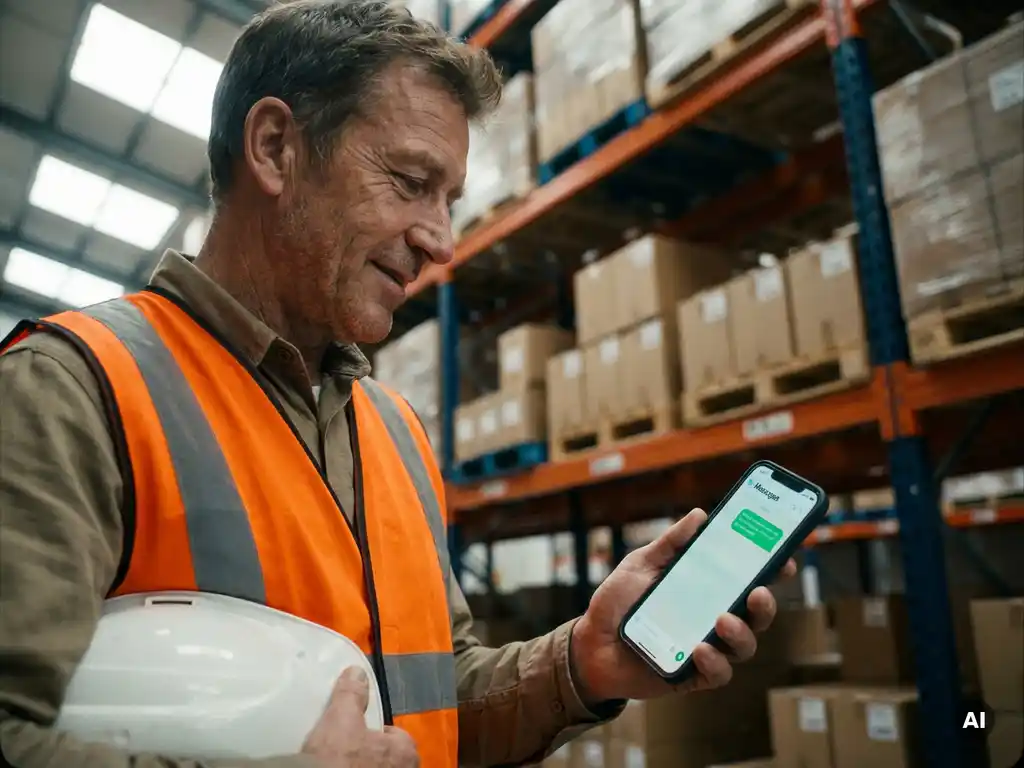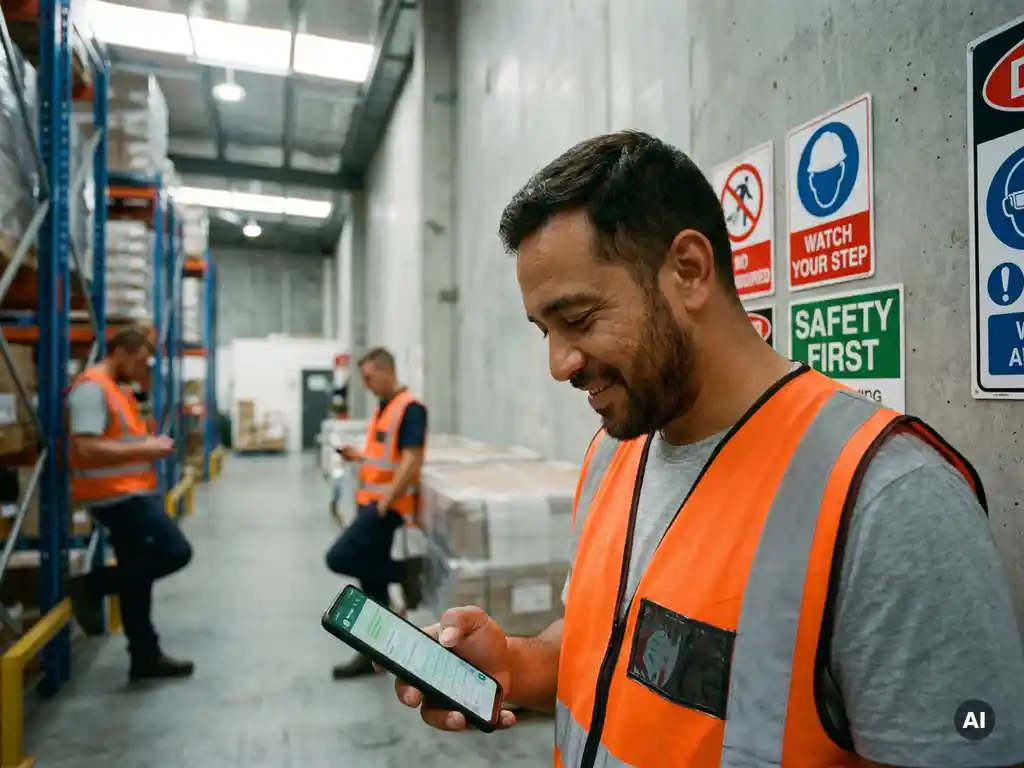



Workplace safety goes beyond wearing a helmet or participating in a fire drill. There are three forms of safety that together determine how safe employees truly feel: physical, social, and psychological. Organisations that take all three seriously build a work environment where people not only stay healthy, but also feel confident speaking up, collaborating, and growing.
In this article, we answer the most frequently asked questions about the three forms of safety, so that you as a trainer, manager, or HR professional can take concrete action. Toolbox meetings play a practical role in this, because those short, focused conversations on the work floor are exactly where you can raise awareness around all forms of safety.
What is physical safety and how do you recognise it in the workplace?
Physical safety is the protection of employees against bodily injury, hazardous situations, and health risks in the workplace. You recognise it through visible measures such as personal protective equipment, clearly marked emergency exits, safe machinery, and well-maintained workspaces.
Concretely, this includes things like:
- Correctly using and providing protective equipment such as gloves, helmets, and safety glasses
- Clear instructions for hazardous tasks or working with machinery
- Regular inspections of equipment and work environments
- Clear procedures for accidents or near-misses
Physical safety is legally required in many sectors and forms the foundation of any safety policy. In logistics, manufacturing, and healthcare, it is a daily reality: an employee who does not know how to operate a forklift or safely lift a patient is at immediate risk. Good work instructions and regular repetition of safety protocols are therefore essential.
What does social safety mean for employees?
Social safety refers to the extent to which employees are free from unwanted behaviour such as bullying, harassment, discrimination, or aggression in the workplace. It comes down to whether someone can be themselves when working with colleagues and managers, without fear of exclusion or boundary-crossing behaviour.
Social safety is not always immediately visible, but the consequences of its absence are significant. Employees who feel socially unsafe are more likely to call in sick, perform worse, and leave the organisation sooner. Employers are legally required to provide a socially safe work environment, meaning that policies, reporting channels, and confidential advisors must be in place.
Signs of social unsafety include:
- Employees who avoid certain colleagues or situations
- A culture where jokes about ethnicity, gender, or religion are normalised
- The absence of clear codes of conduct or consequences for boundary-crossing behaviour
What is psychological safety and why does it matter?
Psychological safety is the feeling that you can share ideas, questions, mistakes, and concerns without fear of negative consequences. It is not about avoiding conflict, but about a team culture where openness and honesty are valued rather than penalised.
Psychological safety matters because it directly influences learning, innovation, and collaboration. In teams where people dare to say “I don’t know” or “I made a mistake,” problems are resolved faster and improvements are identified sooner. Google’s research into effective teams found that psychological safety is the single most important factor in team performance.
How do you recognise psychological safety in a team?
Practical signs that a team is psychologically safe:
- Employees ask questions without feeling embarrassed
- Mistakes are discussed as learning opportunities, not failures
- People address each other’s behaviour without it leading to conflict
- New ideas are taken seriously, even when they are not implemented
For managers, this means: be vulnerable yourself, respond constructively to mistakes, and create space for dialogue. That sounds simple, but it requires consistent attention and sometimes targeted training.
What is the difference between social and psychological safety?
Social safety is about protection from unwanted behaviour by others, while psychological safety is about the freedom to express yourself without fear of judgement or rejection. They are related but clearly distinct concepts.
A practical distinction: if an employee is afraid of being bullied by a colleague, that is a social safety issue. If that same employee has a good idea but does not dare to share it in a meeting out of fear of criticism, that is a matter of psychological safety.
Both forms reinforce each other. A socially safe work environment is a prerequisite for psychological safety, but does not automatically guarantee it. You can have a workplace where no one is bullied, yet where no one dares to speak up. Organisations are well advised to consciously develop both dimensions.
How do you ensure all three forms of safety at work?
Ensuring all three forms of safety requires a combination of policy, behaviour, and repetition. It starts with awareness: employees and managers need to understand what the three forms entail and recognise when one of them is under pressure.
Practical steps per form
Physical safety:
- Work with up-to-date work instructions and make sure they are understandable for everyone
- Hold regular toolbox meetings to keep safety awareness alive
- Make reporting unsafe situations easy and normal
Social safety:
- Establish a code of conduct and communicate it actively
- Appoint a confidential advisor and make them visible
- Address boundary-crossing behaviour not only when incidents occur, but also proactively
Psychological safety:
- Train managers in listening and giving constructive feedback
- Celebrate mistakes as learning moments in team meetings
- Use toolbox meetings for softer topics too, such as workload and collaboration
Consistency is key. Safety is not a one-time project, but an ongoing process that requires regular attention, repetition, and adjustment.
How E-lia helps with workplace safety
At E-lia, we understand that workplace safety only works when the right information reaches the right people, at the right moment, and in a format they can understand. Our platform makes it easy to structurally support all three forms of safety through short, accessible microlearnings via WhatsApp.
What we offer in the area of safety education:
- Quickly build microlearning modules on physical safety, such as instructions for personal protective equipment, ready in an average of 10 to 15 minutes
- Automatic translation, so that multilingual employees also receive safety instructions in their own language
- Schedule recurring modules for toolbox meetings and safety updates, without employees needing to download an app or log in
- A progress dashboard that lets you as a trainer or manager instantly see who has completed the module
- Support for both standard modules and fully customised content, tailored to your sector and work environment
Whether it is distributing a new work instruction, preparing a toolbox meeting on personal protective equipment, or structurally increasing safety awareness in your team: we make it accessible, fast, and effective. Want to see how this works for your organisation? Contact us for a no-obligation demo.
Frequently Asked Questions
How do you start measuring psychological safety within a team?
A good starting point is a short anonymous survey based on Amy Edmondson’s scale, which uses seven statements to measure the extent to which team members feel free to speak up. Additionally, as a manager you can pay attention to behavioural signals during meetings: who speaks up, who always stays silent, and are mistakes discussed openly? Based on those insights, you can schedule targeted conversations or training sessions.
What are common mistakes when implementing a safety policy?
One of the most common mistakes is that organisations get the safety policy right on paper but forget to actively communicate and repeat it on the work floor. In addition, social and psychological safety are often underemphasised compared to physical safety, even though those forms have a major impact on absenteeism and team dynamics. Effective policy requires regular repetition, visible leadership, and accessible reporting options.
How do you discuss sensitive safety topics such as workload or boundary-crossing behaviour in a toolbox meeting?
Start with a concrete, recognisable scenario rather than abstract rules: ‘Imagine a colleague…’ works better than a list of dos and don’ts. Create a safe setting by making it clear that the conversation is non-judgmental and that participation is voluntary. Short microlearnings ahead of the meeting can help introduce the topic and lower the threshold for discussion.
What do you do if an employee says they feel unsafe but does not want any action to be taken?
First, respect the employee’s wishes and do not force immediate action, as this can damage trust. Do make sure you document the situation and point the employee toward available support such as the confidential advisor. If the situation poses a risk to others or safety is at stake, you as a manager are obligated to take steps regardless and to communicate that transparently.
How do you make sure safety training actually sticks with employees?
One-off training sessions have little long-term effect; repetition in small doses is far more effective. Microlearnings of five to ten minutes, spread over several weeks, lead to better knowledge retention than a single long session. Also connect the content to recognisable situations from the employee’s daily work, so that the material feels immediately applicable.
Is there a legal obligation for social and psychological safety, just as there is for physical safety?
Yes, the Working Conditions Act (Arbowet) requires employers to also manage psychosocial work pressure (PSA), which covers both social and psychological safety. This means organisations must have policies in place against bullying, harassment, and excessive workload, and must be able to demonstrate that measures have been taken. A Risk Inventory and Evaluation (RI&E) is legally required and must also map these risks.
How do you actively involve employees who are sceptical about safety initiatives?
Sceptical employees often disengage from top-down programmes, but do become actively involved when they are given a role in the solution. Involve them in drafting workplace agreements, let them contribute ideas for toolbox topics, or ask them to act as a buddy for new colleagues. When people see that their input actually leads to change, engagement increases quickly.