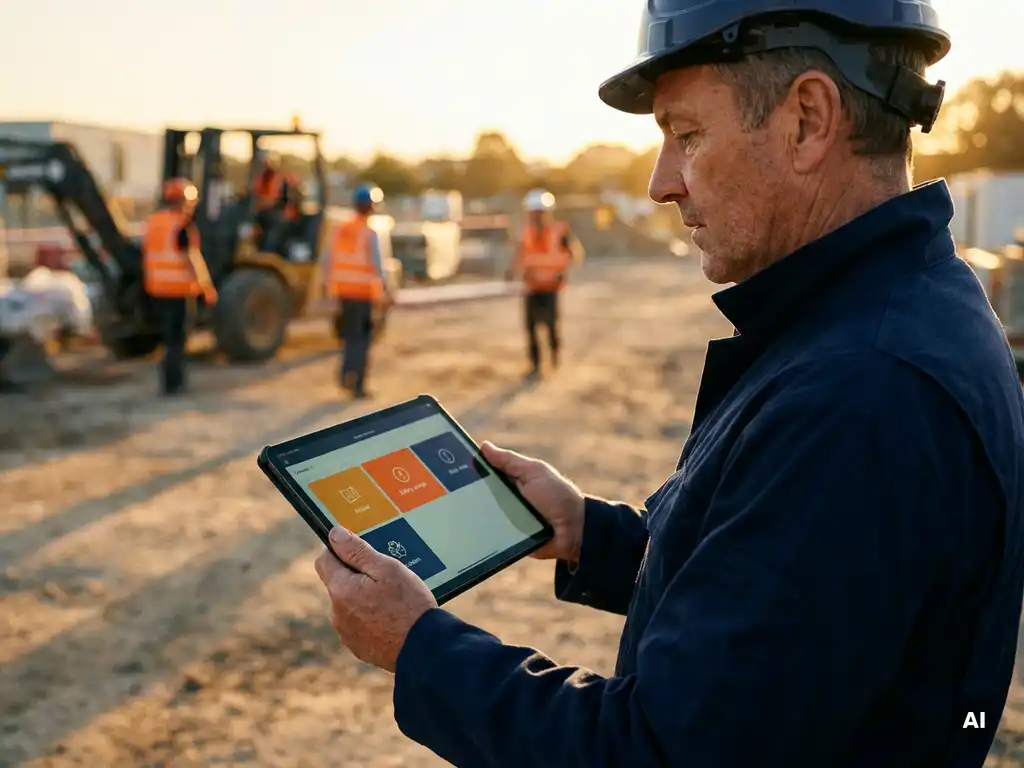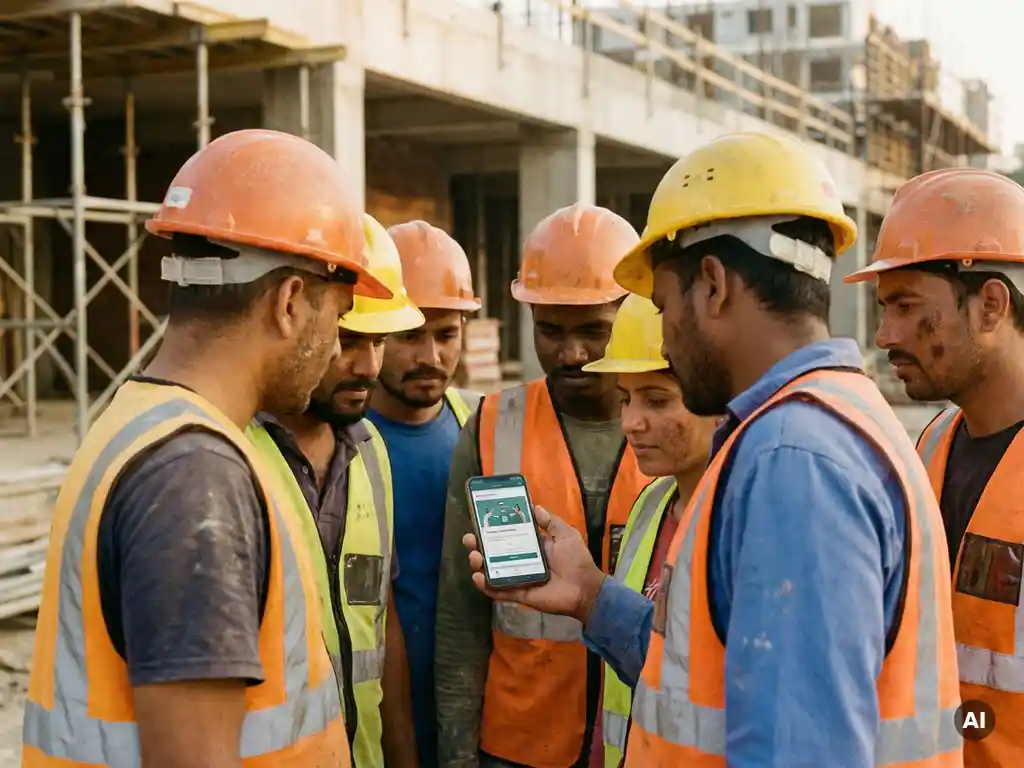


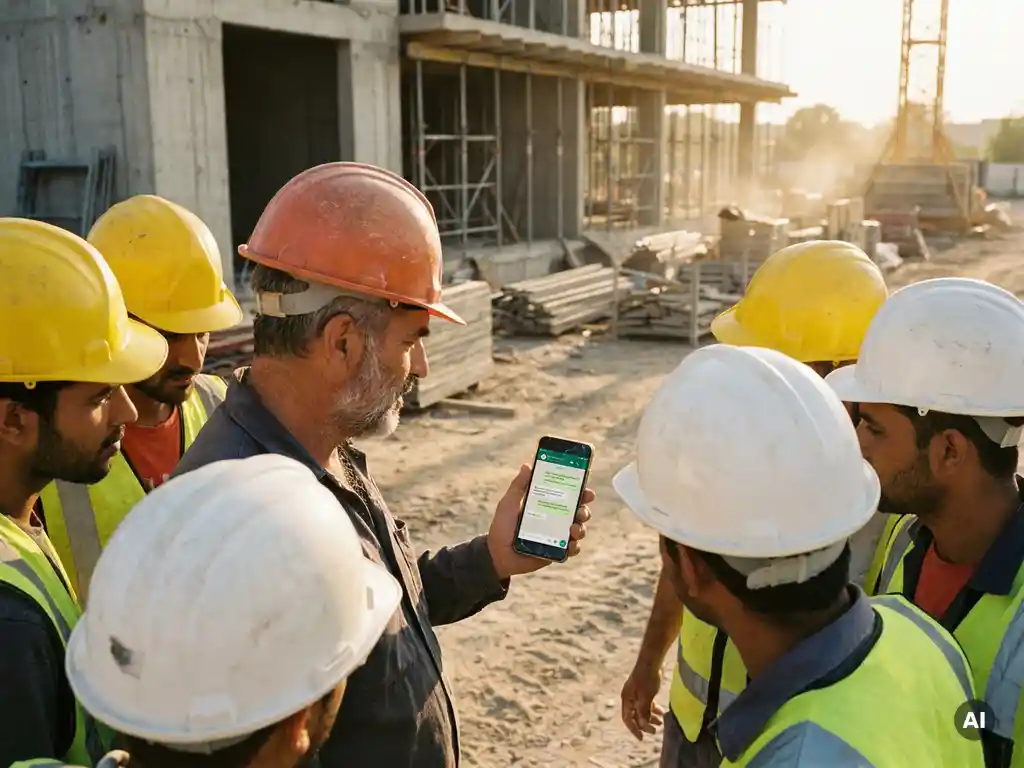
You can deliver toolbox talks to subcontractors without access to your company systems by sending safety instructions directly to their personal mobile phones, no login, no app download, and no company email address required. The most practical approach uses a communication channel workers already have on their phones, such as WhatsApp, to push safety content directly to the individual. This article walks through the most common questions around subcontractor toolbox talks, from legal context to documentation and language barriers.
Why can’t subcontractors access company training systems?
Subcontractors cannot access company training systems because those systems are built for employees, not external workers. Most learning management systems and intranets require a company email address, a personal login, or a device managed by the organization. Subcontractors typically have none of these, which creates a practical barrier to receiving safety information through standard channels.
This is a widespread challenge in construction, logistics, and industrial environments where multiple contractors work on the same site. A subcontractor’s team might arrive on Monday morning without ever having received a single safety briefing through your systems, not because anyone was negligent, but because the infrastructure simply was not designed to include them.
The problem compounds when subcontractors work across multiple sites for different clients. They cannot realistically maintain separate logins for every principal contractor’s platform. The result is that safety information either gets skipped, delivered verbally without documentation, or printed on paper that quickly gets lost.
What are the legal requirements for toolbox talks with subcontractors?
Legal requirements for toolbox talks with subcontractors vary by country, sector, and the specific work being carried out. In general, employers and principal contractors have obligations to ensure that workers, including those employed by subcontractors, receive adequate safety instruction before starting work. The precise scope of those obligations depends on the applicable legislation and any certification requirements in your sector.
In many countries, health and safety legislation places a duty on the party controlling a worksite to ensure that all workers on that site are properly informed about risks and safe working methods. This does not necessarily mean you are responsible for the subcontractor’s own training program, but it does mean you have an interest in ensuring that site-specific safety information reaches every worker present.
In sectors where VCA certification is common, such as construction and industrial contracting, the scheme sets expectations around how safety topics are communicated and documented. VCA is not a legal requirement in itself, but it is frequently required by clients as a contractual condition. Meeting those expectations means being able to demonstrate that safety conversations happened and that workers understood the content.
The safest approach is to treat toolbox talks with subcontractors as a shared responsibility: your site rules, your hazards, your documentation. Consult the applicable regulations and any certification requirements relevant to your sector to understand exactly what applies in your situation.
How do you deliver toolbox talks to workers without a company login?
You deliver toolbox talks to workers without a company login by using a channel they already have access to on their own device. The most effective options are WhatsApp, SMS, or QR codes that open content in a browser, all of which work without any account creation or system access on the worker’s part.
Using WhatsApp to send toolbox content
WhatsApp is widely used among workers in operational roles and requires no additional setup beyond a phone number. Safety content, including short instructional videos, written instructions, and knowledge checks, can be sent directly to a worker’s existing WhatsApp account. The worker reads or watches the content, answers a few questions, and the interaction is logged automatically. No app download, no password, no company account needed.
Using QR codes and browser-based content
Another approach is to display a QR code at the site entrance or in a briefing area. Workers scan the code with their phone camera, which opens a safety module in their browser. This works well for on-site delivery where you want to confirm that workers have reviewed the content before starting work. The limitation is that it typically requires a physical touchpoint and does not work well for remote or pre-arrival delivery.
Whichever method you choose, the goal is the same: remove every barrier between the worker and the safety information. The fewer steps required, the higher the completion rate.
How do you prove subcontractors completed a toolbox talk?
You prove subcontractors completed a toolbox talk by collecting a digital record that captures who received the content, when they engaged with it, and whether they demonstrated understanding through a knowledge check. Digital delivery methods that log participation automatically are far more reliable than paper signature lists, which can be lost, forged, or filled in after the fact.
A strong completion record typically includes:
- The worker’s name or identifier
- The date and time of completion
- The specific topic or module covered
- The results of any knowledge check or confirmation question
When toolbox talks are delivered digitally, for example via WhatsApp, this data is captured automatically and stored in a dashboard that you can access at any time. This makes it straightforward to demonstrate which workers received which safety information and when, which is useful during site audits, client reviews, or any situation where you need to show that safety communication took place.
Paper-based approaches, by contrast, require someone to collect signatures, file the sheets, and manually enter data if a digital record is needed later. That process introduces delays and the risk of incomplete records. Digital registration removes those steps and makes the record available immediately.
What toolbox talk topics are most critical for subcontractors?
The most important toolbox talk topics for subcontractors are those directly related to the specific risks of the site they are entering, combined with general safety fundamentals that apply across all work environments. Site-specific hazards should always take priority because subcontractors may be unfamiliar with your particular layout, equipment, and procedures.
Topics that consistently appear across sectors and are relevant to most subcontractor situations include:
- Personal protective equipment (PPE), what is required on this site and how to use it correctly
- Emergency procedures, evacuation routes, assembly points, and who to contact
- Hazardous substances or materials present on site
- Working at height, if applicable
- Machinery and equipment safety, including restricted zones
- Near-miss and incident reporting, how to report and to whom
- Site access rules and permit-to-work procedures
Beyond site-specific content, sector-wide topics such as manual handling, electrical safety, and working in confined spaces may also be relevant depending on the nature of the work. A practical approach is to maintain a core set of topics that every subcontractor receives on arrival, and then add role-specific or task-specific content based on what they will actually be doing on site.
Keeping modules short and focused, covering one topic at a time, makes it easier for workers to absorb the information and complete the content quickly, which increases the likelihood that it actually gets done.
Which delivery method works best for multilingual subcontractor teams?
The delivery method that works best for multilingual subcontractor teams is one that automatically presents content in each worker’s own language without requiring a separate version to be created manually. Digital platforms with built-in translation capabilities allow you to build a toolbox talk once and deliver it in multiple languages simultaneously, so every worker receives the same safety information in a language they can understand.
Language barriers are one of the most significant risk factors in subcontractor safety. A worker who does not fully understand a safety instruction is less likely to follow it correctly, regardless of how clearly it was presented in the original language. Translating content into the worker’s native language is not just a courtesy, it directly affects whether the information is understood and retained.
Platforms that use AI-assisted translation can handle a wide range of languages and reduce the time and cost involved in producing multilingual content. Rather than commissioning separate translations for each language group on site, you create the content once and the platform handles the rest. Workers receive the same module in their preferred language, complete the same knowledge check, and their participation is recorded in the same dashboard.
For teams with very low digital literacy or limited smartphone experience, pairing digital delivery with a brief in-person introduction can help. A site supervisor who speaks the same language as a worker group can walk them through the first module together, after which most workers are comfortable completing subsequent modules independently.
How E-Lia helps you reach subcontractors without system access
We built E-Lia specifically for situations like this, where the workers you need to reach do not have a company email, a corporate device, or access to your internal systems. With E-Lia, you send toolbox talks directly to a worker’s WhatsApp. No app to download, no account to create, no password to remember.
Here is what that looks like in practice:
- Send to any phone number: Add a subcontractor’s number and send them a toolbox talk module in minutes, regardless of whether they are in your HR system.
- Automatic translation into 50+ languages: Build your content once and deliver it in the worker’s own language using AI-assisted translation.
- Knowledge checks included: Each module includes questions that confirm understanding, not just delivery.
- Live dashboard: See in real time who has completed the content, who has not, and what their knowledge check results were.
- Library of ready-made topics: Access more than 60 practical safety topics, updated regularly by a qualified safety professional, so you do not have to build everything from scratch.
Whether you are managing a single subcontractor team or coordinating across multiple sites, E-Lia gives you a structured way to deliver and document safety talks without relying on systems that external workers cannot access. Get in touch to see how E-Lia works for subcontractor safety communication.
Related Articles
- How do you identify recurring deviations in workplace inspections?
- What is the difference between a workplace inspection and a risk assessment?
- Which PPE aspects are crucial for height work discussions in safety toolbox?
- How do you reach employees without fixed workplaces?
- How long must you keep safety records?