


Consistent onboarding across multiple locations is achievable when you standardise your content, delivery method, and tracking in one centralised system. The core challenge is not creating good onboarding material — it is making sure every new employee, regardless of site or shift, receives the exact same quality of information at the right moment. This article walks through the most common questions organisations ask when building a scalable, consistent onboarding approach.
Why does onboarding quality vary between locations?
Onboarding quality varies between locations primarily because delivery depends on individual managers, local trainers, or printed materials that differ from site to site. When there is no single source of truth, each location improvises — and the result is an uneven experience where some new hires receive thorough guidance whilst others are left to figure things out on their own.
Several factors drive this inconsistency. First, high employee turnover means the person responsible for onboarding changes frequently, and institutional knowledge walks out the door with them. Second, organisations operating across multiple sites often rely on in-person sessions or locally stored documents that are not updated in sync. Third, language barriers can cause key information to be communicated incompletely or skipped entirely.
The practical consequence is that employees at different locations develop different habits, follow different procedures, and carry different levels of confidence into their roles. This creates compliance risks, quality gaps, and higher error rates at sites where onboarding is weakest.
What does a standardised onboarding process actually include?
A standardised onboarding process includes a defined sequence of content, a consistent delivery method, a fixed timeline, and a way to verify that each step has been completed. Standardisation does not mean rigid or impersonal — it means every new employee receives the same foundational knowledge, regardless of who is managing their location that week.
In practice, a well-structured standardised onboarding process covers:
- Pre-onboarding: Welcome messages, practical logistics, and role expectations sent before the first day
- Day-one essentials: Safety procedures, workplace rules, and team introductions
- Role-specific knowledge: Step-by-step work instructions relevant to the employee’s function
- Compliance and policy content: Required reading or training that every employee must complete
- Check-in moments: Short knowledge checks or confirmations that content has been understood
The key is that this sequence is documented centrally and does not rely on any single person’s memory or initiative to execute. When the process is written down and built into a repeatable system, location managers can focus on welcoming people rather than reinventing the wheel each time someone new joins.
How do you deliver the same onboarding content to every location?
The most reliable way to deliver the same onboarding content to every location is to use a digital delivery channel that does not depend on local infrastructure, hardware, or technical skill. When content is pushed to employees through a platform they already use, the delivery is consistent by design — not dependent on whether a local trainer turns up prepared.
Microlearning is particularly effective here. Short, focused modules sent in a structured sequence allow employees to absorb information in manageable pieces without needing to sit through a full-day session. Because each module is self-contained, it can be sent to a new hire in Amsterdam at the same time as one in Rotterdam, with identical content and timing.
Automatic translation is another critical enabler for multi-location organisations. Teams with multilingual workforces can receive the same core content in their preferred language, removing comprehension gaps that would otherwise create inconsistency even when the source material is identical.
Scheduling also matters. Rather than relying on managers to manually share materials, planned delivery ensures that day-one content arrives on day one, week-two content arrives in week two, and nothing falls through the cracks because someone forgot or was too busy.
What tools support consistent onboarding at scale?
Tools that support consistent onboarding at scale share three characteristics: centralised content management, automated delivery, and progress tracking. Any platform that requires local administrators to manually distribute materials or that depends on employees downloading a new app introduces friction that breaks consistency.
Learning management systems (LMS)
Traditional LMS platforms allow organisations to build and store onboarding content in one place and assign it to employees by role or location. They work well for desk-based workers who have regular computer access. The limitation is adoption — employees in logistics, production, or healthcare rarely sit at a desk, and login requirements create a barrier that reduces completion rates.
Mobile and messaging-based platforms
Platforms that deliver onboarding through tools employees already have on their phones — particularly messaging apps — remove the access barrier entirely. No app download, no login, no new system to learn. Content reaches employees directly on a device they carry with them, which is especially valuable for frontline workers across multiple sites. This approach supports microlearning onboarding in short, digestible formats that fit naturally into the working day.
How do you track whether onboarding is working across all sites?
You track whether onboarding is working across all sites by monitoring completion rates, knowledge check scores, and time-to-completion for each module — broken down by location. Aggregate data tells you whether the overall programme is running; location-level data tells you where gaps exist and which sites need attention.
Effective tracking does not require complex analytics. The most useful signals are straightforward:
- Completion rate per location: Are employees at every site finishing the onboarding sequence, or are certain locations consistently falling behind?
- Knowledge check results: Are employees demonstrating understanding, or are certain topics generating repeated incorrect answers?
- Time to completion: Are new hires finishing onboarding within the expected window, or is the process dragging on?
- Drop-off points: At which module or step do employees disengage? This reveals content that is too long, too complex, or poorly timed.
A centralised dashboard that surfaces this data in real time allows L&D teams and HR managers to act quickly. If one location consistently shows low completion, the issue might be a scheduling problem, a language barrier, or a manager who is not reinforcing the process — all of which are fixable once the data makes them visible.
Regular review cycles matter too. Onboarding content should be treated as a living resource. When processes change, regulations update, or new tools are introduced, the onboarding sequence needs to reflect that — across all locations simultaneously, not one site at a time. Pairing onboarding with regular toolbox talks is an effective way to keep knowledge current and reinforce key messages after the initial onboarding period.
How E-Lia helps with consistent onboarding across locations
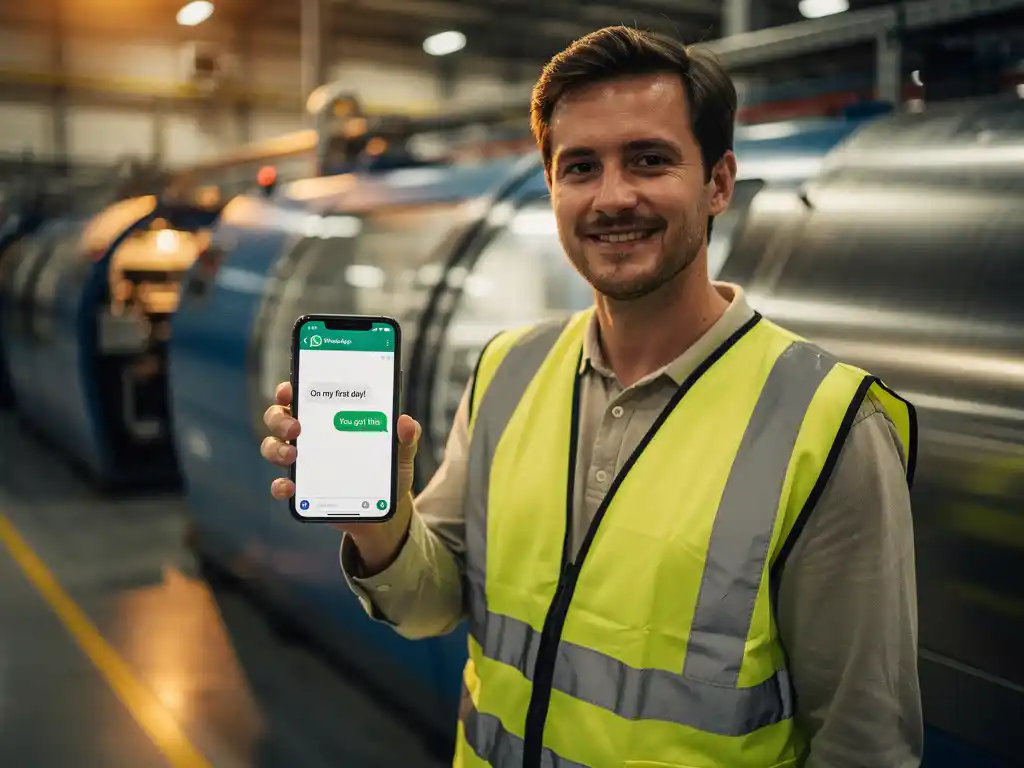
We built E-Lia specifically to solve the problem of inconsistent, hard-to-scale onboarding. Our platform delivers microlearning onboarding modules directly via WhatsApp — no app download, no login, no technical barriers. Whether your team works in a hospital, a warehouse, or a retail store, they receive the same structured content on the device they already use every day.
Here is what makes E-Lia practical for multi-location organisations:
- Centralised content creation: Build a module once in 10 to 15 minutes and deploy it to every location simultaneously
- Scheduled delivery: Set up a pre-onboarding and onboarding sequence that runs automatically, so no manager needs to remember what to send and when
- Automatic translation: Reach multilingual teams in their own language without creating separate content tracks
- Real-time dashboard: Track completion rates, knowledge check results, and progress per location from one central overview
- No friction for employees: New hires receive onboarding content via WhatsApp — a tool they already know and trust
- Knowledge retention: Use built-in tools to retain and maintain knowledge long after the onboarding sequence is complete
- Workplace safety: Integrate workplace inspections and safety checks directly into the onboarding flow for roles where compliance is critical
Organisations like Erasmus MC and ETZ already use our platform to standardise onboarding and keep distributed teams aligned. If you want to see how it works in practice, plan a demo and we will show you exactly how E-Lia fits your organisation.
Frequently Asked Questions
How long should a standardized onboarding process take for frontline or multi-location employees?
The ideal length depends on the role, but for frontline and multi-location workers, onboarding is most effective when spread across the first 4–8 weeks rather than compressed into the first day or two. A phased approach — pre-onboarding before day one, core essentials in week one, and role-specific knowledge in the following weeks — gives employees time to absorb information in context. Microlearning modules of 5–10 minutes each, delivered at regular intervals, consistently outperform long one-time sessions in both retention and completion rates.
What is the biggest mistake organizations make when trying to standardize onboarding across locations?
The most common mistake is standardizing the content but not the delivery — creating one centralized document or slide deck and then leaving it up to individual managers to share it however they see fit. This approach still produces inconsistent results because the human variable remains. True standardization requires automating the delivery itself, so the right content reaches every new hire at the right time regardless of who is managing that location on a given week.
How do we handle onboarding for employees who are not tech-savvy or rarely use computers?
The key is to meet employees on platforms they already use daily rather than introducing new tools that require a learning curve. For most frontline workers, that means a smartphone-based delivery channel like a messaging app, which removes login barriers and app downloads entirely. When the onboarding experience requires zero technical setup from the employee’s side, adoption rates rise significantly — even among workers with limited digital confidence.
Can onboarding content be customized per role or department while still staying consistent across locations?
Yes — and this is actually the recommended approach. Think of your onboarding content in two layers: a universal foundation (safety, compliance, company culture, workplace rules) that every employee receives identically, and a role-specific layer that is tailored to the function. Both layers can be standardized and delivered automatically; the system simply routes the relevant role-specific modules to the right employees. This way, consistency and personalization are not in conflict — they operate at different levels of the same sequence.
What should we do if completion rates at a specific location are consistently low?
Low completion rates at a specific site are a signal, not a verdict — and they usually point to one of three root causes: a scheduling or timing issue (content is arriving when employees are too busy or not yet on shift), a language or comprehension barrier, or a lack of local reinforcement from the site manager. Start by checking when content is being sent relative to shift patterns, whether the language matches the team’s preference, and whether the local manager is aware of and actively supporting the process. Fixing one of these factors is typically enough to see immediate improvement.
How often should onboarding content be reviewed and updated across all locations?
A practical rule of thumb is to schedule a full content review every six months, with trigger-based updates whenever a regulation changes, a process is revised, or a new tool is introduced. The advantage of a centralized system is that a single update propagates to all locations simultaneously — you are not chasing down outdated printed materials or locally saved files across multiple sites. Treating onboarding as a living resource rather than a one-time project is what keeps it accurate and trustworthy over time.
How do we get buy-in from local managers who are used to running onboarding their own way?
Frame the standardized system as something that removes work from their plate rather than something that takes control away from them. When onboarding content is delivered automatically and tracked centrally, managers no longer need to remember what to share, prepare materials, or follow up on completion — the system handles it. Showing managers a clear dashboard where they can see their team’s progress in real time also gives them visibility and ownership without adding administrative burden. Pilot the system at one location first, document the time saved, and use that as your case for broader rollout.