


The best way to onboard seasonal workers in production is to keep it fast, clear, and accessible from day one. Seasonal staff often start with little notice, work in physically demanding environments, and may speak different languages — which means your onboarding process needs to reach them where they already are, without requiring new apps, logins, or lengthy classroom sessions. This article walks through the most common questions about onboarding seasonal workers in production and gives you practical answers to each one. If you want to see how a modern approach works in practice, feel free to book a demo with us.
What makes onboarding seasonal workers in production so challenging?
Onboarding seasonal workers in production is challenging because of the combination of time pressure, high turnover, physical work environments, and workforce diversity. Unlike permanent staff, seasonal employees often start in large groups, need to be productive almost immediately, and may only stay for a few weeks or months — leaving little room for slow or complex onboarding processes.
Several factors make this particularly difficult in production settings:
- Speed: Production floors cannot afford long ramp-up times. Workers need to understand safety procedures, machine operation, and workflow from the very first shift.
- High volume: Hiring dozens or even hundreds of temporary staff at once makes individual onboarding sessions impractical.
- Multilingual teams: Seasonal workforces in production are often made up of employees from different countries, meaning language barriers can slow down knowledge transfer.
- Inconsistency: Without a standardised process, different supervisors explain things differently, which leads to uneven knowledge and preventable mistakes.
- No desk access: Most production workers do not sit behind a computer, making traditional e-learning or intranet-based training hard to reach.
The result is that many organisations rely on rushed verbal briefings or printed handouts — both of which are easy to forget and hard to verify. A structured, mobile-friendly approach solves most of these problems at once. Learn more about how a structured onboarding process can work for your team.
How long should onboarding take for seasonal production workers?
For seasonal production workers, onboarding should ideally be completed within the first one to three days, with the most critical safety and task information delivered on day one. The goal is not to overwhelm workers with everything at once, but to give them exactly what they need to perform safely and confidently from the start.
A practical onboarding timeline for production settings might look like this:
- Day one: Safety rules, emergency procedures, workplace layout, and their specific role or station.
- Days two and three: Deeper process knowledge, quality standards, reporting procedures, and team-specific workflows.
- First week: Any compliance requirements, shift-specific protocols, or role updates based on early performance.
Short, focused learning moments work far better than a single long session. When information is broken into small chunks and delivered over the first few days, retention improves significantly. This is especially true in physical work environments where attention is split between listening and getting to grips with the actual job. Explore how retaining and maintaining knowledge can be built into your onboarding programme from the start.
What information do seasonal production workers need on day one?
On day one, seasonal production workers need safety-critical information, basic workflow instructions, and enough context to do their job without putting themselves or others at risk. Everything else can follow in the days after. Overloading new starters with too much information on the first day typically leads to poor retention and confusion.
The essentials for day one include:
- Health and safety rules specific to their work area
- Emergency exits, alarm procedures, and first aid locations
- Personal protective equipment requirements
- Their specific role, station, or task for the day
- Who to report to and how to ask for help
- Basic hygiene or quality standards relevant to their area
- Shift times, break rules, and reporting procedures
Keep day one content focused on what workers need to stay safe and get started. Save process depth, compliance modules, and product knowledge for the days that follow. A well-structured pre-onboarding message sent before the first shift — even just a short welcome and what to expect — can also reduce first-day anxiety and improve readiness. See how clear work instructions support workers from their very first shift.
How can you onboard seasonal workers without extra apps or logins?
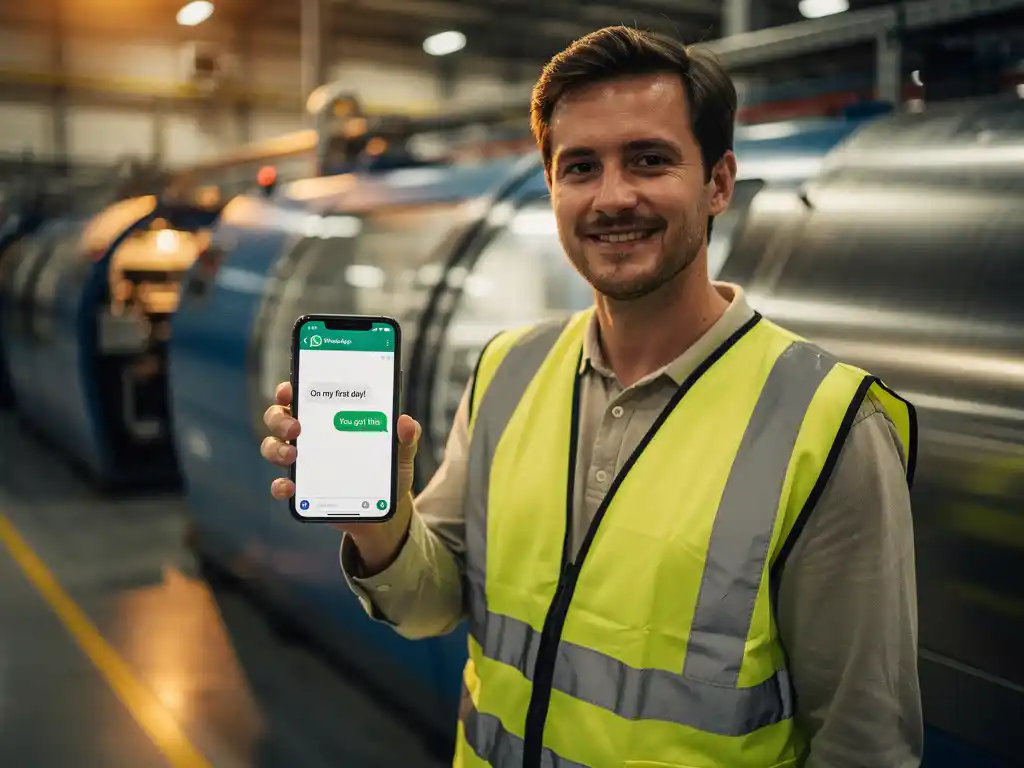
You can onboard seasonal workers without extra apps or logins by delivering training through a channel they already use, such as WhatsApp. Since most workers already have WhatsApp on their phones, there is no installation, no account creation, and no password to remember — which removes the biggest friction point in digital onboarding for non-desk workers.
This approach is particularly effective in production environments where workers may not have company email addresses, do not use computers on the job, and are expected to be productive almost immediately. Sending short instructional messages, videos, or microlearning modules directly to a worker’s phone means they can complete their onboarding during a break, before their shift starts, or at any moment that suits them.
The practical advantages of a no-login onboarding approach include:
- No IT setup required per worker
- Works on any smartphone without downloading anything new
- Workers can revisit instructions whenever they need a reminder
- Managers can send updates or new modules instantly, without waiting for system access
- Pre-onboarding can start before the first day, reducing pressure on day one
For organisations managing large groups of seasonal staff, this kind of frictionless delivery makes a real operational difference. Book a demo to see how it works in practice.
How do you train multilingual seasonal workers in production?
Training multilingual seasonal workers in production requires delivering content in each worker’s preferred language, ideally automatically and without creating a separate workflow for each language group. When workers can read and understand instructions in their own language, comprehension improves, safety risks decrease, and onboarding takes less time overall.
Practical steps to support multilingual seasonal employee training include:
- Use automatic translation: Platforms that support automatic translation allow you to build a module once and deliver it in multiple languages without duplicating your work.
- Use visuals and short text: Short sentences, clear images, and simple video clips reduce reliance on language fluency and make instructions easier to follow across language groups.
- Avoid jargon: Production-specific terminology can confuse even fluent speakers. Use plain language and explain technical terms when they appear.
- Test with real workers: Before rolling out multilingual content, ask a few workers from each language group to review it for clarity.
In sectors like production and logistics, where workforces are often highly international, multilingual onboarding is not a nice-to-have — it is a safety requirement. A worker who misunderstands a safety instruction because it was only available in a language they do not fully speak is a risk to themselves and to others. Find out how toolbox talks can reinforce safety messages across multilingual teams.
How do you track whether seasonal workers completed their onboarding?
You track whether seasonal workers completed their onboarding by using a platform that automatically records completion data and displays it in a central dashboard. Without tracking, it is nearly impossible to know which workers have received critical safety information and which have not — especially when managing large groups of temporary staff across multiple shifts or locations.
Effective tracking for production onboarding should include:
- Completion rates per module: Know exactly which workers finished which training steps and when.
- Progress per individual: Identify workers who have not yet completed required modules so you can follow up before they start a task unsupervised.
- Automated reminders: Send follow-up messages to workers who have not completed a module within a set timeframe, without manual chasing.
- Exportable reports: For compliance purposes, being able to export completion data is essential in regulated industries like food production or healthcare manufacturing.
Tracking also helps you improve your onboarding content over time. If a particular module consistently shows low completion or poor quiz results, that is a signal the content needs to be clearer or shorter. Good data turns onboarding from a one-time event into a continuously improving process. See how workplace inspections and onboarding tracking can work hand in hand to keep your production environment safe and compliant.
How E-Lia helps with onboarding seasonal workers in production
We built E-Lia specifically to solve the onboarding challenges that production environments face every day. Our platform delivers microlearning modules directly via WhatsApp — no app downloads, no logins, no IT setup per worker. Here is what that means in practice for onboarding temporary staff:
- Fast to build: Creating a new onboarding module takes an average of 10 to 15 minutes, so you can respond quickly when seasonal hiring ramps up.
- Fast to complete: Workers finish a module in 3 to 6 minutes, making it easy to fit into a break or pre-shift moment.
- No friction for workers: Because WhatsApp is already on their phone, there is zero barrier to getting started.
- Automatic translation: Train multilingual teams in their own language without rebuilding content from scratch.
- Real-time progress tracking: Track completion rates and individual progress through a clear, user-friendly dashboard.
- Scheduled delivery: Plan modules to arrive at the right moment — before the first shift, at the start of a new task, or as a refresher mid-season.
Organisations like Erasmus MC, the University of Utrecht, and ETZ already use E-Lia to onboard and train their teams effectively. If you want to see how it works for production onboarding, plan a demo and we will walk you through it. You can also explore our HACCP training module, which is particularly relevant for production environments with food safety requirements.
Frequently Asked Questions
What is the biggest mistake companies make when onboarding seasonal production workers?
The most common mistake is treating onboarding as a one-time event rather than a structured, phased process. Dumping all information into a single briefing on day one leads to poor retention and increases the risk of safety incidents. Spreading content across the first few days, using short focused modules, and following up with reminders makes a significant difference in how much workers actually retain and apply.
How do you onboard seasonal workers who are not tech-savvy?
The key is to use a channel that requires zero learning curve — and for most workers, that means WhatsApp. Since they already use it daily, there is no new interface to figure out, no login to create, and no app to install. Pairing that with short messages, simple visuals, and plain language means even workers with limited digital experience can complete onboarding without frustration or assistance.
Can onboarding content be reused across multiple seasonal hiring cycles?
Yes, and it should be. A well-built onboarding module can be reused each season with only minor updates to reflect any changes in procedures, safety rules, or team structure. This is one of the biggest efficiency gains of going digital — you build it once, refine it over time based on completion data, and redeploy it every time a new wave of seasonal staff comes in.
How do you handle onboarding when new seasonal workers start on different dates throughout the season?
A digital, asynchronous onboarding approach handles staggered start dates naturally. Instead of waiting to run a group session, you can trigger onboarding automatically the moment a worker is added to the system — or even send a pre-onboarding message before their first day. This means every worker gets the same quality of onboarding regardless of when they start, without putting extra pressure on supervisors or HR.
What role should supervisors play in the onboarding of seasonal production workers?
Supervisors should focus on hands-on guidance and answering questions on the floor — not on delivering the same verbal briefing repeatedly to every new starter. When the foundational information is handled digitally, supervisors are freed up to spend their time on what actually requires human presence: demonstrating tasks, checking understanding, and building rapport with new team members. This makes onboarding faster and more consistent at the same time.
How do you ensure seasonal workers actually read and engage with onboarding content, rather than just skipping through it?
Short, relevant content is the most effective engagement strategy. Workers are far more likely to engage when each module takes only a few minutes and feels directly useful to their specific role. Adding simple knowledge checks or interactive questions within the module also reinforces attention and gives you a reliable signal that the content was genuinely understood, not just opened and ignored.
Is WhatsApp-based onboarding compliant with data privacy regulations like GDPR?
This depends on how the platform is configured and what data is collected, but reputable WhatsApp-based learning platforms are built with GDPR compliance in mind. It is important to ensure that worker data is stored securely, that consent is properly obtained, and that your provider can demonstrate compliance with applicable regulations. If you operate in a regulated industry such as food production, always verify your onboarding platform’s data handling practices before rollout.