


Repeatedly offering the same safety information to employees who already have that knowledge wastes time and causes frustration on the work floor. You can avoid unnecessary repetition by gaining insight into what each employee already knows, sending safety information in a targeted way based on role, location and knowledge profile, and recording participation and understanding in a measurable way. This article answers the most frequently asked questions about targeted safety communication, from recognising the problem to practical approaches.
Why do employees keep receiving the same safety information?
Employees keep receiving the same safety information because organisations lack a clear overview of who has already acquired which knowledge. Without records of previous participation or knowledge checks, it is impossible for managers and safety coordinators to determine which employee still needs which information. The easiest alternative is then: everyone receives everything.
This pattern often arises from a combination of factors. Safety information is provided via paper lists, physical meetings or email, where participation is recorded but understanding is not. New employees go through the same programme as experienced workers. Seasonal workers and agency staff are treated as beginners, even if they have worked in the same sector for years. And with rotating shifts or locations, the same toolbox is rolled out again, without checking who was already present.
The result is that employees disengage. They experience the repetition as a waste of time, which undermines engagement with safety training as a whole. Particularly for operational employees in construction, logistics or production, where every minute counts, this is a genuine risk.
What is the difference between generic and targeted safety training?
Generic safety training offers the same content to all employees, regardless of their role, experience or location. Targeted safety training aligns with the specific risks, tasks and knowledge level of the individual employee. The difference lies not only in the content, but also in the timing and manner of delivery.
With generic training, the organisation is central: everyone receives the same package, at the same time, via the same channel. This is straightforward to organise, but leads to an oversupply for experienced employees and potentially an undersupply for employees in specific high-risk roles.
Targeted training starts from the employee. Which risks are associated with this role? Which instructions are relevant for this work location? Which knowledge has this person already demonstrated through previous knowledge checks? Based on that information, you as an employee receive only what is relevant to you at this moment. This makes the training not only more effective, but also shorter and easier to combine with daily work.
How does an organisation know which employee already has which safety knowledge?
An organisation knows which employee already has which safety knowledge by systematically recording participation and knowledge testing and making this visible through a central overview. Without that registration system, this information is scattered across paper lists, email confirmations and the memories of managers.
The first step is tracking participation: who has completed which toolbox, instruction or training, and when? The second step is testing understanding: has the employee actually understood the content, or were they simply present? Knowledge checks after an instruction answer that question and reveal where gaps exist.
With that combined information, you as an organisation can make targeted decisions. Employees who have already completed a topic and answered the associated questions correctly do not need to repeat that module. Employees who scored poorly or missed a session receive targeted follow-up. In this way, you build a knowledge profile per employee that forms the basis for smart, personalised safety communication.
How do you send safety information in a targeted way to the right employees?
You send safety information in a targeted way by grouping employees based on role, location, shift or risk group, and then sending only the information that matches their situation and knowledge profile. This requires a platform that supports segmentation and selective sending.
In practice, this means that when creating a toolbox or work instruction, you consciously choose for whom the content is intended. An instruction about the use of a specific machine is only relevant for employees who work with that machine. A safety instruction about working at height does not need to be sent to office employees. By making these choices systematically, you prevent everyone from receiving everything.
It also helps to make use of the registration data you already have. If it turns out that an employee has recently completed a particular topic and passed the knowledge check, you can automatically exclude that person from a repeat session on the same topic. This makes the planning of toolboxes and safety instructions increasingly precise and less burdensome for the work floor.
What role does multilingualism play in preventing unnecessary repetition?
Multilingualism plays a significant role in unnecessary repetition: when employees do not fully understand safety information because it is not available in their own language, the same information must be offered more frequently to ensure understanding. By providing instructions in the employee’s native language, you increase the likelihood that information is retained the first time.
In sectors such as construction, logistics and production, many employees have different language backgrounds. If a toolbox is only available in Dutch, employees who speak other languages may not fully understand the content. The knowledge check is then completed not on the basis of understanding, but on the basis of guessing or copying. The result is that the same information must be offered again, sometimes multiple times.
Automatic translations make it possible to offer the same module in multiple languages simultaneously, without having to create separate content for each language. Employees receive the instruction in their own language, understand the content better and achieve higher scores on knowledge checks. This reduces the need for repetition and makes the registration more reliable.
When is repeating safety information actually useful?
Repeating safety information is useful when there are changed working conditions, new risks, a longer period without contact with the topic, or when an employee has previously demonstrated insufficient understanding. Not all repetition is unnecessary: deliberate, targeted repetition is part of good safety policy.
Situations in which repetition is useful include:
- After an incident or near-miss where a specific risk needs to be brought to attention again
- When introducing new machines, working methods or hazardous substances
- When an employee returns after a prolonged absence
- When changing location or role where different risks apply
- When a knowledge check reveals that the information was not properly understood previously
The difference from unnecessary repetition lies in the reason. Repetition based on a concrete cause, a changed situation or an identified knowledge gap adds value. Repetition because there is no insight into who already knows what is an organisational loss. By distinguishing between these two forms of repetition, you as an organisation can consciously decide when to offer a topic again and when not to.
How E-lia helps with targeted safety communication
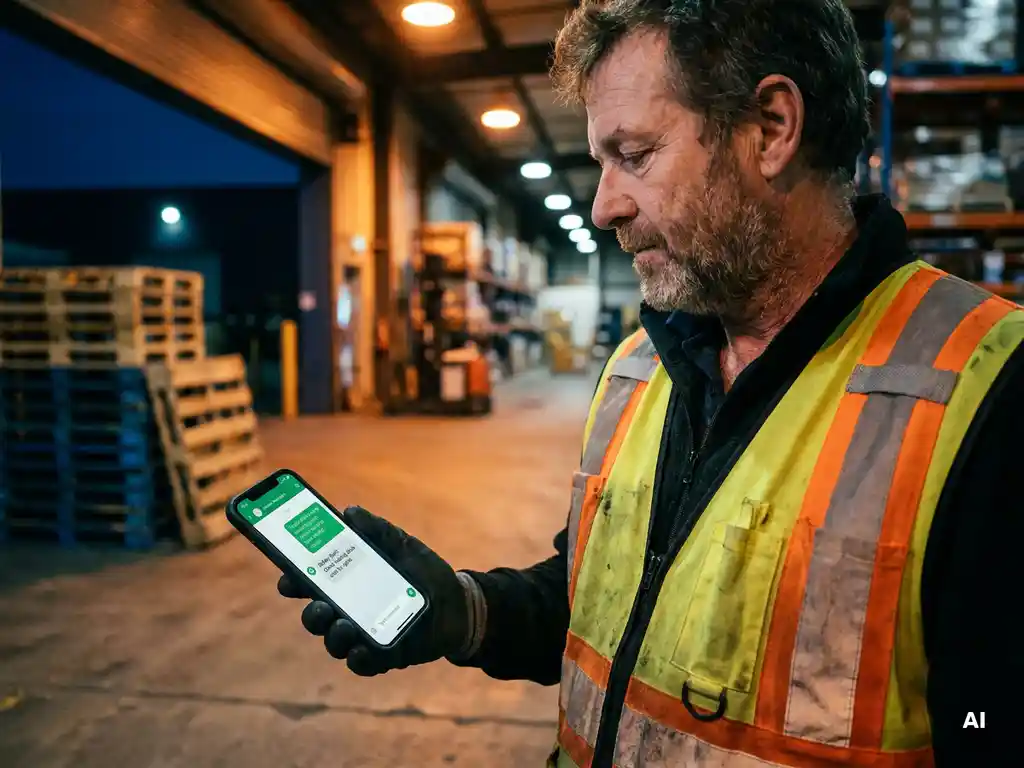
Unnecessary repetition of safety information is in many cases a registration problem: you simply do not know who already knows what. We solve this by delivering toolboxes, work instructions and knowledge checks directly via WhatsApp, without employees needing to download an additional app or create an account.
- Targeted sending: you decide which employees receive which module, based on role, location or shift
- Knowledge checks per module: after each toolbox or instruction, you test understanding, so you know who has grasped the material and who has not
- Live dashboard: you can see in real time who has participated, which scores have been achieved and where follow-up is needed
- Automatic translations: modules are available in more than 50 languages, so employees who speak other languages receive instructions in their own language
- Library of practice-oriented topics: in addition to your own content, you have access to more than 60 ready-made modules, updated monthly
Would you like to see how you can deploy safety information more effectively and prevent unnecessary repetition? Get in touch with us or request a demo.