

Which safety information an employee genuinely needs depends on the tasks they carry out, the risks associated with those tasks, and the context in which they work. There is no universal list that applies to everyone. The right approach begins with a targeted analysis of the tasks, risks, language, and background of each employee or group of employees. In this article, we answer the most frequently asked questions about how to conduct that analysis and how to keep safety information targeted, comprehensible, and up to date.
Which factors determine the safety information needs of each employee?
An employee’s safety information needs are determined by the combination of tasks, workplace, risk profile, experience, and personal characteristics such as language and level of education. Someone who works with hazardous substances needs different information than a colleague who carries out administrative work at the same location.
The most important factors to map out are:
- Tasks and role: Which actions does the employee carry out on a daily basis? Where are they located on the work floor?
- Risks associated with the workplace: Are there hazardous machines, substances, working at height, or physical strain present?
- Level of experience: Is the employee new, or do they have years of experience in the same role?
- Language and educational background: Does the employee understand the instructions in the language and format in which they are provided?
- Changes in the work situation: Are there new machines, procedures, or locations with which the employee is not yet familiar?
By combining these factors, you can determine per employee or per job group which safety information is relevant. This prevents both information overload and dangerous blind spots.
How do you carry out a task-based risk analysis for safety training?
A task-based risk analysis for safety training is mapped out step by step: you start with the tasks an employee carries out, identify the associated risks, and then determine which knowledge and instructions are needed to manage those risks. This connects to the risk inventory and evaluation that employers are required to carry out.
Step 1: Inventorise tasks and work situations
Start with an overview of all tasks carried out by an employee or job group. Think of operating machinery, working with chemical substances, lifting heavy loads, or working at height. Make this as concrete as possible. General descriptions such as “working in production” are too broad to derive useful safety information from.
Step 2: Identify risks per task
Link the associated risks to each task. Which hazards are present? What could go wrong? Involve the risk inventory and evaluation of your organisation, but also the practical knowledge of managers and employees themselves. They are often the first to know where things go wrong in practice.
Step 3: Determine the required knowledge and instructions
Determine per risk which knowledge an employee needs in order to act safely. Does it concern the correct use of personal protective equipment? Recognising hazardous situations? Or following a specific work instruction? This produces a targeted list of safety information that is genuinely relevant to that employee.
A task-based approach makes safety training more concrete and effective. Employees recognise the situations being described and understand why the information applies to them.
What is the difference between mandatory and supplementary safety information?
Mandatory safety information arises from legal obligations or from contractual requirements set by clients. Supplementary safety information goes beyond the minimum and is based on the specific risks, culture, or ambitions of an organisation. Both are valuable, but the distinction helps you set priorities.
Mandatory safety information includes, among other things:
- Information about risks arising from the risk inventory and evaluation
- Instructions on the use of personal protective equipment
- Information about emergency response and emergency procedures
- Instructions arising from specific legislation or regulations applicable to the sector
Supplementary safety information may consist of:
- Toolbox meetings on specific safety risks identified in practice
- Instructions on safe behaviour when using new working methods or materials
- Information on safety culture and the reporting of near-misses
- In-depth training for employees with a heightened risk profile
It is important not to confuse mandatory information with certification requirements such as VCA. VCA is a private certification scheme and not a legal obligation. It is, however, frequently required contractually by clients in sectors such as construction and industry. Ensure that your safety training makes a clear distinction between what is legally required, what is contractually required, and what your organisation adds itself.
How do you take language and level of education into account in safety instructions?
Safety instructions are only effective if the employee understands them. This means that when drawing up instructions, you take into account the language the employee speaks and the level at which information is provided. Instructions in a language an employee does not understand, or full of technical jargon, will not achieve their purpose.
Practical approaches to do this well:
- Use plain language: Avoid technical jargon and long sentences. Write as if you are explaining it to someone who has never encountered the term before.
- Provide instructions in the employee’s native language: Particularly in sectors with many international employees, such as logistics, construction, and production, this is not a luxury but a necessity for effective knowledge transfer.
- Use visual aids: Images, pictograms, and short videos can make safety information more accessible and easier to understand, regardless of language level.
- Adapt the complexity to the target group: An experienced tradesperson needs different instructions than a new employee without sector experience.
- Actively check understanding: Ask whether the information has been understood, for example through a short knowledge check. This quickly reveals whether the instruction has achieved its purpose.
Language is an underestimated barrier to safety communication in many organisations. By addressing this consciously, you increase the likelihood that safety information is genuinely absorbed and applied.
When should safety information be repeated or updated?
Safety information should be repeated or updated when the work situation changes, when incidents or near-misses have occurred, or when it becomes apparent that knowledge has faded. There is no universal frequency that applies to every organisation. The appropriate repetition depends on the risks, the work activities, and the applicable requirements.
Situations that give rise to repetition or updating:
- Introduction of new machines, substances, or working methods
- Changes in legislation or regulations affecting the work situation
- An incident or near-miss in which knowledge or behaviour played a role
- Signals from managers that instructions are not being followed
- New employees joining an existing team
- Seasonal risks, such as working in extreme heat or cold
- Results of workplace inspections or audits that highlight areas for attention
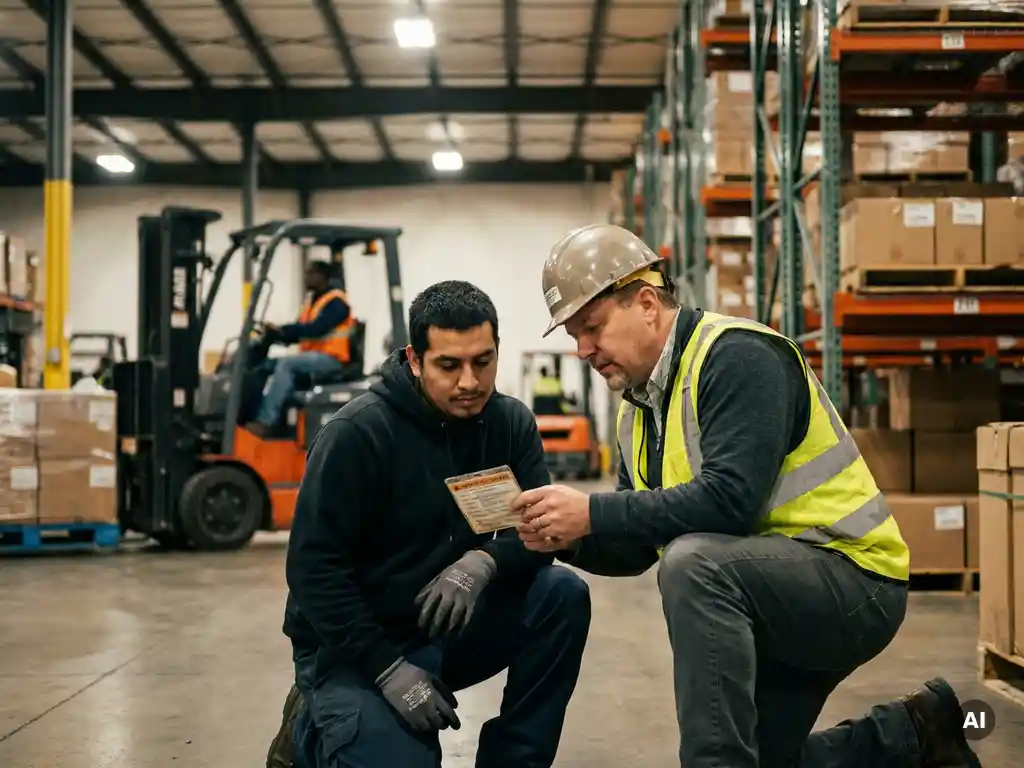
Regular toolbox meetings are a good way to keep safety information current and open to discussion. They give employees the opportunity to ask questions and share experiences, and they help managers to assess whether knowledge is genuinely present. Determine a frequency that suits the risks and work activities in your organisation, and adjust it when the situation calls for it.
How E-lia helps with targeted safety information on the work floor
Determining the right safety information per employee is one thing. Actually getting that information to the right people, in an understandable format and at the right moment, is a second challenge. That is precisely what we at E-lia address.
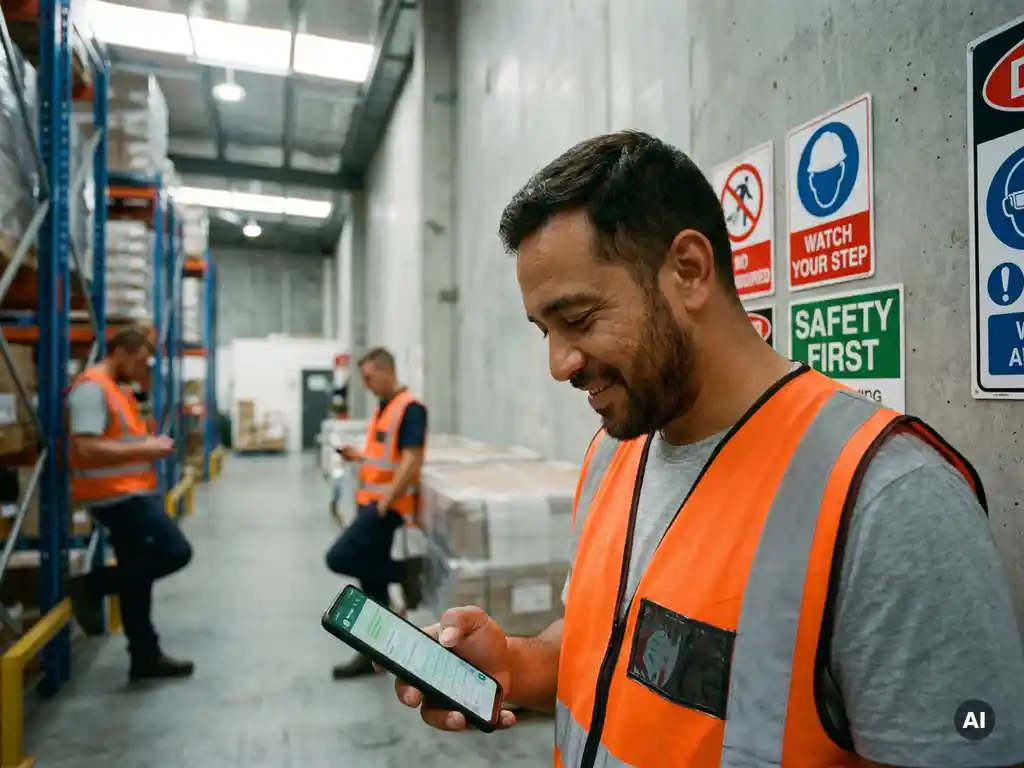
Via our platform, you send targeted safety instructions, toolbox meetings, and knowledge checks directly to employees’ phones via WhatsApp. No additional app, no login procedure. What this means in practice for your organisation:
- Targeted distribution: Send instructions to specific teams, roles, or locations, so that employees only receive what is relevant to them.
- Multilingual instructions: Thanks to AI-assisted translations, employees receive safety information in their own language, which greatly improves comprehension.
- Knowledge checks: After each instruction, you can assess whether the information has been understood, so that you can not only demonstrate that someone received the instruction, but also that the knowledge has been retained.
- Real-time insight: Via the dashboard, you can see immediately who has participated and who has not, so that you can follow up in a timely manner.
- Library of practice-oriented topics: In addition to your own content, you have access to more than 60 ready-made modules on safety topics, compiled by a senior safety professional and updated monthly.
Would you like to see how E-lia works for your organisation? Contact us for a no-obligation demo and discover how you can make safety information more targeted, more comprehensible, and more measurable.