

Standardising workplace inspections across multiple sites means establishing one uniform inspection protocol that is carried out and recorded in the same way at every location. The key lies in clear agreements, digital support, and measurable follow-up. This article answers the most frequently asked questions about how to approach this in practice.
Why do workplace inspections so often vary between sites?
Workplace inspections vary between sites because there is no shared protocol and execution depends on the interpretation of individual employees or managers. Without a fixed structure, each location decides for itself what is checked, how findings are recorded, and what happens with them afterwards.
A number of factors compound this problem:
- Different managers, different priorities. What one site manager considers important may fall outside the scope of the inspection at another.
- No shared format. If one location uses a paper checklist and another uses a spreadsheet, results cannot be compared.
- Multilingual workforce. At locations with employees who speak different languages, instructions and checklists may be understood or completed differently.
- Changing staffing. With high staff turnover or many temporary workers, knowledge of internal inspection procedures is frequently lacking.
The result is that your organisation does not get a reliable picture of the safety situation across all locations. Findings cannot be compared, trends are difficult to identify, and follow-up is inconsistent.
What are the risks of non-standardised inspections?
Non-standardised workplace inspections increase the risk of undetected safety hazards, inconsistent compliance with internal and external requirements, and a weak position during audits or inspections by external parties. Without uniform recording, it is also difficult to demonstrate which checks have taken place.
The practical consequences are varied:
- Blind spots in safety. Risks identified at one location go unnoticed at another because the checklist differs.
- Incomparable data. When every site records differently, you cannot identify trends or patterns at organisational level.
- Weak demonstrability. During an audit or incident, it is difficult to show that inspections were carried out structurally and consistently.
- Unequal treatment of employees. Employees at one location are exposed to risks that have already been addressed elsewhere.
Organisations operating in sectors such as construction, logistics, or healthcare also face specific requirements around safety management. An inconsistent inspection process makes it more difficult to demonstrate that the organisation takes its obligations seriously.
How do you establish a uniform inspection protocol for all locations?
You establish a uniform inspection protocol by starting with a shared foundation: the same inspection categories, the same assessment criteria, and the same recording format for all sites. Involve employees and managers from different locations in this process, so that the protocol connects with day-to-day practice.
Step 1: Define the inspection categories
Map out which aspects of the workplace should be covered in every inspection. Think of personal protective equipment, emergency exits, storage of hazardous substances, condition of machinery, and workplace hygiene. Distinguish between categories that apply everywhere and categories that are site-specific.
Step 2: Make the format concrete and unambiguous
Use closed questions with fixed answer options such as “satisfactory”, “point of attention”, or “action required”. Avoid open questions where the person completing the form must interpret for themselves what is acceptable or not. Add a comment field or photo option where needed, so that findings are clearly documented.
Step 3: Establish a follow-up process
An inspection protocol is only complete when there is also a clear process for following up on findings. Who is responsible for remediation? Within what timeframe? Who checks whether the action has been completed? Record this as part of the protocol, not as a separate agreement.
Which tools help with rolling out inspection procedures?
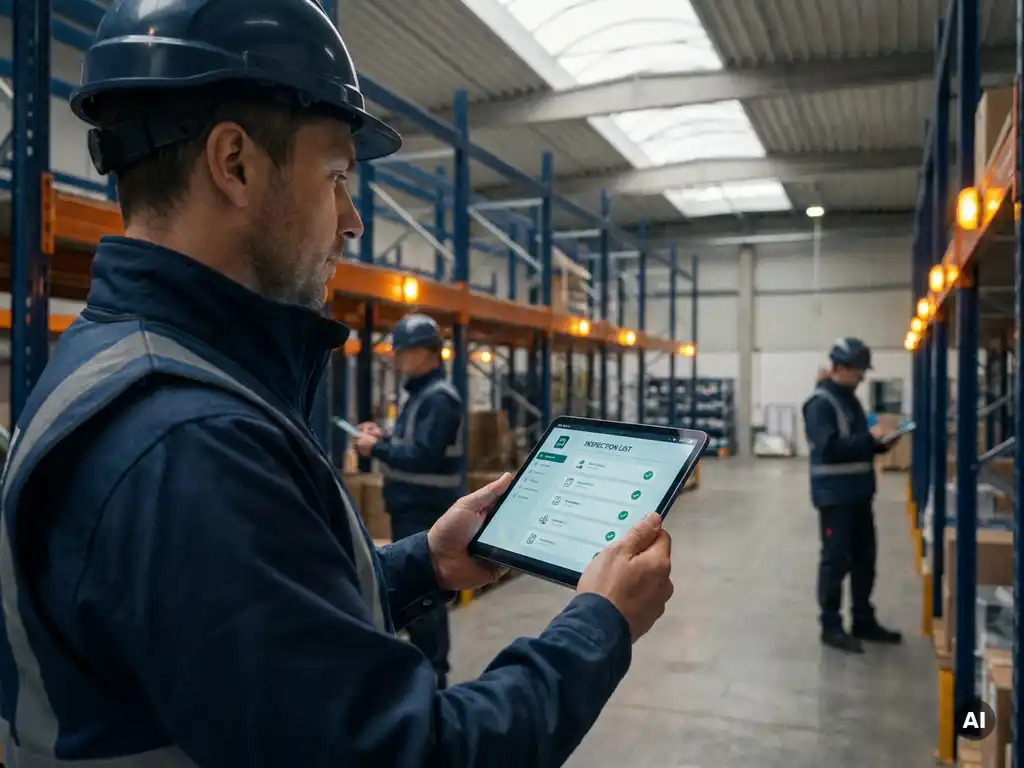
Digital tools help with rolling out inspection procedures by centrally managing the inspection format, simplifying execution, and automatically centralising records. This means you do not have to rely on paper lists or local files that may differ between sites.
When choosing a tool, a number of aspects are relevant:
- Low-threshold use. If employees need to download a separate app or create an account, adoption drops quickly. Tools that work via a channel employees already know significantly lower the barrier.
- Central management of forms. Changes to the inspection protocol must be immediately visible to all sites, without each location having to receive a new document.
- Automatic recording. Timestamp, location, completed answers, and any photos are saved automatically, without manual transfer.
- Reporting across sites. A dashboard that shows results per location makes it possible to quickly see where deviations or recurring points of attention exist.
- Multilingual support. At locations with employees who speak different languages, it is useful if the inspection form is automatically presented in the correct language.
Paper checklists and spreadsheet records are a familiar starting point for many organisations, but make central comparison and follow-up labour-intensive. A digital solution for workplace inspections makes the inspection process scalable across multiple locations.
How do you ensure employees actually apply the inspection standards?
Employees actually apply inspection standards when they understand why the standards exist, know how to carry out the inspection, and the procedure is simple enough to fit into their daily work routine. Training and clear communication are the starting point for this.
Practical approaches that work:
- Explain the why. Employees who understand which risk an inspection helps to prevent are more inclined to take it seriously than employees who fill in a form without context.
- Provide concrete work instructions. Describe per inspection category what “satisfactory” means and when something is a point of attention. Leave as little room for interpretation as possible.
- Make the procedure accessible. The fewer steps required to start and complete an inspection, the greater the likelihood that it is carried out consistently.
- Provide feedback. Show employees what has been done with their findings. This reinforces the sense that the inspection is worthwhile and encourages careful execution.
- Actively involve managers. If a site manager takes the inspection seriously and makes follow-up visible, this influences the behaviour of the team.
At locations with multilingual employees, it is useful to offer work instructions and inspection forms in the employee’s native language. This reduces the risk of misunderstandings and improves the quality of the completed data.
How do you measure whether workplace inspections are being carried out consistently?
You measure the consistency of workplace inspections by tracking whether inspections are carried out at all sites, whether the results are comparable, and whether findings are followed up. A central dashboard that combines data from all locations makes this transparent without requiring you to report on each site separately.
Relevant measurement points are:
- Frequency of execution per location. Are inspections being carried out at all sites? Are there locations that are falling behind?
- Completeness of completed forms. Are all inspection categories consistently filled in, or are sections regularly skipped?
- Follow-up on findings. Are identified points of attention actually addressed and resolved within the agreed timeframe?
- Recurring findings. Which risks or points of attention recur across multiple locations? This may indicate a structural issue that requires attention at organisational level.
By discussing this data periodically with site managers and those responsible for safety, you turn measurement into a steering instrument. Consistency is not a one-off result, but something you actively monitor and adjust.
How E-lia helps with standardising workplace inspections
Standardising workplace inspections across multiple sites requires an approach that is easy to use, can be centrally managed, and provides direct insight into execution at all locations. That is precisely what we make possible with E-lia.
Via our platform, workplace inspections are carried out directly through WhatsApp, the channel employees already use every day. No app to download, no account to create. This lowers the barrier for those carrying out inspections on the shop floor and increases the likelihood that inspections are actually completed.
What E-lia concretely offers for workplace inspections across multiple sites:
- Existing paper checklists or spreadsheet forms are digitised on a one-to-one basis into the E-lia environment, so you can continue using familiar processes.
- Inspection forms are centrally managed and immediately available to all locations.
- Completed inspections are automatically saved with a timestamp and photos, without manual transfer.
- A live dashboard shows progress and results per site, so you can quickly see where follow-up is needed.
- AI-assisted translations in more than 50 languages ensure that employees who speak other languages can also carry out the inspection in their own language.
- All records are centrally stored and easy to export for internal reporting or external audits.
Would you like to see how E-lia works for your organisation? Get in touch with us or request a demo.