

The core difference between paper and digital onboarding in manufacturing comes down to speed, consistency, and adaptability. Paper-based onboarding relies on printed manuals, physical checklists, and in-person instruction sessions that are difficult to update and easy to lose. Digital onboarding delivers the same information through structured, trackable formats that employees can access on the devices they already use. For manufacturing companies weighing which approach fits their operation, the sections below break down the most important practical questions.
What are the biggest drawbacks of paper-based onboarding in manufacturing?
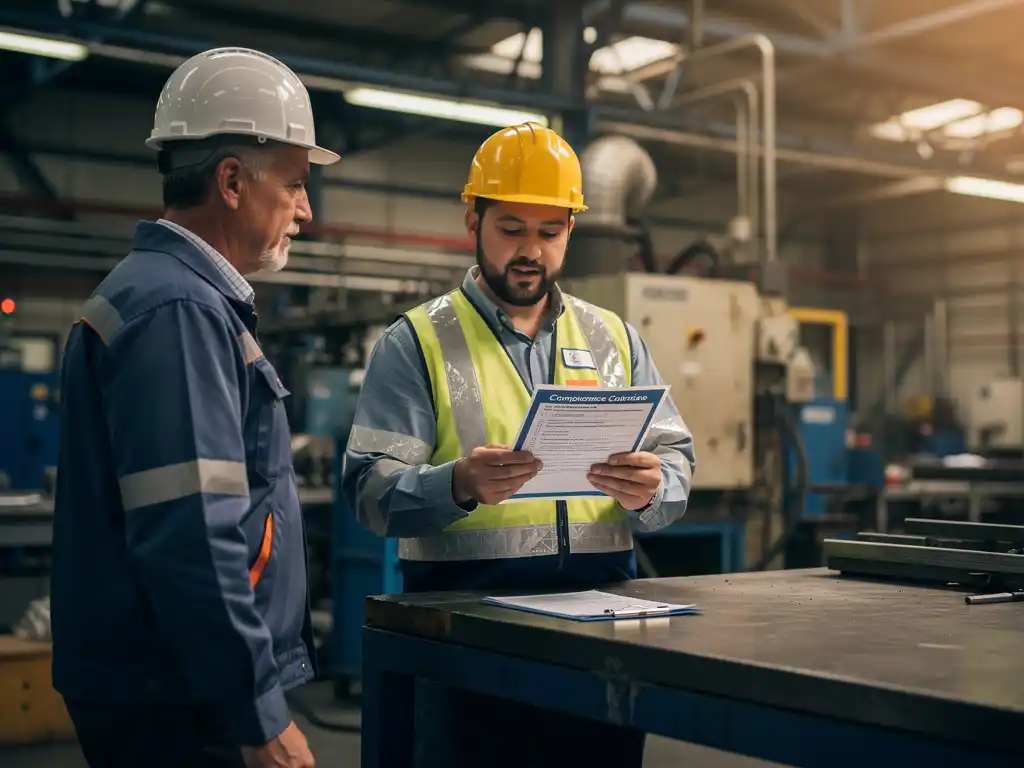
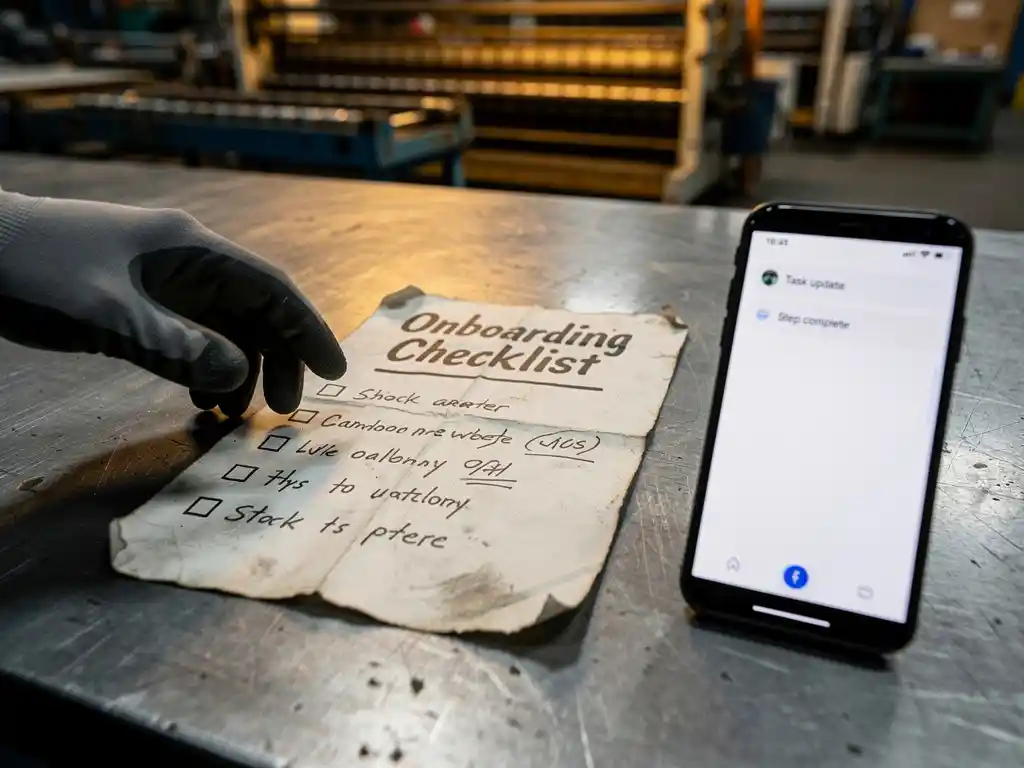
Paper-based onboarding in manufacturing creates four persistent problems: materials go out of date quickly, information is delivered inconsistently across shifts, physical documents get lost or damaged on the shop floor, and there is no reliable way to verify that a new employee has actually read and understood the content.
Manufacturing environments are fast-moving. Safety procedures change, equipment gets updated, and compliance requirements evolve. When that happens, paper manuals need to be reprinted, redistributed, and physically replaced — a process that takes time and often results in different employees working from different versions of the same document. On a production floor where a missed update can mean a safety incident or a quality failure, that inconsistency is a real operational risk.
There is also the human factor. A stack of printed documents handed to a new employee on day one competes with noise, nerves, and the general chaos of a first shift. Research consistently shows that information overload during initial onboarding leads to poor retention. Paper offers no way to pace the learning, no reminders, and no feedback loop to confirm understanding.
How does digital onboarding work for manufacturing employees?
Digital onboarding for manufacturing employees delivers structured training content through a platform employees can access on their phone or computer, without requiring them to sit at a desk or log into a complex system. Content is broken into short modules covering safety, processes, equipment, and compliance, sent at the right moment in the onboarding journey.
The most effective digital onboarding approaches for manufacturing use microlearning: short, focused modules that take three to six minutes to complete. Rather than handing a new hire a 40-page manual, the onboarding process sends them a brief module on day one covering the essentials, followed by more detailed content as they settle into the role. This staged approach matches how adults actually learn and retain information.
For multilingual workforces, which are common in manufacturing, digital platforms can deliver the same content in multiple languages automatically. This removes a significant barrier that paper-based onboarding simply cannot solve without printing separate manuals for every language spoken on the floor.
Which onboarding method gets new employees productive faster?
Digital onboarding gets new manufacturing employees productive faster than paper-based onboarding because it delivers the right information at the right moment, reduces cognitive overload, and allows employees to revisit instructions independently without waiting for a supervisor.
With paper onboarding, a new employee who forgets a procedure has two options: find the manual (if it has not been misplaced) or ask a colleague, which pulls someone away from their own work. With digital onboarding, the same employee can retrieve the relevant module in seconds. This self-sufficiency shortens the time between starting a job and performing it confidently.
Pre-onboarding is another area where digital clearly outperforms paper. Sending new hires a short digital module before their first day means they arrive already familiar with basic safety rules, the site layout, and what to expect. That preparation reduces first-day anxiety and means the first shift can focus on hands-on practice rather than introductory information.
What happens to onboarding materials when production processes change?
When production processes change, paper onboarding materials become immediately obsolete and require a full reprint and redistribution cycle. Digital onboarding materials can be updated in minutes and the revised version reaches every employee automatically, without any physical logistics.
This is one of the most underappreciated advantages of digital onboarding in manufacturing. A process change in a paper-based system means identifying which manuals are affected, drafting the update, getting it approved, printing new copies, collecting old copies, and distributing replacements across every shift. That cycle can take days or weeks, during which employees may still be following outdated instructions.
In a digital system, an updated module can be built and sent to the relevant employees within the same working day. Teams receive a notification, complete the short update module, and the change is documented. The organisation has a clear record of who has been informed and when, which matters significantly for compliance and audit purposes. Clear work instructions delivered digitally ensure every employee is always working from the latest version.
How can manufacturing companies track onboarding progress and compliance?
Manufacturing companies can track onboarding progress and compliance through digital onboarding platforms that record module completion, quiz results, and timestamps in a centralised dashboard. Paper-based onboarding offers no equivalent tracking capability without manual administration.
For regulated industries and safety-critical environments, the ability to prove that a specific employee completed a specific training module on a specific date is not optional. Auditors, inspectors, and HR departments need that evidence. Paper sign-off sheets can be lost, forged, or simply never collected. A digital dashboard provides a reliable, searchable record that requires no manual effort to maintain.
Progress tracking also allows managers to identify where new employees are struggling. If a significant proportion of new hires are failing a quiz on a particular safety topic, that signals either a training gap or a content problem that needs addressing. Paper onboarding provides no equivalent signal. Regular toolbox talks delivered digitally can help reinforce critical safety knowledge and close those gaps quickly.
When should a manufacturing company switch from paper to digital onboarding?
A manufacturing company should switch from paper to digital onboarding when any of the following conditions apply: onboarding is inconsistent across shifts or locations, compliance tracking is unreliable, process changes are slow to reach all employees, or the workforce includes employees who speak different languages.
In practice, most manufacturing companies reach a tipping point when the administrative burden of maintaining paper materials becomes impossible to ignore. Reprinting manuals, chasing signed checklists, and managing translations manually are all symptoms of a system that has outgrown its format. The switch to digital onboarding does not require a large IT project or a complete overhaul of existing training content. Many organisations start by digitising their most critical onboarding modules and expand from there, incorporating tools such as workplace inspections and knowledge retention programmes as they scale.
The question is not really whether to switch, but when. In 2026, the tools available to manufacturing companies make the transition more accessible than it has ever been, including platforms that work through apps employees already have on their phones, requiring no new software downloads or login credentials.
How E-Lia helps manufacturing companies modernise their onboarding
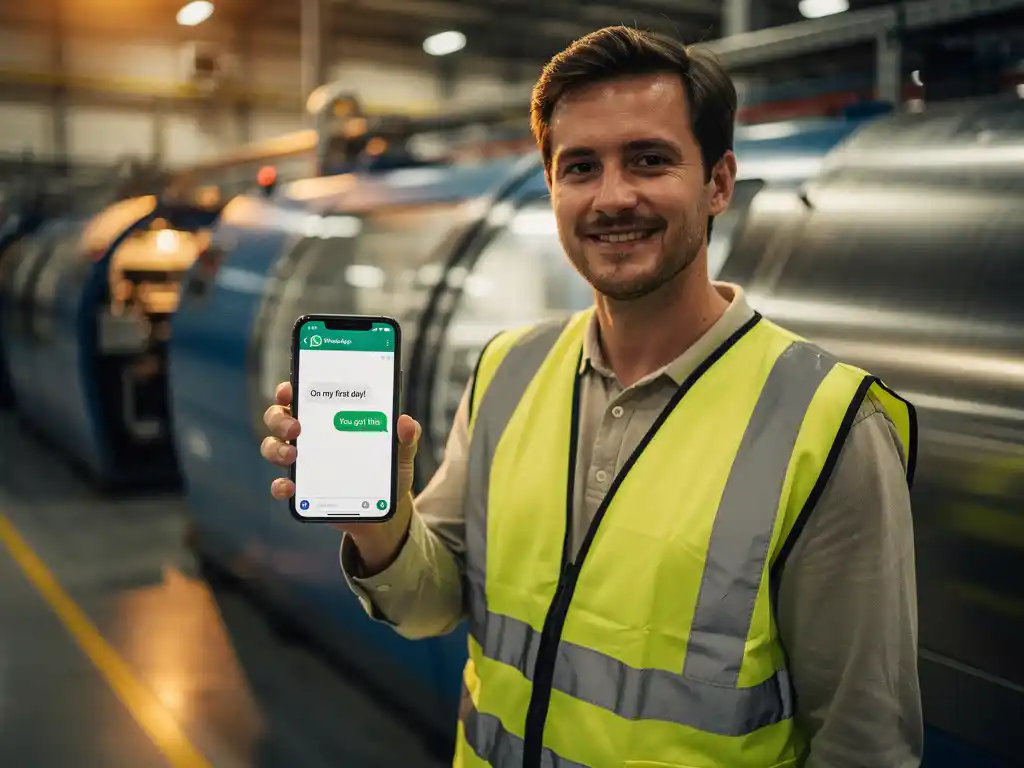
We built E-Lia specifically for organisations where traditional training methods create more friction than value. For manufacturing companies moving away from paper-based onboarding, our platform delivers structured microlearning modules directly through WhatsApp, with no app to download and no login required. Here is what that looks like in practice:
- Fast module creation: Building a new onboarding module takes an average of 10 to 15 minutes, so your team can respond to process changes the same day they happen.
- Short, effective learning: Employees complete each module in three to six minutes, making it easy to fit training into a shift without disrupting production.
- Automatic multilingual delivery: Content is automatically translated so every employee receives onboarding in their own language, without extra work from your team.
- Real-time progress tracking: A clear dashboard shows you exactly who has completed which modules, giving you the compliance documentation you need without manual administration.
- Pre-onboarding support: New hires receive relevant information before their first day, so they arrive prepared and day one can focus on getting them onto the floor.
If your manufacturing operation is still relying on printed manuals and paper checklists, we would be glad to show you what a practical digital onboarding process looks like. Plan a demo and see how E-Lia fits into your onboarding process.
Frequently Asked Questions
How long does it typically take to fully transition from paper to digital onboarding in a manufacturing setting?
Most manufacturing companies can complete a basic transition within two to four weeks, especially if they start by digitising their most critical safety and compliance modules rather than overhauling everything at once. The key is to prioritise the content that carries the highest risk if delivered inconsistently, get that live first, and build out the rest of the onboarding journey from there. A phased approach reduces disruption to ongoing operations and gives your team time to get comfortable with the new format before scaling it across all shifts and locations.
What if some of our employees are not comfortable using digital tools or smartphones?
This is one of the most common concerns, and in practice it tends to be less of a barrier than expected — particularly when digital onboarding is delivered through a familiar app like WhatsApp rather than a new platform employees have never seen before. Short, conversational modules with clear visuals are accessible even for employees with limited digital confidence. A brief introduction session showing employees how to access and complete a module is usually all that is needed, and many companies find that hesitant employees become comfortable after completing their first one or two modules.
Can digital onboarding replace hands-on training for equipment and machinery, or does it only cover theory?
Digital onboarding is not designed to replace hands-on training for equipment operation — it is designed to make that hands-on time more effective. When employees arrive at the machine already familiar with its purpose, basic safety rules, and key procedures from a short digital module, the in-person session can focus entirely on practice rather than explanation. Think of digital onboarding as preparation that maximises the value of every hands-on training minute, rather than a substitute for it.
How do we handle onboarding for temporary or seasonal workers without creating extra administrative work?
This is actually one of the strongest use cases for digital onboarding in manufacturing. Because modules are pre-built and can be sent automatically when a new employee is added to the system, temporary and seasonal workers can begin their onboarding immediately without requiring a manager or HR team member to coordinate printed materials or schedule an in-person session. Completion is tracked automatically, so you have the compliance documentation you need regardless of how short the contract is — with no additional administrative effort per person.
What types of content work best in a digital manufacturing onboarding programme?
The most effective digital onboarding content for manufacturing covers safety procedures, site rules, equipment introductions, quality standards, and role-specific processes — all broken into short, focused modules rather than delivered as one long document. Visual content such as short video clips, labelled diagrams, and photo-based steps works particularly well for explaining physical tasks. Quizzes at the end of each module reinforce retention and give managers a clear signal of where understanding is strong and where additional support may be needed.
How do we make sure onboarding content stays accurate when our processes change frequently?
The most practical approach is to assign clear ownership of each onboarding module to a specific person — typically a team lead, safety officer, or operations manager — who is responsible for flagging when that content needs updating. In a digital system, making the update itself takes minutes rather than days, so the bottleneck shifts from logistics to awareness. Setting a regular review cadence, such as quarterly checks on all active modules, ensures that even gradual process drift gets caught before it becomes a compliance or safety issue.
Is digital onboarding suitable for smaller manufacturing companies, or is it mainly built for large enterprises?
Digital onboarding is arguably more impactful for smaller manufacturing companies than for large ones, because smaller operations rarely have a dedicated L&D team to manage the administrative burden that paper-based onboarding creates. Modern platforms are designed to be set up and managed by a single person without any technical background, and the cost per employee is typically low enough to make sense even for teams of 20 to 30 people. The consistency and compliance benefits apply equally regardless of company size.