

A workplace inspection in installation technology must check for electrical hazards, fall risks, proper use of personal protective equipment, valid permits, and accurate documentation. These inspections are structured assessments that verify whether working conditions meet legal safety requirements and internal standards. The questions below walk through each critical inspection point in detail, from identifying hazards to recording findings and taking corrective action. For organisations looking to keep teams informed and inspection-ready, book a demo to find out how we support safety training.
What are the main safety hazards in installation technology workplaces?
The main safety hazards in installation technology workplaces include electrical risks, falls from height, exposure to hazardous substances, and risks associated with confined spaces or pressurised systems. These hazards are present across sectors such as construction, building services, and industrial maintenance, and they form the foundation of any installation technology safety inspection.
Electrical hazards are among the most serious. Live conductors, inadequate insulation, and overloaded circuits can cause electrocution or fire. Beyond electricity, installation technicians frequently work at height on ladders, scaffolding, or elevated platforms, making fall prevention a consistent priority during any workplace inspection checklist review.
Other common hazards include:
- Exposure to asbestos, solvents, or other chemical substances during renovation or maintenance work
- Manual handling injuries from lifting heavy equipment or cables
- Noise and vibration from power tools used over extended periods
- Risks in confined spaces such as crawl spaces, ducts, or technical shafts
- Fire risks from welding, cutting, or working near flammable materials
A thorough installation technology safety inspection begins by identifying which of these hazards are present on-site and assessing whether adequate controls are in place before work starts. Learn more about how structured workplace inspections can support this process.
What personal protective equipment must be checked during the inspection?
During a workplace inspection in installation technology, inspectors must verify that the correct personal protective equipment (PPE) is available, in good condition, properly fitted, and appropriate for the specific hazards present on that site. PPE is a last line of defence, so its presence alone is not enough — its suitability and condition matter equally.
The PPE check typically covers:
- Head protection: Hard hats or safety helmets where there is a risk of falling objects or low overhead structures
- Eye and face protection: Safety glasses, goggles, or face shields for grinding, drilling, or chemical exposure
- Hand protection: Insulating gloves rated for the voltage levels involved in electrical installation work
- Foot protection: Safety footwear with toe protection and, where relevant, anti-static or electrical insulation properties
- Hearing protection: Earplugs or earmuffs when noise levels exceed permitted thresholds
- Respiratory protection: Dust masks or respirators when working with insulation materials, solvents, or in poorly ventilated spaces
- Fall arrest equipment: Harnesses, lanyards, and anchor points when working at height
Inspectors should also check that workers have received instruction on how to wear and maintain their PPE correctly. Equipment that is worn incorrectly offers little protection, which is why training and inspection go hand in hand during any safety points installation work review. Explore how toolbox talks can reinforce PPE knowledge across your teams.
How are electrical systems and connections assessed during a workplace inspection?
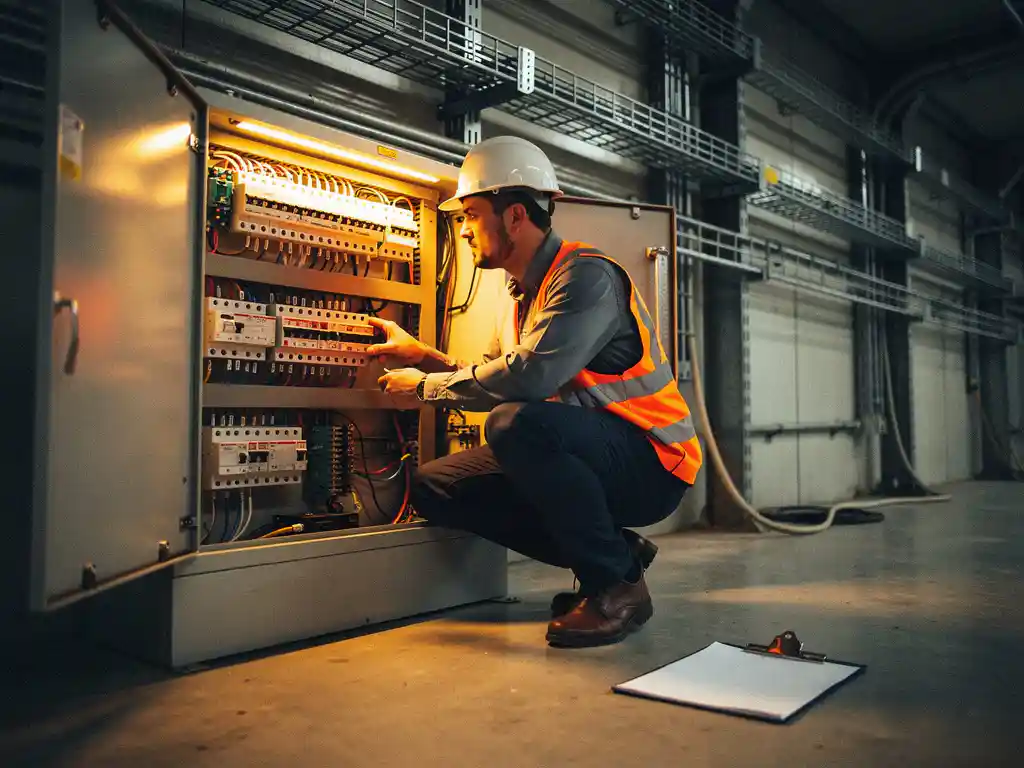
Electrical systems and connections are assessed during a workplace inspection by checking whether all electrical work complies with applicable standards, whether installations are properly earthed and protected, and whether no live parts are accessible to unauthorised or unqualified personnel. In installation technology, this is one of the most detailed and technical parts of the inspection.
Key assessment points for electrical systems include:
- Verification that temporary power supplies and distribution boards are correctly installed and protected
- Checking that cables are routed safely, without damage, and not creating trip hazards
- Confirming that residual current devices (RCDs) are present and functioning where required
- Assessing whether lockout and tagout procedures are in place to prevent accidental energisation during maintenance
- Reviewing whether only qualified and certified electricians are performing electrical installation tasks
Inspectors also look for visible signs of overheating, improper connections, or improvised wiring. Any temporary installations must meet the same safety standards as permanent ones. Where high-voltage systems are involved, additional checks on isolation procedures and warning signage are required as part of the workplace inspection requirements. Clear work instructions can help teams follow correct procedures consistently.
What does a workplace inspection check regarding working at height?
A workplace inspection checks that all work at height in installation technology is planned, supervised, and carried out using the correct equipment, with adequate fall prevention and rescue measures in place. Working at height remains one of the leading causes of serious injury in installation and construction environments.
During the inspection, the following aspects are reviewed:
- Equipment condition: Ladders, scaffolding, mobile elevated work platforms (MEWPs), and access towers must be inspected before use and show no signs of damage or instability
- Collective fall protection: Guardrails, edge protection, and safety nets should be in place wherever practicable before personal fall arrest systems are considered
- Personal fall arrest systems: Harnesses and lanyards must be correctly fitted, anchored to a suitable point, and within their inspection and replacement dates
- Ground conditions: The surface beneath elevated work must be stable and clear of hazards that could affect equipment stability
- Competency: Workers using MEWPs or erecting scaffolding must hold the appropriate training certificates
Inspectors also assess whether a rescue plan exists in case someone becomes suspended or incapacitated at height, as this is a legal requirement in many jurisdictions and a key element of any installation technology safety inspection.
Which documentation and permits must be present during an inspection?
During a workplace inspection in installation technology, inspectors must find valid work permits, risk assessments, method statements, equipment inspection records, and relevant certifications readily available on-site. Missing or outdated documentation is treated as a non-conformity, regardless of how safe the physical conditions appear.
The documentation typically required includes:
- Permit to work: Required for high-risk activities such as hot work, confined space entry, electrical isolation, or working at height above certain thresholds
- Risk assessment and method statement (RAMS): A written assessment of the hazards involved and the steps taken to control them, specific to the task being carried out
- Equipment inspection records: Certificates confirming that ladders, lifting equipment, harnesses, and electrical tools have been inspected within the required intervals
- Worker certifications: Proof that individuals performing specialist tasks hold valid qualifications, such as electrical certification, scaffold training, or confined space entry competency
- Emergency procedures: A site-specific emergency plan, including first aid arrangements and evacuation routes
Inspectors verify not only that documents exist but that they are current, site-specific, and understood by the workers they apply to. A generic risk assessment that does not reflect actual site conditions will not satisfy inspection requirements. Supporting workers with effective onboarding helps ensure they understand documentation requirements from day one.
How should inspection findings be recorded and followed up?
Inspection findings should be recorded in a structured written report that clearly identifies each observation, classifies its severity, assigns responsibility for corrective action, and sets a deadline for resolution. A finding that is not formally recorded is unlikely to be addressed consistently, which undermines the entire purpose of the inspection.
An effective recording and follow-up process includes:
- Categorise findings by severity: Distinguish between immediate dangers requiring work to stop, significant issues requiring urgent correction, and minor observations for improvement
- Assign clear ownership: Each finding should be linked to a named person or team responsible for resolving it
- Set realistic deadlines: Immediate hazards should be addressed before work resumes; lower-priority items should have a defined timeframe
- Document corrective actions: When a finding is resolved, the action taken should be recorded alongside the original observation
- Conduct a close-out review: A follow-up check confirms that corrective actions were effective and the hazard is genuinely resolved
Many organisations use digital tools to manage inspection records, which makes it easier to track open findings, generate trend reports, and demonstrate compliance to clients or regulators. Keeping inspection records accessible to the relevant team members also supports a culture of continuous safety improvement on installation technology sites. Tools that help teams retain and maintain knowledge play an important role in sustaining that culture over time.
How E-Lia helps with workplace inspection readiness in installation technology
Keeping installation teams inspection-ready means more than handing out a checklist once a year. Workers need to understand the why behind each safety requirement, know what to do in specific situations, and be able to access that knowledge quickly, even on a busy site. That is exactly where we come in.
With E-Lia, organisations in installation technology can:
- Create short, focused microlearning modules on topics like PPE use, permit-to-work procedures, and electrical safety, each completable in 3 to 6 minutes
- Deliver safety training and inspection reminders directly via WhatsApp, with no app download or login required
- Send modules in the worker’s own language using automatic translation, ensuring multilingual teams receive the same quality of instruction
- Track who has completed which training via a clear dashboard, providing documentation that supports inspection compliance
- Build new modules in 10 to 15 minutes, so safety content can be updated quickly when procedures change or new hazards are identified
Whether you are preparing a team for an upcoming workplace inspection or building a structured approach to installation technology safety training, we can help you get there efficiently. Plan a demo to see how E-Lia works in practice.
Frequently Asked Questions
How often should a workplace inspection be carried out in installation technology?
The frequency of workplace inspections in installation technology depends on the nature of the work, the level of risk involved, and any applicable legal requirements. High-risk activities such as electrical installation, confined space work, or working at height typically require inspections before each shift or task begins, while broader site inspections may be conducted weekly or monthly. Regulatory frameworks in many countries set minimum inspection intervals for specific equipment such as scaffolding, lifting gear, and harnesses, so these legal requirements should form the baseline of your inspection schedule.
What is the difference between a workplace inspection and a risk assessment in installation technology?
A risk assessment is a documented process carried out before work begins to identify hazards and determine the controls needed to manage them, while a workplace inspection is an on-site check that verifies whether those controls are actually in place and working effectively. Both are required and complementary: the risk assessment sets out what should be done, and the inspection confirms whether it is being done. If an inspection reveals that conditions have changed significantly from what the risk assessment anticipated, the risk assessment should be reviewed and updated before work continues.
What should happen if a serious hazard is discovered during an inspection?
If a serious or imminent hazard is identified during a workplace inspection, work in the affected area should be stopped immediately and workers should be moved to a safe location. The hazard must be reported to the site manager or safety officer without delay, and no work should resume until the hazard has been eliminated or adequately controlled. The finding should be formally recorded with a note of the immediate action taken, and a follow-up check should confirm that the corrective measure is effective before the area is reopened.
Who is qualified to carry out a workplace inspection in installation technology?
Workplace inspections in installation technology should be carried out by a competent person — someone with sufficient knowledge, training, and experience to identify hazards, assess their severity, and understand the relevant legal requirements. This may be a qualified safety officer, a site supervisor with formal health and safety training, or an external inspector depending on the complexity of the work. For specialist elements such as electrical systems or lifting equipment, the inspector may need specific technical qualifications in addition to general safety competency.
How can organisations make sure workers are actually prepared for an inspection, not just familiar with the checklist?
Genuine inspection readiness comes from regular, practical safety training that helps workers understand the reasoning behind each requirement, not just what the checklist says. Short, scenario-based training modules that address real on-site situations — such as what to do when a permit is missing or how to check a harness correctly — build the kind of applied knowledge that holds up under inspection conditions. Delivering training in workers’ own languages and keeping it accessible on mobile devices ensures that even multilingual or mobile teams can stay consistently informed.
Are there common mistakes organisations make when preparing for a workplace inspection?
One of the most common mistakes is treating inspection preparation as a one-time activity rather than an ongoing process, which often results in documentation gaps, expired certificates, or PPE that has not been replaced on schedule. Another frequent issue is having generic risk assessments and method statements that do not reflect the actual conditions or tasks on the current site, which inspectors will typically flag as a non-conformity. Organisations also sometimes overlook worker competency records, assuming that experienced staff do not need documented proof of training — but valid, up-to-date certifications are required regardless of how long someone has been in the role.
Can digital tools replace paper-based inspection records for compliance purposes?
In most jurisdictions, digital inspection records are fully accepted for compliance purposes provided they are tamper-evident, accurately timestamped, and accessible to relevant parties such as inspectors or regulators when requested. Digital tools offer practical advantages over paper, including easier tracking of open findings, automated reminders for re-inspection dates, and the ability to attach photographs as evidence of conditions or corrective actions. The key requirement is that records are complete, retrievable, and clearly linked to the specific tasks, equipment, and personnel they relate to.