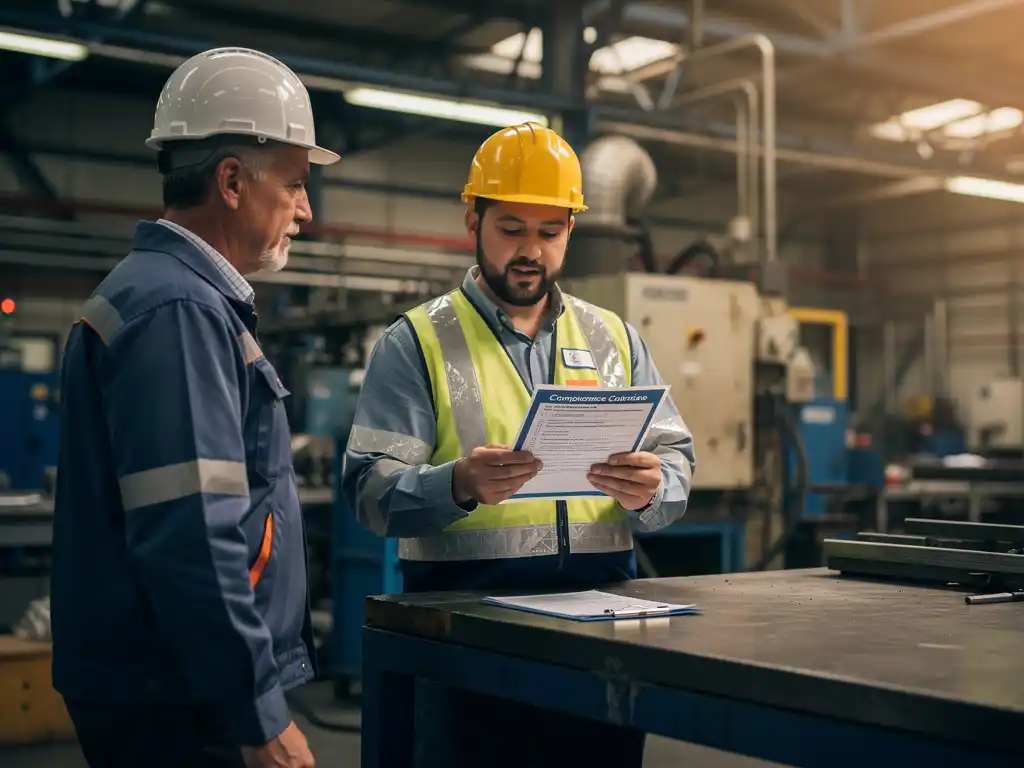


The most important onboarding trends for manufacturing companies in 2026 centre on digital delivery, microlearning, and multilingual accessibility. Traditional paper-based or classroom-heavy onboarding simply cannot keep pace with the demands of a modern factory floor, where new hires need to be productive quickly and safely. This article walks through the key questions manufacturing leaders are asking about onboarding right now, from the biggest challenges to how you measure whether your process is working.
What are the biggest onboarding challenges in manufacturing?
The biggest onboarding challenges in manufacturing are high employee turnover, safety compliance requirements, shift-based scheduling, and a diverse, often multilingual workforce. These factors combine to make traditional onboarding approaches slow, expensive, and inconsistent, leaving new workers underprepared and increasing the risk of errors on the floor.
Manufacturing environments move fast. A new hire on the production line needs to understand safety protocols, machine operation, and quality standards before they can contribute effectively. When onboarding relies on printed manuals or scheduled classroom sessions, gaps appear quickly. Workers on night shifts may miss training sessions entirely. Seasonal staff hired at short notice rarely receive the same depth of instruction as permanent employees.
High turnover compounds the problem. When a significant portion of your workforce cycles through every year, the cost of onboarding each new person adds up fast. If the process is slow or inconsistent, productivity suffers and safety incidents become more likely. The challenge for manufacturing companies in 2026 is building an onboarding process that is fast to deliver, consistent across every hire, and flexible enough to reach workers wherever and whenever they start.
How is digital onboarding changing the factory floor in 2026?
Digital onboarding is transforming manufacturing by replacing paper-based and classroom-dependent processes with mobile, on-demand learning that workers can access from any device. In 2026, the shift towards digital onboarding manufacturing solutions means new hires can begin learning before their first shift and continue training at their own pace without disrupting production schedules.
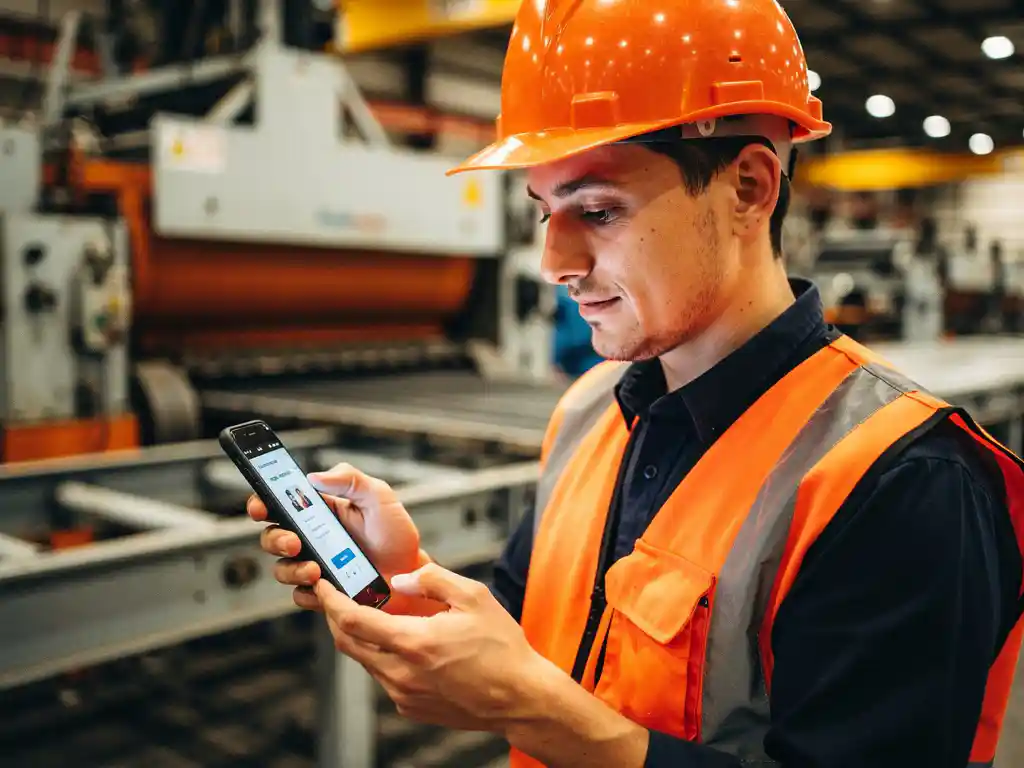
The practical impact is significant. Instead of pulling a supervisor away from the floor to walk a new employee through a manual, digital onboarding delivers structured information directly to the worker. Video walkthroughs, step-by-step work instructions, and knowledge checks can all be completed on a smartphone between tasks or before a shift begins.
What makes digital onboarding particularly valuable in manufacturing is consistency. Every new hire receives exactly the same information in the same sequence, reducing the variation that comes with informal, verbal handovers. Managers gain visibility into who has completed which modules, making compliance tracking straightforward. As manufacturing onboarding best practices continue to evolve, the companies seeing the strongest results are those treating digital onboarding not as a one-time event but as a continuous process that supports workers through their first weeks and beyond.
What role does microlearning play in manufacturing onboarding?
Microlearning plays a central role in modern manufacturing onboarding by breaking complex information into short, focused modules that workers can complete in three to six minutes. This format fits naturally into the rhythm of a production environment, where attention is divided and extended learning sessions are rarely practical.
Rather than overwhelming a new hire with a full training manual on day one, microlearning delivers information in digestible pieces tied to specific tasks or situations. A worker starting on a packaging line might receive a short module on machine startup procedures, followed by one on quality checks, then one on safety reporting. Each module builds on the last without requiring a large block of uninterrupted time.
The format also improves retention. Research into learning and memory consistently shows that spaced, repeated exposure to information outperforms single intensive sessions. Microlearning supports this naturally by spreading content over days or weeks, reinforcing key knowledge at the moments when workers are most likely to apply it. For manufacturing companies dealing with complex compliance requirements or frequent process updates, microlearning makes it practical to retain and maintain knowledge without pulling employees off the floor.
How can manufacturers onboard multilingual workers effectively?
Manufacturers can onboard multilingual workers effectively by delivering training content in each employee’s preferred language, using visual formats where possible, and leveraging platforms that support automatic translation. Language barriers are one of the most common causes of onboarding failure in manufacturing, where misunderstood instructions can lead to safety incidents or quality errors.
The first step is acknowledging that a single-language onboarding process excludes a significant portion of many manufacturing workforces. Workers who cannot fully understand their training are more likely to make mistakes, less likely to ask questions, and more likely to leave. Providing content in multiple languages is not just a courtesy, it is a safety and retention measure.
Practical approaches include:
- Using platforms that offer automatic translation so the same module can reach workers in Polish, Turkish, Arabic, or any other language without creating separate content for each
- Pairing written content with images, diagrams, and short videos to reduce dependence on language alone
- Allowing workers to select their preferred language at the start of onboarding rather than requiring a manager to configure it for them
- Testing comprehension through simple knowledge checks rather than open-ended written responses
Effective multilingual onboarding also signals to new employees that the company values their inclusion from day one, which has a measurable impact on early engagement and retention.
What does a good pre-onboarding process look like in manufacturing?
A good pre-onboarding process in manufacturing starts before the employee’s first day and covers essential information such as safety rules, site orientation, and role expectations. Effective pre-onboarding reduces the overwhelm of day one, shortens time-to-productivity, and gives new hires the confidence to start contributing sooner.
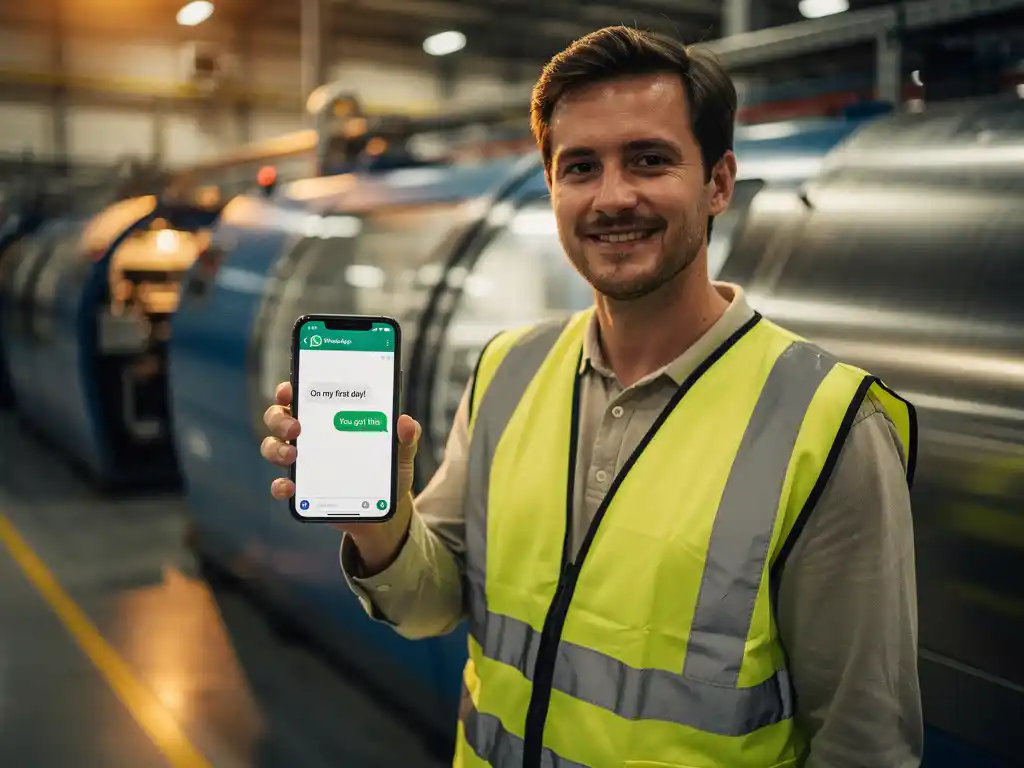
The period between a job offer being accepted and the first shift is an underused opportunity. New employees are motivated and receptive during this window. Sending them a short welcome message, a brief safety overview, or a site map via a familiar channel like WhatsApp takes minimal effort but creates a meaningful first impression.
A strong pre-onboarding process typically includes:
- A welcome communication confirming start details and introducing the team or manager
- Basic safety information relevant to the site, so the employee arrives prepared rather than starting from zero
- Practical logistics such as where to park, what to wear, and who to report to
- An introduction to the role covering what the first week will look like
Keeping pre-onboarding content short and accessible is critical. If it requires downloading an app or logging into a system the new hire has never used, many will not engage with it at all. The goal is to reduce friction, not add it. Learn more about how a structured onboarding approach can make a real difference from day one.
How do you measure onboarding success in a manufacturing environment?
Onboarding success in manufacturing is measured by tracking completion rates, time-to-productivity, safety incident rates among new hires, and early turnover figures. These metrics together give a clear picture of whether your onboarding process is actually preparing workers to perform safely and effectively.
Completion rate is the most immediate indicator. If a large proportion of new hires are not finishing their onboarding modules, the content may be too long, too inaccessible, or poorly timed. A dashboard that shows who has completed what, and when, makes it easy to identify drop-off points and address them.
Time-to-productivity measures how quickly a new hire reaches the expected output level for their role. In manufacturing, this is often trackable through production data. A shorter time-to-productivity suggests onboarding is delivering the right information at the right time. A longer one points to gaps in the training content or delivery.
Safety incidents involving new employees are a critical measure in any manufacturing context. A well-designed onboarding process should result in fewer incidents among recent hires compared to those who received minimal training. Tracking this over time helps justify investment in onboarding improvements. Regular workplace inspections and toolbox talks can further reinforce the safety knowledge introduced during onboarding.
Finally, early turnover, typically measured as employees leaving within the first three to six months, reflects the overall quality of the onboarding experience. Workers who feel unprepared, unsupported, or disconnected from their team are more likely to leave early. Reducing this figure through better onboarding has a direct impact on recruitment costs and team stability.
How E-Lia helps manufacturing companies with onboarding
We built E-Lia specifically to solve the onboarding and training challenges that manufacturing companies face every day. Our platform delivers microlearning modules, work instructions, and onboarding content directly via WhatsApp, meaning no app downloads, no logins, and no barriers to access. Here is what that looks like in practice:
- Fast content creation: Building a module takes an average of 10 to 15 minutes, so your team can respond quickly to process changes or new compliance requirements
- Short, effective learning: Workers complete modules in 3 to 6 minutes, making it easy to fit training into shift schedules without disrupting production
- Multilingual support: Automatic translation means every employee receives training in their own language, reducing misunderstandings and improving safety
- Pre-onboarding via WhatsApp: New hires receive structured information before their first day, arriving prepared and confident
- Progress tracking: A clear dashboard shows exactly who has completed what, making compliance reporting straightforward
- No technical barriers: Because we use WhatsApp, workers engage with training on a platform they already use and trust
E-Lia is already used by organisations including the University of Utrecht and ETZ to support effective onboarding and knowledge retention. If you want to see how it works for a manufacturing environment, book a free demo or explore our onboarding solutions to find out more.
Frequently Asked Questions
How long should the onboarding process last for a new manufacturing employee?
While day-one orientation might cover the basics, effective manufacturing onboarding typically spans the first 30 to 90 days. The goal is not to front-load everything into a single session but to gradually build knowledge and confidence through structured touchpoints — covering safety first, then role-specific skills, then broader process understanding. Platforms that support ongoing microlearning make it easy to sustain this without pulling workers off the floor for extended training blocks.
What if our workforce has very low digital literacy — can digital onboarding still work?
Yes, but the choice of platform matters enormously. Tools that require new logins, app downloads, or unfamiliar interfaces create friction that low-digitally-literate workers are unlikely to push through. Delivering onboarding through a platform workers already use daily — such as WhatsApp — removes that barrier almost entirely. Pairing text with images, short videos, and simple multiple-choice checks also reduces the reading and tech skills required to engage meaningfully with training content.
How do we keep onboarding content up to date when processes change frequently?
This is one of the most common pain points in manufacturing training, and it is why content creation speed matters as much as content quality. Look for platforms that allow non-technical team members to build or update modules quickly — ideally in under 15 minutes — so that when a process, machine, or compliance requirement changes, the relevant training can be updated and redistributed the same day. Avoid systems that require external developers or lengthy approval workflows just to correct a single step in a work instruction.
What are the most common mistakes manufacturers make when rolling out a new onboarding process?
The most frequent mistakes are trying to digitise a paper manual without rethinking the format, skipping pre-onboarding entirely, and failing to track completion data. Simply converting a 40-page PDF into a digital document does not make onboarding more effective — the content needs to be restructured into short, task-focused modules. Equally, launching a new system without monitoring who is actually completing it means problems go undetected until they show up as safety incidents or early turnover.
How do we handle onboarding for temporary or seasonal workers who join at short notice?
Temporary and seasonal workers are exactly where a slow or manual onboarding process breaks down most visibly. The solution is having a streamlined, always-available onboarding track specifically designed for short-term hires — covering the essential safety and role information they need in the first day or two, without requiring a supervisor to walk them through everything in person. Pre-onboarding content sent via a familiar channel like WhatsApp before their first shift means they arrive already briefed on the basics, even with minimal lead time.
Can onboarding content be personalised for different roles or shifts without creating separate programmes for each?
Modern onboarding platforms allow you to build a shared content library and then assign specific modules to specific roles, teams, or shift patterns — so a forklift operator and a quality inspector receive different training tracks without you needing to build two entirely separate programmes. This modular approach also makes updates easier: when a safety protocol changes on the packaging line, you update one module rather than overhauling an entire programme. Role-based content personalisation is one of the clearest ways to improve relevance and completion rates simultaneously.
How do we get buy-in from floor managers and supervisors for a new onboarding approach?
The most effective argument is time saved, not technology gained. Floor managers are typically resistant to new systems because previous implementations added to their workload rather than reducing it. Demonstrating that a digital onboarding tool means fewer interruptions to answer basic questions, less time spent walking new hires through manuals, and a clear dashboard showing who is trained and compliant — without requiring the manager to chase anyone — tends to shift that resistance quickly. Starting with a small pilot on one line or shift and sharing the results internally is often the fastest route to wider adoption.