


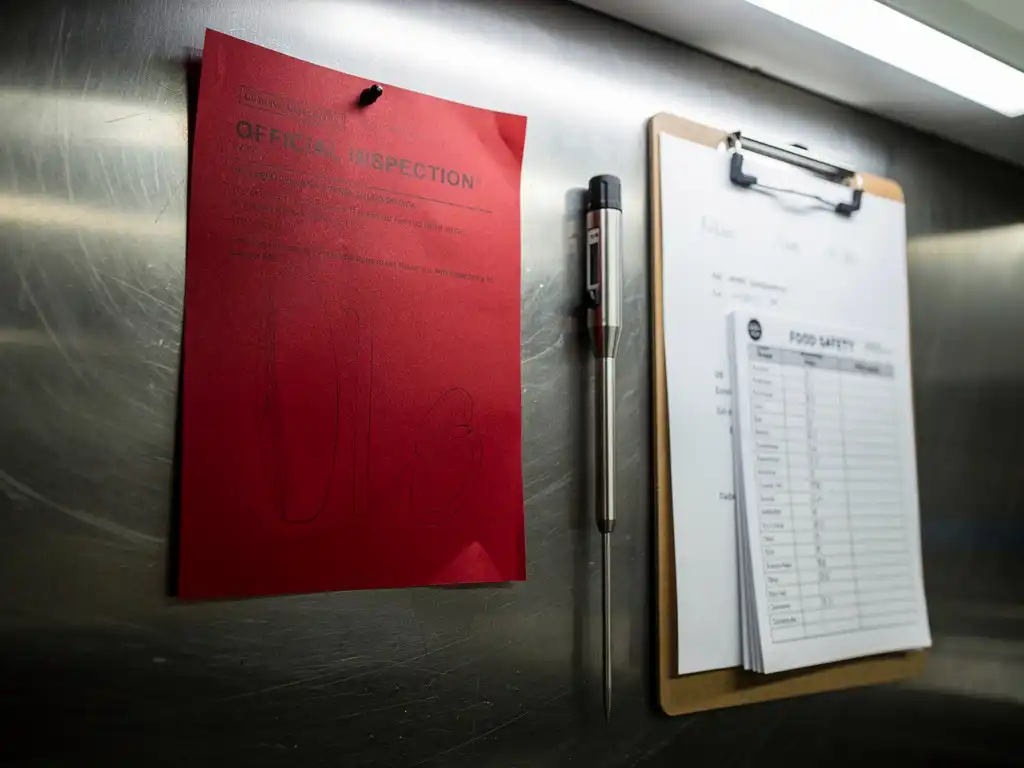
Food safety is not a minor concern. Businesses in the food industry are subject to strict HACCP regulations, and those who fail to comply risk not only a fine, but also reputational damage and, in the worst case, a temporary closure. Yet many business owners and managers do not know exactly what constitutes a violation, who enforces the rules, and how significant the financial consequences can be.
In this article, we answer the most frequently asked questions about HACCP violations in the Netherlands: from the definition to the size of fines, from repeat violations to practical training tips for your team.
What exactly is an HACCP violation?
An HACCP violation is any situation in which a business fails to comply with the mandatory requirements of the HACCP system. HACCP stands for Hazard Analysis and Critical Control Points and is a legally required food safety system for businesses that produce, process, store, or serve food. A violation occurs when critical control points are not monitored, documented, or corrected.
In practice, this includes situations such as missing temperature records, failure to separate raw and prepared products, insufficient personal hygiene amongst staff, or not maintaining cleaning schedules. It is not just about major incidents: even small, structural shortcomings in administration or working practices count as violations.
It is important to understand that HACCP is not only about the final check, but about the entire process. If a control point is missing or not correctly applied anywhere in the chain, a violation has occurred, regardless of whether anyone has actually become ill.
Which authority enforces HACCP regulations in the Netherlands?
In the Netherlands, the Nederlandse Voedsel- en Warenautoriteit (NVWA) — the Dutch Food and Consumer Product Safety Authority — is responsible for enforcing HACCP regulations. The NVWA carries out unannounced inspections at food industry businesses and assesses whether the HACCP system is in place, up to date, and correctly applied.
During an inspection, the NVWA looks at the presence of a written HACCP plan, the implementation of that plan in practice, temperature records, hygiene protocols, and the knowledge of staff. Inspectors assess not only the paperwork, but also how things actually operate on the shop floor.
In addition to the NVWA, municipal supervisory authorities and sector-specific bodies may also play a role, depending on the industry. For hospitality businesses, for example, the municipality may exercise additional oversight through licensing and enforcement of the Licensing and Catering Act.
How large is the fine for an HACCP violation?
The size of a fine for an HACCP violation depends on the severity and nature of the violation. The NVWA works with a fine catalogue in which violations are classified into categories. Fines can range from a few hundred euros for minor violations to tens of thousands of euros for serious or repeated breaches of food safety regulations.
Minor violations, such as a missing record or a small administrative error, typically result in a warning or a relatively low fine. Serious violations, such as the presence of harmful bacteria due to inadequate temperature control or the complete absence of an HACCP system, can lead to fines of thousands of euros and additional measures.
Additional sanctions beyond the fine
In addition to a financial fine, the NVWA can also impose administrative law measures. These include a penalty order, whereby a business pays an amount for each day the violation continues, or a temporary suspension of production. In extreme cases, a business may be closed until the situation has been remedied.
What are the consequences of a repeated HACCP violation?
In the case of a repeated HACCP violation, sanctions become considerably more severe. The NVWA keeps a record of previous inspections and violations. A second or third violation of the same nature almost always results in a higher fine, more intensive supervision, and in some cases the publication of inspection results.
That publication is one of the most feared consequences for many businesses. The NVWA has the authority to make inspection reports public, which can cause direct reputational damage. Customers, suppliers, and the media can become aware of the violations, with all the commercial consequences that entails.
Structural shortcomings can also result in a business being placed under enhanced supervision. This means more frequent, unannounced inspections and a higher bar for demonstrating that the situation has improved. It is therefore in every business’s interest not only to comply on a one-off basis, but to build a sustainable HACCP system.
How do you prevent an HACCP violation in your organisation?
You prevent an HACCP violation by combining a well-documented and actively managed food safety system with structural training of staff. The HACCP plan must not only exist on paper, but must also be genuinely followed on the shop floor every single day.
Practical steps that help prevent violations include:
- Ensure you have a current, written HACCP plan that reflects your actual working processes
- Establish clear responsibilities for maintaining records and carrying out checks
- Conduct internal audits before the NVWA visits
- Make sure new employees are informed about HACCP procedures from day one — structured onboarding makes this process consistent and measurable
- Keep records in real time, not retrospectively
- Actively discuss deviations and corrective measures with the team, for example during regular toolbox talks
A common mistake is treating HACCP as a one-off project rather than a continuous process. Food safety requires daily attention and a culture in which employees understand why the rules exist, not just what they are required to do.
How do you train employees effectively on HACCP regulations?
Effective HACCP training starts with accessibility. Employees need to understand and retain the rules, not simply complete a course. Short, repeatable training sessions that connect to daily work practice have been proven more effective than lengthy, one-off sessions. Tools that help retain and maintain knowledge over time are especially valuable in food safety contexts.
When training employees, ensure the following elements are in place:
- Training content tailored to the specific workplace and tasks of the employee
- Use of visual examples and real-life work situations, such as clear work instructions
- Regular repetition to consolidate knowledge
- Accessibility in the employee’s native language, especially in multilingual teams
- Ability to complete training without a computer or login credentials
Particularly in sectors such as hospitality, production, and care, many employees work without a fixed workstation or computer. Traditional e-learning or classroom training often fits poorly with this reality. Microlearning delivered via a familiar channel such as WhatsApp ensures that employees receive the information at the moment it is relevant, with no barriers to access.
Regular workplace inspections are another effective way to verify that HACCP knowledge is being applied correctly on the shop floor and to identify gaps before an NVWA inspector does.
How E-Lia helps with HACCP training for your team
At E-Lia, we make it simple to train your employees effectively on HACCP regulations — without the hassle of apps, login credentials, or computers. Via WhatsApp, we send short, easy-to-understand microlearning modules directly to your employees’ phones, at exactly the moment they are most relevant.
What we offer for HACCP training:
- Ready-made HACCP modules that can be deployed immediately
- The ability to build your own modules in an average of 10 to 15 minutes
- Automatic translations, so multilingual teams can learn in their own language
- Progress tracking via a clear and intuitive dashboard
- Modules that employees complete in 3 to 6 minutes, even during a busy working day
- No app download or login required
Whether you want to onboard new employees or upskill existing teams on the latest HACCP procedures, we ensure that knowledge is delivered and retained. Explore our HACCP training via WhatsApp and discover how your organisation can get started today. You are also welcome to book a free demo to see E-Lia in action.
Frequently Asked Questions
Does every business in the food industry need an HACCP system, including sole traders?
Yes, the HACCP requirement applies to all businesses that produce, process, store, or serve food, regardless of size. However, legislation does allow for a simplified system based on hygiene guides for smaller operators, such as an independent baker or small hospitality business. It is advisable to check with your industry association which simplified approach applies to your situation.
How much notice do you receive before an NVWA inspection?
In most cases, you receive no notice at all: the NVWA carries out unannounced inspections precisely in order to get a realistic picture of day-to-day practice. This means your HACCP system must always be in order, not only when you are expecting an inspection. Some re-inspections following a previous violation are announced in advance, but this is the exception rather than the rule.
What should I do if a violation is recorded during an NVWA inspection?
Do not sign the inspection report until you have read it carefully, and make use of your right to lodge an objection within the specified deadline if necessary. Immediately after the inspection, ensure the identified violation is corrected and document the corrective measures you have taken. Proactively demonstrating improvements can be taken into account during a follow-up inspection or objection procedure.
How often should I update my HACCP plan?
Your HACCP plan must be updated whenever relevant changes occur in your working processes, products, suppliers, or business layout. In addition, it is advisable to review the plan at least once a year, even if there is no immediate reason to do so. An outdated HACCP plan that no longer reflects the actual situation is considered a violation by the NVWA, even if the plan itself was previously correct.
Are employees personally liable for an HACCP violation, or does responsibility always rest with the employer?
Legal and financial liability rests primarily with the operator or owner of the business, not with the individual employee. However, an employee who can be shown to have acted negligently may face employment law consequences in serious cases. This underlines the importance of good training: employees must know what the rules are and why they exist, so that they act consciously and correctly.
What is the difference between a warning and an official fine for an HACCP violation?
A warning is a formal notification from the NVWA that a violation has been identified, without an immediate financial penalty, but with an obligation to correct the situation. An official fine is an administrative law sanction in which a monetary amount is imposed based on the NVWA's fine catalogue. A warning is recorded and can carry more weight during a subsequent inspection, meaning that a comparable violation the second time around will typically result directly in a fine.
Can I as an employer demonstrate that my employees have been sufficiently trained on HACCP, and how do I do that?
Yes, and this evidence is crucial during an NVWA inspection. Always retain documentation of completed training, such as participant lists, certificates, training dates, and the content of the modules covered. Digital platforms such as E-Lia provide automatic progress tracking via a dashboard, allowing you to demonstrate with a single click who completed which training and when — giving inspectors immediate insight into the knowledge and compliance level of your team.