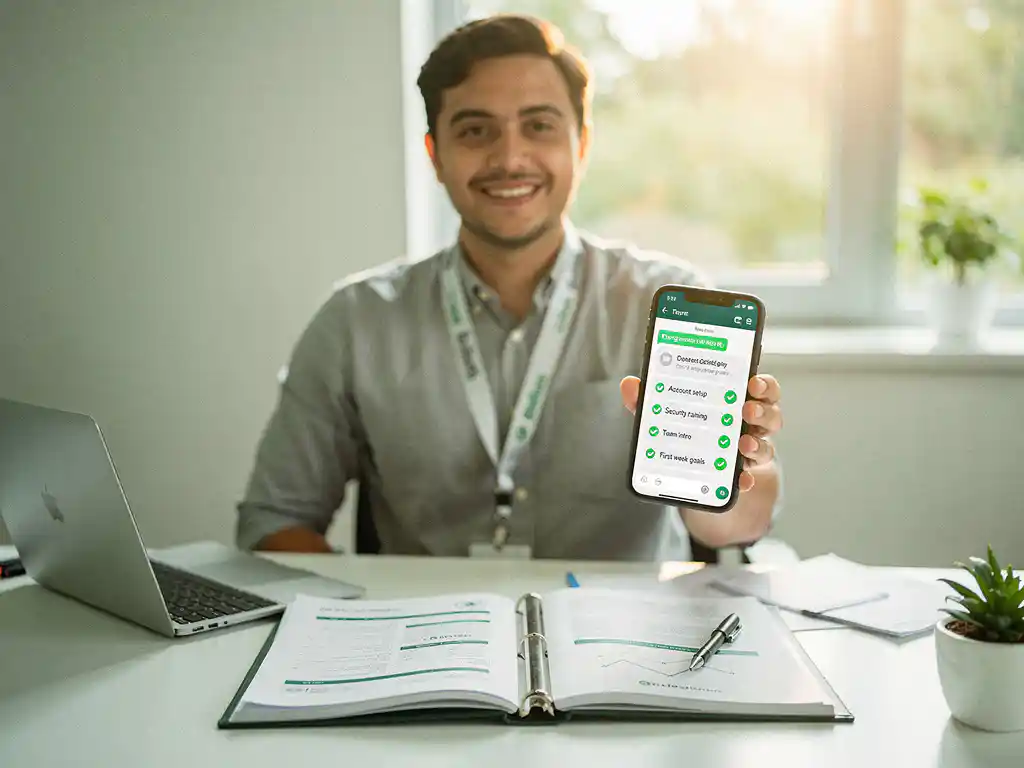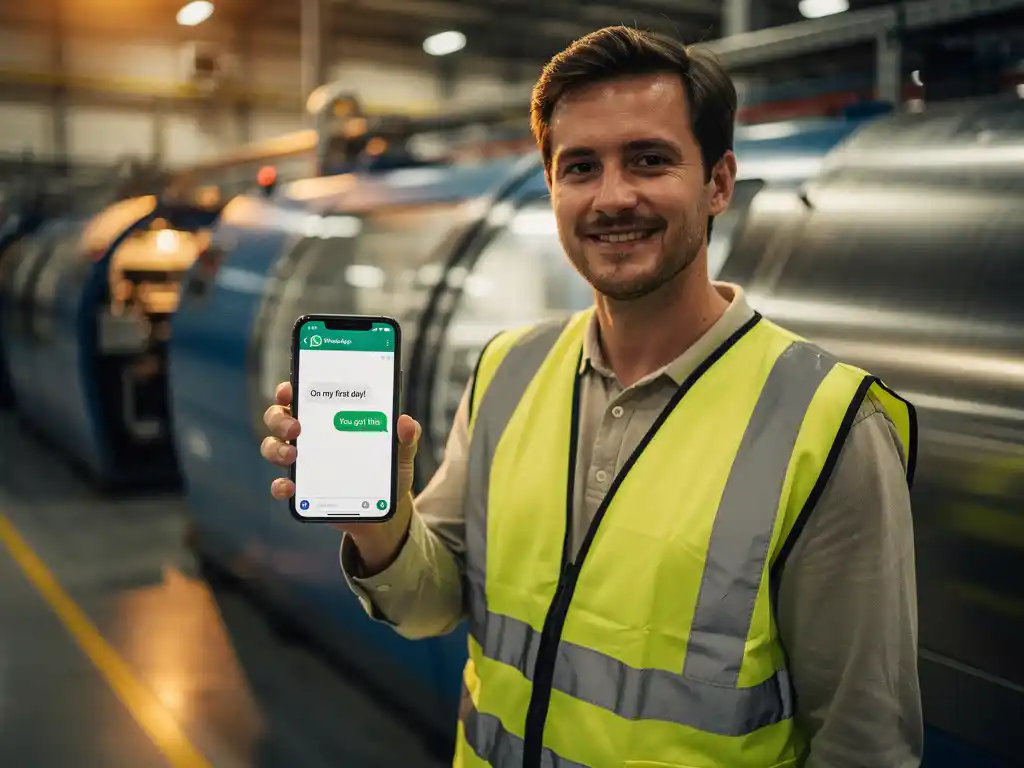
You can onboard new employees via WhatsApp by sending structured microlearning modules, step-by-step work instructions, and scheduled check-ins directly to their phone number — no app download, no login required. Because WhatsApp is already installed on most smartphones, new hires can start learning from day one without any technical barriers. The sections below cover everything from content formats and onboarding flows to multilingual support and progress tracking.
What makes WhatsApp an effective onboarding channel?
WhatsApp is an effective onboarding channel because it meets new employees where they already are. With open rates far exceeding those of email and no requirement to download a separate tool or remember a password, WhatsApp removes the friction that causes many digital onboarding programmes to fail before they even begin. New hires receive onboarding content on the device they use every day, in a format they already know how to use.
From an organisational perspective, digital onboarding via WhatsApp is also practical to manage. Content can be scheduled in advance, sent automatically at the right moment in the onboarding journey, and updated quickly when processes change. This combination of high engagement on the employee side and low administrative overhead on the employer side makes WhatsApp a genuinely strong channel for employee onboarding, particularly for organisations with frontline, deskless, or multilingual workforces.
The channel also supports a variety of content formats, including text, images, short videos, and interactive questions, which means onboarding content does not have to be limited to lengthy documents or slide decks.
What types of onboarding content work well via WhatsApp?
The content types that work best for WhatsApp onboarding are short, focused, and immediately actionable. Microlearning modules covering a single topic, step-by-step work instructions, safety protocols, house rules, and short knowledge checks all translate well to the format. Each piece of content should be completable in three to six minutes so it fits naturally into a new hire’s day without feeling like a burden.
Practically speaking, effective WhatsApp onboarding content tends to include:
- Welcome messages and team introductions that help new employees feel connected from day one
- Work instructions that explain exactly how to perform a specific task, ideally with supporting images or short video clips
- Compliance and safety modules covering essential rules and procedures in a clear, digestible format
- Knowledge checks with simple multiple-choice questions that reinforce learning and give managers insight into comprehension
- Scheduled reminders and follow-up content that guide new hires through their first days and weeks progressively
The key principle is to keep each message focused on one learning objective. Trying to cover too much in a single message reduces both completion rates and knowledge retention.
How do you structure a WhatsApp onboarding flow for new hires?
A WhatsApp onboarding flow works best when it is structured as a sequence of timed messages that guide new employees through a logical progression, from pre-boarding through their first weeks on the job. Rather than sending all information at once, you space content out so each module builds on the last and arrives at a moment when it is relevant and actionable.
A practical structure for a WhatsApp onboarding flow looks like this:
- Pre-boarding (before the first day): Send a welcome message, practical information about where to go and what to bring, and a brief introduction to the team or organisation.
- Day one: Deliver essential work instructions, a safety or compliance module, and any tools or systems the new hire needs to get started.
- Week one: Follow up with role-specific content, more detailed process instructions, and an initial knowledge check.
- Weeks two to four: Continue with deeper modules covering company culture, quality standards, or product knowledge, spaced out to avoid information overload.
- End of onboarding: Close the sequence with a final check-in or short assessment to confirm the new hire has the knowledge they need.
Automation is what makes this scalable. Once the sequence is built, it can run automatically for every new hire who joins, triggered by a start date or HR system event. This means onboarding is consistent regardless of how many people join at once or which manager is responsible for them.
How do you handle multilingual employees in a WhatsApp onboarding programme?
Multilingual employees can be supported in a WhatsApp onboarding programme by delivering content in each employee’s preferred language, either by building separate language versions of each module or by using a platform with automatic translation capabilities. The goal is to ensure every new hire receives onboarding information they can actually understand, not just content that has been technically delivered.
For organisations operating in sectors like logistics, healthcare, or production, where workforces are often multilingual, this is not a minor detail. An employee who receives safety instructions or work procedures in a language they do not fully understand is both less effective and more at risk. Delivering onboarding content in someone’s native language significantly improves both comprehension and retention.
When building a multilingual onboarding programme, consider the following:
- Identify the languages spoken across your workforce before building your content
- Prioritise safety-critical and compliance content for translation first
- Use automatic translation tools to reduce the manual effort of maintaining multiple language versions
- Test translated content with native speakers where possible to ensure clarity and natural phrasing
How do you track whether new employees are completing onboarding via WhatsApp?
You track WhatsApp onboarding completion by using a platform that captures module delivery, opens, answers to knowledge checks, and completion rates in a central dashboard. This gives managers and learning and development teams a clear view of where each new hire is in the onboarding journey and which modules may need a follow-up nudge.
Effective tracking in a WhatsApp onboarding programme typically covers three levels:
- Delivery confirmation: Confirming that content has been sent and received
- Engagement data: Tracking whether employees opened and interacted with the content
- Knowledge outcomes: Reviewing answers to knowledge checks to identify gaps in understanding
This data is especially useful for onboarding at scale, where it is not practical for a manager to check in individually with every new hire. When completion rates drop or a particular module consistently produces incorrect answers, that is a signal to review the content or follow up directly with the affected employees.
Which industries benefit most from WhatsApp-based onboarding?
Industries with large numbers of frontline, deskless, or shift-based workers benefit most from WhatsApp-based onboarding because these employees typically do not sit at a desk with easy access to a computer or a company email account. Healthcare, logistics, production, retail, and hospitality are among the sectors where WhatsApp onboarding delivers the most practical value.
In each of these sectors, the combination of high staff turnover, multilingual teams, and the need for fast, consistent knowledge transfer makes traditional onboarding methods difficult to scale. A new warehouse operative, care worker, or retail employee needs to be productive quickly, and waiting for a classroom session or logging into an LMS they have never used before creates unnecessary delays.
WhatsApp training for employees in these environments works because it requires no infrastructure beyond a smartphone and a phone number, both of which virtually every worker already has. Onboarding content reaches people on the floor, in the ward, or on the road, exactly where they are working.
How E-Lia helps you onboard new employees via WhatsApp
We built E-Lia specifically to make WhatsApp onboarding practical, scalable, and measurable for organisations of all sizes. Whether you are onboarding ten new hires a month or hundreds, our platform gives you the tools to deliver consistent, engaging onboarding content without the complexity of traditional learning management systems.
Here is what you can do with E-Lia:
- Build microlearning modules in 10 to 15 minutes using our straightforward module builder, with no technical skills required
- Schedule content automatically so new employees receive the right information at the right moment in their onboarding journey
- Support multilingual teams with automatic translation so every employee learns in their own language
- Track progress and completion in a clear dashboard that shows exactly who has completed what
- Integrate with HR systems and LMS platforms via API for seamless data exchange and workflow automation
- Deliver everything via WhatsApp with no app download, no login, and no technical barriers for new hires
E-Lia is already used by organisations including the University of Utrecht and ETZ to run effective, scalable onboarding programmes. If you want to see how it works in practice, plan a demo and we will walk you through the platform with your specific use case in mind.
Frequently Asked Questions
Can WhatsApp onboarding replace a traditional Learning Management System (LMS) entirely?
WhatsApp onboarding does not have to fully replace an LMS — it can work alongside one, or serve as a standalone solution depending on your organisation’s needs. For frontline and deskless workers who rarely interact with an LMS, WhatsApp can be the primary onboarding channel, while desk-based employees might use both. Platforms like E-Lia even offer API integration with existing LMS and HR systems, so you can combine the accessibility of WhatsApp with the reporting depth of your current infrastructure.
How do I get new hires enrolled in the WhatsApp onboarding programme — do they need to opt in?
Enrolment is typically triggered by a start date or an HR system event, meaning new hires are automatically added to the onboarding sequence without any manual setup. Depending on your region’s data privacy regulations, employees may need to provide consent to receive messages via WhatsApp, so it is worth building a simple opt-in step into your pre-boarding flow. In practice, most new hires are happy to engage via WhatsApp given how familiar and frictionless the channel already is for them.
What if a new employee does not use WhatsApp or does not have a smartphone?
While WhatsApp is installed on the vast majority of smartphones globally, it is sensible to have a fallback plan for the small number of employees who may not use it. In these cases, the same onboarding content can often be delivered via an alternative channel such as SMS or email, or printed as a physical reference guide for day one. It is worth auditing your workforce’s device and app usage before rolling out the programme so you can identify and accommodate any exceptions in advance.
How long does it typically take to build and launch a WhatsApp onboarding programme?
With a platform like E-Lia, you can build individual microlearning modules in 10 to 15 minutes, meaning a complete onboarding sequence covering the first two to four weeks can realistically be ready within a few days. The biggest time investment is usually gathering and structuring your existing onboarding content — work instructions, safety protocols, and company information — rather than the technical setup itself. Starting with a core sequence for day one and week one, then expanding over time, is often the most practical approach.
How do I make sure the onboarding content stays up to date when processes or policies change?
One of the key advantages of digital WhatsApp onboarding is that content can be updated centrally and immediately, unlike printed handbooks or static documents. When a process changes, you update the relevant module once and every future new hire automatically receives the current version. It is good practice to assign a content owner for each module and schedule a quarterly review to ensure all materials remain accurate and aligned with current procedures.
What are the most common mistakes organisations make when setting up WhatsApp onboarding for the first time?
The most common mistake is trying to replicate a traditional onboarding handbook by sending large amounts of information in one go, which overwhelms new hires and reduces engagement. Other frequent pitfalls include neglecting to test the sequence from the employee’s perspective before going live, skipping knowledge checks that would reveal comprehension gaps, and failing to translate safety-critical content for multilingual teams. Starting small with a focused, well-tested sequence and iterating based on completion data will consistently outperform a large but poorly structured rollout.
Is WhatsApp onboarding suitable for senior or office-based employees, or is it mainly for frontline workers?
WhatsApp onboarding works well for any employee who uses a smartphone regularly, regardless of their role or seniority level. For office-based or senior hires, the content focus naturally shifts — from operational work instructions toward company culture, strategic context, and role-specific knowledge — but the format remains just as effective. The key is tailoring the content and tone to the audience, rather than assuming the channel is only relevant for frontline or deskless workers.